Ambiguity in the Affordable Housing Act has allowed the William Ruto-led government to divert funds for building low-cost homes and their related amenities to unrelated projects such as the markets across the country.
This week, President Ruto raised a storm over possible misuse of the money raised from the affordable housing levy collected by the government every month, saying that the cash from the fund is also being used to complete ongoing markets, some of which were started in the Mwai Kibaki era and which are not part of the low-cost buildings project.
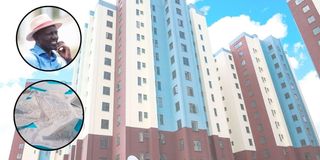
“We are not only using that housing levy kujenga hio affordable housing (to build those affordable houses). We are using it to build markets,” said Dr Ruto.
"We now have 260 markets going on in Kenya. We have hostels that are about to begin now. So, our young people in colleges will benefit. Our women and all the other market people will benefit.”
The Affordable Housing Act imposes a levy of 1.5 per cent on the gross salary of an employee, which is to be matched by the employer.
Self-employed people are charged 1.5 per cent of their gross income, which is derived from their businesses, dividends or retirement.
Besides affordable houses and their related infrastructure, the Act also permits the Affordable Housing Board to use the money from the levy to build institutional houses such as hostels and houses for civil servants.
President William Ruto.
Photo credit: File
Dr Ruto’s Kenya Kwanza administration projects to raise about Sh500 billion from the housing levy to be used to build homes and related social infrastructure and other public utilities. The money will also be used to build physical infrastructure for these housing schemes, such as access roads, water, sewerage, electricity, drainage and other utilities.
John Denge, a real-estate expert, reckons there is a lacuna in the law that allows the government to divert the money in social infrastructure that is not within the housing project, in light of the slow absorption of the funds.
“The Act does not say whether ‘associated infrastructure’ is within the project. It gives a lot of room for the funds to be diverted to ongoing markets,” he said.
The Chief Executive Officer of the Affordable Housing Board, Sheila Waweru, said the law does not restrict them to use the money only for social infrastructure within the project.
“The associated social infrastructure is built both where there is a project, but also where there is human settlement,” said Ms Waweru, noting that sometimes the project might not have enough space for an amenity such as a school, forcing them to look for land outside the scheme.
She also said that because of plans to have affordable housing in every constituency, there is a need for the board to build markets even outside of the housing projects.
Under the constituency affordable housing programme, the government plans to facilitate the building of a 100,000 units, mostly through the Public-Private Partnership (PPP).
The State Department for Housing and Urban Development has a pipeline of under 100 markets that it is either constructing or rehabilitating. The total cost of these projects is about Sh12.4 billion.
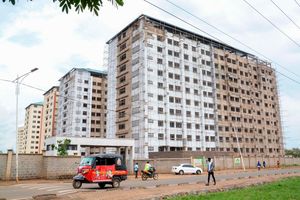
The Makasembo Housing Project in this photo taken on May 29, 2025.
Photo credit: Alex Odhiambo | Nation
The State Department has also recently been advertising tenders for the building of ESP (Economic Stimulus Programme) and modern markets.
On March 25, it advertised a tender for the construction of 10 ESP and modern markets.
Less than two months later, on May 13, it floated another open tender for the construction of eight modern markets, 18 ESP markets, two institutional houses, and four affordable housing projects.
“It would be hard to challenge it (using the levy to build markets), because markets are essential,” said Mr Denge.
But with the auditor-general’s report showing that there is a low absorption of the funds, against their collection, it is tempting for the money to be diverted to unrelated social infrastructure.
Ms Waweru, however, insists that the money cannot be spent on physical and social infrastructure not listed in the law.
Most of the ongoing markets are not close to the affordable housing projects, with the largest being the construction of 79 modern markets across the country under the Economic Stimulus Programme that was initiated by the Coalition Government of the late President Mwai Kibaki and the then Prime Minister Raila Odinga in 2009 to revitalise the economy following the 2007-2008 crisis.
The ESP markets will be built at an estimated cost of Sh2.66 billion. There is also the construction of Ruai Wholesale Market for Sh2.2 billion, urban renewal of Gikomba Market (Sh2 billion), and the construction of Chaka Market (Sh1.6 billion).
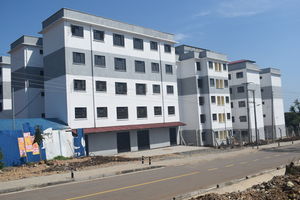
The Mukuru Affordable Housing project in Nairobi in this photo taken on December 14,2024.
Photo credit: File | Nation
The State Department for Urban Housing states that it completed the construction of 17 markets, while six are ongoing on an average of 82 percent completion level.
The latest affordable housing plan was launched in 2022, but available data indicates that fewer than 5,000 houses have already been completed.
National Treasury disclosures show that of the Sh500 billion to be collected from the affordable housing levy in the next five years, the State Department for Housing and Urban Development will spend Sh357.65 billion on the delivery of various affordable housing units, including rural housing loan programmes by the end of 2032.
The difference of Sh142.35 billion will be used to deploy the associated physical and social infrastructure in what is aimed at attracting private developers to the projects.