Ruto defends four-year record on cost of living, says incomes are rising and prices falling
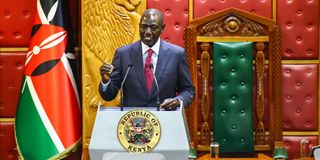
President William Ruto delivers the State of the Nation address at Parliament Buildings, Nairobi, on November 18, 2026.

President William Ruto on Wednesday mounted a defence of his administration’s four-year record on the cost of living, a central promise of his 2022 presidential campaign, arguing that his government had lowered the cost of essential goods and services while increasing household incomes.
In his fourth State of the Nation Address, Dr Ruto cited interventions in food production, healthcare, education and housing, alongside job creation and a proposed income tax exemption for low-income workers, as evidence of progress in easing the financial burden on households.
“Our economic proposition was simple: Reduce the cost for families and increase the income from what they do,” President Ruto said during the joint sitting of the National Assembly and Senate, in what could be his final State of the Nation Address before the 2027 General Election.


The cost-of-living promise, however, has delivered mixed results over the past four years.
Some of the gains cited by the President have been accompanied by growing pressure on take-home pay, with salaried workers complaining of shrinking net salaries following increased statutory deductions for the Affordable Housing Levy, the Social Health Insurance Fund (SHIF) and the National Social Security Fund (NSSF).
Fuel prices, which were already high when Dr Ruto took office in 2022 and which he pledged to bring down, are also trending upwards again as he prepares to return to voters seeking a second term.
The renewed pressure from global petroleum markets threatens to reverse some of the relief households have experienced from lower food prices and a more stable exchange rate.
Despite these challenges, the Head of State was bullish about the state of the economy, insisting that his administration had reduced the cost of living through deliberate macroeconomic policy decisions, including stabilising the exchange rate and lowering borrowing costs.
The President said his administration had approached the challenge by addressing both household expenditure and incomes, arguing that lower prices alone would not resolve the difficulties facing families without reliable earnings.
“And even where prices fall, life remains difficult for a citizen who has no income,” he said.
Food prices and farm earnings
Dr Ruto highlighted the reduction in the price of a 50-kilogramme bag of fertiliser from Sh7,500 in 2022 to Sh2,000 this year, alongside increased agricultural production, as evidence of the government's efforts to lower food costs.
He said national maize production had risen from 44.3 million bags in 2022 to 71 million bags last year, while imports declined from 9.9 million to 3.3 million bags.
The average price of a two-kilogramme packet of sifted maize flour fell from Sh230 in September 2022 to Sh152 in September this year, according to figures presented in the address.
The government has also distributed 38.5 million bags of subsidised fertiliser and registered nearly nine million farmers.
Dr Ruto said increased production and better returns for farmers were intended to translate into more affordable food for consumers.
He also pointed to higher earnings in coffee, tea and dairy farming, alongside investments in markets and agricultural infrastructure, as part of the broader strategy to improve household incomes.
Healthcare and education were also presented as areas where increased public investment should ease the financial burden on families.
The President said 33.7 million Kenyans had registered under the Social Health Authority (SHA), compared with about eight million under the former National Hospital Insurance Fund in 2022.
He said 53,465 patients were receiving cancer treatment and 24,468 were accessing dialysis under SHA, arguing that shared health financing would reduce the need for families to borrow money or sell assets to meet medical bills.
“A medical emergency could turn a family that was getting ahead into one struggling to survive,” he said.
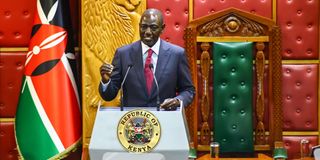
President William Ruto delivers his annual State of the Nation Address (SONA) before Parliament at Parliament Buildings in Nairobi on November 18, 2026.
In education, Dr Ruto said the government had employed 100,000 teachers in four years and built 23,000 classrooms, with another 20,000 teachers due for recruitment.
The annual education allocation has risen from Sh521 billion in the 2022/23 financial year to Sh784 billion in the current financial year.
“Parents should not be required to carry public obligations through unauthorised charges,” he said.
Housing and infrastructure drive
The President also defended the affordable housing programme, saying it offered a pathway to home ownership through monthly payments starting at Sh4,000.
He said more than 313,000 homes were at different stages of construction across the country and that the programme had generated more than 1.1 million employment opportunities.
Beyond household relief, Dr Ruto highlighted infrastructure expansion, including roads, housing and other public projects, as part of his administration's economic transformation agenda.
With high debt repayments constraining the government's ability to finance major projects through the national budget, the administration has increasingly turned to private capital through public-private partnerships (PPPs).
Figures from the PPP Directorate show that the project pipeline expanded from 36 projects in the 2024/25 financial year to 54 by June 2026.
Of these, 10 were under implementation, while 44 were at different stages of the project cycle.
Among the major projects under implementation is the Rironi-Nakuru-Mau Summit highway, a Sh183.7 billion road project being delivered through a PPP arrangement. Other projects include geothermal power developments at Menengai and electricity transmission investments.
The government says the infrastructure investments will lower the cost of transporting goods, improve access to markets and support economic activity.
However, the growing use of PPPs also comes with long-term contractual commitments and potential fiscal risks for the State.
Dr Ruto further cited macroeconomic stability as a foundation for economic recovery, saying the shilling had stabilised at around Sh129 against the dollar after weakening to nearly Sh162.
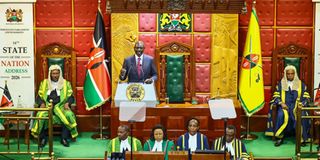
President William Ruto delivers his annual State of the Nation Address (SONA) before Parliament, flanked by National Assembly Speaker Moses Wetang’ula (left) and Senate Speaker Amason Kingi (right), at Parliament Buildings in Nairobi on November 18, 2026.
Inflation, a measure of changes in the cost of living, which reached 9.6 per cent in 2022, averaged 4.1 per cent in 2025.
Commercial bank lending rates also declined to about 14.4 per cent in September this year from 17.2 per cent in November 2024.
However, pressure from international fuel markets remains a risk for households and businesses.
In the November 15 to December 14 pricing cycle, the energy regulator retained pump prices despite higher landed costs of imported petroleum products, after the government used Sh4.6 billion from the Petroleum Development Levy Fund to cushion consumers.
Dr Ruto said the broader objective of his Bottom-Up Economic Transformation Agenda was to reduce household expenses while expanding opportunities for Kenyans to earn.
“Our task is far from complete, but our purpose remains clear: To make everyday life more affordable and productive effort more rewarding,” he said.
Follow our WhatsApp channel for breaking news updates and more stories like this.