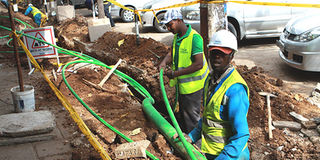
Workers dig trenches to lay the fibre optic cables along Kimathi Street in Nairobi.

The State has only installed 37 per cent of its planned fibre optic network with just months to the 2027 deadline, exposing a major delivery gap in President William Ruto's dream project that seeks to expand the country's ICT backbone.
ICT Cabinet Secretary William Kabogo revealed that 37,000 kilometres of the targeted 100,000km fibre optic network has been installed. This leaves a gap of 63,000km in the targeted network.
“The government’s target is to have 100,000 kilometres of fiber serving 53,000 government facilities across the country, including hospitals, administrative offices and so on. Already, we’ve laid down 37,000 kilometres, and it is still ongoing,” he said in an interview with Inooro TV.
The disclosure puts the State-built portion of the flagship connectivity programme, promised in 2022, under fresh scrutiny, with a whopping 63,000 kilometres still undelivered with just months to the anticipated deadline.

Cabinet Secretary, Ministry of ICT and Digital Economy, William Kabogo, at a past event.
The programme was intended to extend reliable broadband beyond major urban centres and connect public institutions, businesses and households to support digital services and online work.
President Ruto announced the target in November 2022, saying the government was working with telecommunications companies to deliver the project across every part of Kenya.
“The government is committed to investing in the digital superhighway and the creative economy, which will be enablers of transformation, productivity and overall competitiveness,” said Ruto at the time.
“Over the next five years, the government will ensure universal broadband availability by hastening the roll-out of connectivity throughout the country. The laying of an additional 100,000 kilometres of the national fibre-optic network is expected to deliver this target.”
The plan was part of the administration’s Digital Superhighway programme, with the government presenting fibre infrastructure as a foundation for digital jobs, e-commerce, and online government services.
The project covers underserved counties and is funded through the Universal Service Fund, with the CA and ICT Authority initially signing a Sh5 billion agreement for connectivity across 19 counties.
The government has increasingly turned to existing utility infrastructure to accelerate the rollout, with Kenya Power contracted to use its electricity network to carry fibre to public institutions.
Kenya Power disclosed that it received Sh940.6 million from the ICT Authority by June 2025 as partial reimbursement for design, supply and installation work under the Digital Superhighway project.
In 2023, then-ICT Cabinet Secretary Eliud Owalo announced that the government would be responsible for 52,000 kilometres, leaving the remaining 48,000 kilometres to private companies.
The slowed pace of implementation comes at a time when private sector players are accelerating investments in fibre infrastructure in a race to secure bandwidth and control of data traffic.
Safaricom, Kenya’s leading telco, is among the private companies that have sought regulatory approval to land its first undersea fibre optic cable, signalling a strategic pivot away from reliance on third-party systems that handle most of its international data traffic.
The slow government rollout also comes as demand for broadband continues to rise, with the CA reporting 52.85 million broadband subscriptions by March 2026, more than double the 22.08 million recorded in June 2020.
Fixed internet subscriptions also rose from 609,611 in June 2020 to 2.66 million by March, while 4G population coverage reached 73.4 percent and 5G coverage stood at 3.04 percent.
The State’s fibre target is also linked to other flagship digital projects, including 25,000 public Wi-Fi hotspots and 1,450 ward-level digital hubs, whose effectiveness depends partly on reliable broadband infrastructure.
Follow ourWhatsApp channel for breaking news updates and more stories like this.