President William Ruto is signalling a shift in strategy to woo votes for a second term, as he commits more State funding to sectors his predecessors downplayed in election years.
In budgeting for the last financial year ahead of the August 2027 elections, he has placed his bet on security and employment-heavy sectors such as teachers and police, while slowing down on infrastructure-heavy projects in the roads and energy sectors.
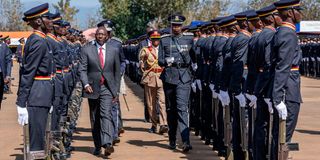
The 2026/27 financial year will see the Teachers Service Commission (TSC) and the National Police Service (NPS) funded to recruit 24,000 teachers and 10,000 police officers respectively, as the Ministry of Defence gets an extra Sh25 billion to boost its operations. On Friday, 6,000 individuals formally joined the police service after a passing out parade attended by President Ruto at the National Police College in Kiganjo, Nyeri County.
TSC’s Sh13 billion extra budget in the year ahead of the August 2027 elections caters for hiring of 24,000 intern teachers on permanent terms, and promotion of 50,000 others. The President has courted Kenya’s teaching fraternity since coming into office, with 61,000 hired during his first three years in office.
The government is also raising police funding by Sh11 billion, part of it to cater for 10,000 recruits who graduated from the national police training college in Kiganjo on Friday.
“During the medium-term expenditure period FY 2026/27 to FY 2028/29, the NPS aims to strategically allocate its resources towards police modernisation, recruitment of 30,000 police officers and 3,210 non-uniformed officers,” Treasury says.
With an addition of Sh25.7 billion to the spending it had in the last financial year, the Ministry of Defence is getting the highest increment in the year to June 2027, largely to run operations and upgrade equipment.
On the other hand, the roads sector is losing about Sh29 billion funding compared to the 2025/26 budget, the highest budgetary reduction of any sector. It is expected to construct about 1,891km roads over the next three years.
The state department for roads, however, remains the third largest funded in the year heading to elections, and the Rironi-Mau Summit Highway is among projects President Ruto wants to deliver ahead of elections.
“The Government targets to mobilise at least Sh70 billion through PPP investments in FY 2026/27 across the energy, transport, water, housing, health, and digital infrastructure sectors. Other priority projects, besides the Nairobi–Nakuru–Mau Summit Project, include the Nairobi–Mombasa Expressway and the Mau Summit–Eldoret–Malaba Highway,” Treasury Cabinet Secretary John Mbadi said in June.
The State is has cut Sh28 billion funding to the State Department for Energy compared to the past fiscal year, the second-highest drop for a sector expected to connect 900,000 new customers to power and construct 2,175km transmission lines over three years.
Funding for the State Department for Housing has also been cut by 6.5 per cent to Sh138 billion. It is expected to construct over half a million houses under the President’s affordable housing programme (AHP).
From a funding perspective, the President appears to place his cards on sectors that will employ more public servants to campaign for re-election next year, even as he sustains considerable funding to sectors that will deliver projects.
This strategy is a departure from his predecessors’, who in the election years prioritised more funding to sectors that delivered projects while downplaying the employment-heavy departments.
While teachers and the security sector have been prioritized in election year budgeting previously, they have always come second to infrastructure-heavy and price-sensitive sectors.
In the 2022 election cycle, for instance, the highest budgetary increment was to the Ministry of Petroleum and Mining, which got an extra Sh78.8 billion for fuel subsidies, as the State sought to calm the masses by keeping fuel prices down.
Former President Uhuru Kenyatta , who rooted for Raila Odinga in the 2022 General Election, also allocated an extra Sh86 billion to the National Treasury and state department for infrastructure, which were implementing railway and road projects such as the Eastern Bypass and Lamu-Garissa road.
This has been the tone set in previous elections, where governments channel heavy spending to sectors they can use to endear incumbents to the electorate, either by putting more to projects closer to the people, or subsidising staple commodities.
Ahead of the 2017 elections, President Kenyatta gave the State Department for Infrastructure an extra Sh50 billion as he charged it with delivering 5,000km roads, using the projects as his main campaign tool for re-election.
In the 2016/17 financial year, the government also allocated an extra Sh25 billion to the Ministry of Energy, which had last-mile power connectivity projects, and Sh21 billion to the Ministry of Water, where several dams under construction were key campaign tools.
The government at the time also funded the State Department for Transport an extra Sh11.3 billion as it worked to deliver a 270 km standard gauge railway (SGR) line and construct some 2,000 affordable houses for residents of Kibera and Mukuru.
In both the 2017 and 2022 elections, while funding to the TSC and security agencies remained among the top in government, their increases were moderate, with the government channeling resources to agencies that drove massive projects.
Funding to the Ministry of Defence in 2021/22 grew by Sh11.8 billion while that of Interior rose by Sh9.8 billion, ranking fifth and seventh respectively. They ranked similarly in the 2017 election year, trailing other sectors.