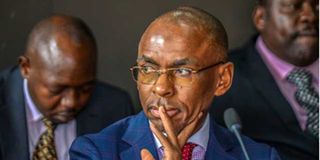
The price of Safaricom shares the government’s plans to sell featured prominently in yesterday's stakeholder engagement, with the telco’s CEO Peter Ndegwa revealing that it was decided by the National Treasury.
In the proposed transaction, the government plans to divest 15 percent of its 35 percent shareholding to Vodacom to raise Sh204.3 billion towards the national infrastructure fund that President William Ruto promised during the State of the Nation address in November 2025.
At a joint sitting of the National Assembly Committees on Finance and National Planning and the Public Debt and Privatisation considering the proposed divestiture, Mr Ndegwa also defended the offloading of the shares to Vodacom due to its “longevity with the government” as members cast doubts on the valuation.
The Kenyan government and Vodacom are the significant shareholders in the telco with 35 percent and 40 percent respectively.
This means that if the transaction goes through, Vodacom will enjoy a majority shareholding of 55 percent and the government at 20 percent, casting doubts about the safety of the security-related data likely to be controlled by a foreign entity.
The security of the jobs held by Kenyans at the telco, including the CEO and whether the investment decisions of the company whose board is controlled by a foreign entity also manifested during the stakeholder engagement yesterday.
“We were not involved in determining or seeking to see what the right share price is because as Safaricom, we are the subject of the sale,” said Mr Ndegwa. “The price offered to the government is higher than the average price, a clear price premium.”
The Safaricom CEO added: “When two shareholders are having a transaction, you leave it to them to determine how they want to conclude a transaction.”
“My understanding is that the pricing was determined based on the average trading price in the past six months because Safaricom PLC is a listed business and therefore, the most representative price is usually the listed price that you see on the stock exchange,” he said.
Although he admitted that the price may vary, and that a need may be required to do “an average of whatever price, there are other mechanisms of delivering valuation.”
This even as he made it clear to the MPs that “we were not privy to what mechanisms were determined but we are aware there is a professional advice that was used to be able to determine what the best mechanism was.”
Molo MP Kuria Kimani, the chairman of the Finance and National Planning Committee had demanded to know whether the government shares were fairly priced “at that share price or could we get a better price for it?”
The Molo MP also sought to know whether the current programmes undertaken by Safaricom in the country will be abandoned with the controlling majority shareholding of a foreign entity.
“With Vodacom taking over majority control of the company, how will you ensure that Safaricom maintains the Kenya-centric innovations programmes rather than group wide Vodacom priorities?” posed Mr Kimani.
“Kenyans are worried about the possible loss of pricing of the Mpesa, data and voice services. Vodacom is purely profit driven. What guarantees that the programmes will continue in the same scale of growth as Safaricom?” the Molo MP wondered.
Kesses MP Julius Rutto, a member of the Finance and National Planning Committee, noted that once the South African-based Vodacom takes over, it will call the shorts.
“The company law states that whoever is in control, determines the operations of the business because he controls the board and when there is a vote to be taken, the majority carries the day,” said Mr Rutto.
“What is the certainty from your statement that the new board which will be composed post this reorganisation will not change the course and direction of business? How is it possible it will not reorganize the innovation because we pride in Safaricom being the innovative company?” posed the Kesses MP.
According to the sessional paper on the government’s proposed divestiture in the telco, which was adopted by Parliament, Vodacom has made various commitments.
This includes no acquisition related redundancies within three years of the transaction, ensuring the chairman and independent directors remain Kenyan, as well as Vodacom's continued support of the Safaricom Foundation.
This means that after three years of transaction, the board will make its independent decisions including having a CEO and staff of their choice and the government’s feel in the telco diminishes.
This will also likely affect the Telco’s dealers that employ at least 1.2 million Kenyans directly and indirectly.
“Has there been any meeting with your dealers to disclose to them the nature of this transaction because it may affect them in future,” posed Homabay Town MP Peter Kaluma as he expressed fears about the company’s continued operation in the country.
“What will tie them to Kenya when the regulatory framework becomes too hard and unconducive to their business? What will stop them from leaving this space?” he posed.