The decision requiring Safaricom’s majority shareholder, Vodacom Group, to make an upfront payment of Sh40.2 billion to the government instead of future dividends poses a significant risk, Auditor General Nancy Gathungu has warned.
Ms Gathungu says the structure effectively converts a recurring revenue stream into a one-off payment, thereby foregoing long-term returns that would otherwise accrue to the government’s remaining 20 percent stake.
She told the National Assembly’s joint committees on Finance and National Planning, and on Debt and Privatisation, that the arrangement—under which Vodacom Group, through Vodafone Kenya, would make an upfront payment of Sh40.2 billion in lieu of future dividends from the residual 20 percent stake—warrants closer scrutiny.
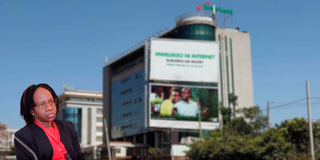
Auditor-General Nancy Gathungu.
Photo credit: File | Nation Media Group
Through Sessional Paper No. 3 of 2025, the government is seeking to generate approximately Sh204 billion ($1.57 billion) in gross proceeds by divesting a 15 percent stake in Safaricom at a premium of 23.6 percent to the six-month volume-weighted average price as at December 2, 2025.
The government currently owns 35 percent of Safaricom, with the stake’s market value estimated at between Sh280 billion and Sh300 billion.
“This arrangement warrants closer scrutiny because even after the divestiture, Safaricom PLC is expected to continue generating substantial profits, and historically, annual dividends to the government have averaged Sh15–20 billion when it held a 35 percent stake,” Ms Gathungu said in submissions to the joint committee.
“Although the dividend attributable to a 20 percent stake would proportionately reduce, the Sh40.2 billion payment still represents only a few years of potential dividend income.”
Appearing before the joint team chaired by Molo MP Kuria Kimani and Balambala MP Abdi Shurie, Ms Gathungu warned that there is a significant risk the structure converts a recurring revenue stream into a one-off payment, thereby foregoing long-term returns accruing to the government’s remaining stake.
She said that if the proposed upfront payment of Sh40.2 billion is not based on a clearly defined future dividend period, the valuation should instead be anchored on the present value of perpetual cash flows expected from the government’s residual 20 percent stake.
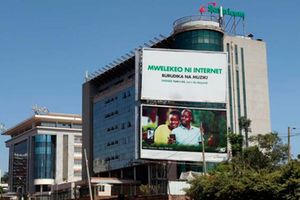
The Safaricom head office in Nairobi.
Photo credit: Pool I Nation Media Group
“Use of the perpetual cash flow approach ensures the government captures the true economic value of an ongoing dividend stream rather than accepting an arbitrary lump sum that may significantly undervalue long-term returns,” Ms Gathungu said.
“This method reflects the principle that dividends from a profitable entity like Safaricom PLC are expected to continue indefinitely, subject to market and regulatory conditions.”
She recommended that the joint committee require disclosure of how the Sh40.2 billion figure was arrived at, including the number of years of dividends assumed.
“If no definite period is provided, apply the perpetual cash flow model to determine a fair valuation for negotiation or for structuring alternative monetisation options,” she said.
Ms Gathungu also noted that while the sessional paper proposes a negotiated price of Sh34 per share—representing a 17 percent premium over the six-month volume-weighted average price—the committee should require additional valuation benchmarks to ensure the government realises optimal value.
She said this was critical given Safaricom PLC’s strategic importance and the absence of competitive bidding.
“These may include Discounted Cash Flow (DCF) analysis, Comparable Company Analysis, and public tender or IPO pricing simulations,” she said.
Ms Gathungu further recommended that the Sh204 billion proceeds from the sale of the government’s Safaricom stake be ring-fenced.
Auditor-General Nancy Gathungu.
Photo credit: Dennis Onsongo | Nation Media Group
She warned lawmakers that to safeguard the integrity and intended impact of the proposed partial divestiture, the proceeds should not be diverted to other government activities, including recurrent expenditure, as has occurred previously with some Eurobond proceeds.
Such diversion, she said, would undermine the strategic rationale of the transaction and erode public trust.
In her written submissions, Ms Gathungu observed that while the sessional paper indicates the proceeds will be used to mobilise resources for critical infrastructure investments—such as energy, roads, water, airports, and digital transformation—it does not mention the proposed Sovereign Wealth Fund or the National Infrastructure Fund as potential vehicles for managing the funds.
“If the government intends to credit proceeds into either of the proposed funds, then enabling legislation to operationalise the funds must be enacted first,” she said.
“Without a clear legal and governance framework, there is a risk of misallocation or opaque utilisation of the proceeds, which could compromise fiscal discipline and accountability.”
She also called for increased post-divestiture regulatory oversight, arguing that given Safaricom PLC’s unique role, regulators—including the Communications Authority of Kenya (CA), Central Bank of Kenya (CBK), Nairobi Securities Exchange (NSE), and the Competition Authority of Kenya (CAK)—should prepare for heightened vigilance.
Separately, the banking sector wants Parliament to reserve five percent of the proposed partial sell of government shareholding in Safaricom to the public to broaden public ownership and participation in the key national asset.
The Kenya Bankers Association (KBA) said the banking sector supports capital market development and deepening.
"Although banks support the divestiture, the sector recommends that five percent of the shares under divestiture be reserved to the public to broaden public ownership and participation in this national key asset," Raimond Molenje, the KBA Chief Executive said in submissions to Parliament.
Mr Molenje said by placing more Safaricom shares in free float and aligning a major portion with a strategic investor like Vodacom or Vodafone Kenya, the Nairobi Securities Exchange (NSE) stands to benefit from higher liquidity and deeper market participation.