During the Covid-19 lockdown imposed due to the outbreak of the virus, businesses were closed, workers were laid off and learners were out of school for a long period.
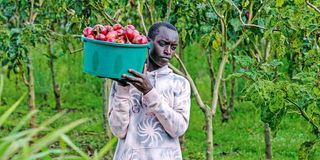
On this bright day, we find Elisha Lemiso, an 18-year-old Form Three student at Rombei Day Secondary School in Mariashoni, Molo sub-county, Nakuru County, harvesting tree tomato fruits.
He planted them after learning from his parents, who grow fruit on the farm. Lemiso is now reaping the rewards of his hard work.
"Thanks to their encouragement, I created my own timetable to help me balance my studies with helping my parents on the farm, as I was also interested in growing my own fruit,” he says, adding that in 2024, his parents gave him a plot of land on which to grow his own tree tomatoes, as he believed he would reap greater rewards in the future, just as his parents had done when they switched from maize farming to growing fruit.
Elisha Lemiso, 18, at his portion of the farm where he grows tree tomato fruits in Mariashoni, Molo in Nakuru County.
Photo credit: John Njoroge| Nation Media Group
He says that his parents depend on the fruits grown on the farm to pay his and his siblings' school fees.
Based on what he had learnt from his father, Lemiso dug holes measuring 1 foot by 1 foot and spaced each row 2 metres by 3 metres apart on the quarter-acre plot of land that his father, Mr Ole Kitienye, had given him.
He said that the spacing allowed him to more easily maintain his crop, especially when weeding, applying manure and spraying. His father gave him 200 seedlings, which he planted.
He also used livestock manure and applied it to his seedlings. During term time, his father made sure that nobody trespassed on or grazed near the farm.
Lemiso continued to monitor and manage his fruit farm. After eight months, he sprayed foliar fertiliser to boost growth during the flowering stage.
The rains were sufficient during that time, which helped his new investment do well and made him hopeful that he would have a bumper harvest at the end of the season.
The student revealed that, during his first harvest in early 2025, he produced 400kg of fruit, which he sold to his father’s client at 75 shillings per kilogram.
“In my second harvest, which I did after two weeks, my production increased to 650 kg. I promised my parents that I would use the money from the sales to help clear the fees balance for both my siblings and myself,” says Lemiso, adding that the fruit has enabled him to cater for his personal needs and other requirements without depending on his parents.
A Form Three student, Elisha Lemiso, 18, displays some of the tree tomato fruits harvested from his portion of land in Mariashoni, Molo in Nakuru County.
Photo credit: John Njoroge| Nation Media Group
Lemiso, who is following in his father’s footsteps, attributes his success to hard work and a commitment to excellence.
He says that farming has made agriculture one of his favourite subjects at school, and he plans to study horticulture at Egerton University. Currently, the student sells his own fruit seedlings locally for Sh20 each.
“My father has been the pillar of my success over the past year of horticultural farming. We have extended our plot of land and are growing Hass avocados together, which are now six months old,” says Lemiso.
He adds that the local environment is ideal for growing fruit, which makes him optimistic that he will get a good yield from the avocados when they mature in three years' time.
Lemiso, the second child in a family of four, affirmed that fruit boosts the immune system because it is rich in vitamin C, which increases the production of white blood cells and helps the body fight off infections.
He noted that, during the period of the Coronavirus pandemic, the Ministry of Health urged consumers to eat large quantities of fruit in order to boost their immunity and fight disease.
He adds that fruit farming requires minimal labour compared to other crops, which demand greater financial investment and management.
Elisha Lemiso harvesting tree tomato fruits at his farm in Mariashoni, Molo in Nakuru County.
Photo credit: John Njoroge| Nation Media Group
Although it is rarely witnessed, aphids and whiteflies affect tree tomato leaves during the dry season, but farmers use pesticides to control and kill them. Lemiso plans to grow fruit on a large scale in the future and become a leading farmer in the country and abroad.
To increase his skills, the aspiring farmer consults his father, conducts internet research, interacts with experts and extension officers who visit farms, and learns from farmers and experts who contribute to newspapers.
According to the former Molo Sub-County Agriculture Officer, Mr Alfred Waithaka, farmers are advised to buy certified seedlings from recommended dealers and to practise crop rotation and soil testing in order to combat diseases and bacteria found in the soil.
“We urge farmers to learn about new farming technologies and to visit field days and seminars in order to improve their production. Growing the same type of crop for a long time without practising crop rotation or soil testing leads to lower production,” said Mr Waithaka.