How climate education is taking root in Kenyan schools
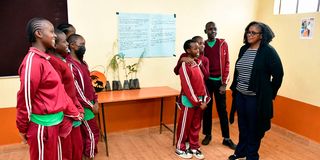
Teacher Julie Nandi (far right) of Athi-River GK Comprehensive School engages with her pupils during the Climate Change Infused Learning event at Kabete Vetlab Primary School on July 05, 2025.

What you need to know:
- 85 per cent of partner schools in climate education programmes have successfully integrated climate content into their curricula, with student learning outcomes improving.
Julie Nandi stands in her school garden at GK Comprehensive Primary in Athi River, watching her students carefully mix rabbit urine with kitchen scraps. Two years ago, this scene would have been unimaginable. Today, it represents the quiet revolution transforming Kenya's classrooms—one organic fertiliser project at a time.
"I started this project two years ago in our school with the goal of empowering students to actively respond to the environmental challenges they see in their own communities," Miss Nandi explains, her hands still dusty from the morning's agriculture lesson. "By integrating practical, hands-on activities into our learning, we've encouraged learners to not only understand climate change but also to take meaningful action—from waste reduction and tree planting to promoting sustainable farming practices like using organic manure."
Nandi's transformation mirrors that happening across Kenya, where schools are rewriting the script on how learning happens. Once defined by chalkboards, textbooks, and exam drills, today's classrooms are evolving into hubs of innovation, creativity, and climate consciousness.
Like many of her colleagues, Nandi initially struggled with climate education. When Education Development Trust (EDT) first approached teachers for their action-research programme, many educators had limited understanding of climate change's scope and relevance to their daily teaching.
"Most of the teachers equated climate change to tree planting, an activity often promoted in schools but rarely connected to broader climate literacy. Others viewed it as a distant issue, something happening 'out there' in other regions or countries, not something relevant to their immediate classrooms," explains Dr Herine Otieno, regional educational lead for Sub-Saharan Africa, who led the teacher training sessions.
Nandi was among those teachers. But the reflective consultative sessions changed her perspective fundamentally.
"We brought them onboard to reflect and understand the meaning of climate change and the impacts it has in our environment," Dr Otieno notes. The training helped teachers recognise climate change as both a global and local concern, understanding their crucial role in addressing it through inquiry-based, problem-based, and project-based learning methods.
"These approaches shift the focus from teacher-led instruction to student-centered exploration, aligning well with the aims of the Competency-Based Education," EDT explains.
Creating change, one student at a time
Nandi's approach embodies this transformation. Instead of teaching about fertilisers from textbooks, her students investigate environmental impacts firsthand. "We use organic manure instead of chemical fertilisers as part of our efforts to combat climate change and promote sustainable farming in our school," she explains.
Her students have embraced this hands-on approach enthusiastically. Felix Ombachi from nearby Riruta Junior School, inspired by similar programmes, explains their innovation: "We collect urine waste from the rabbits in our school and mix them together with kitchen waste to manufacture organic waste instead of purchasing fertilisers harmful to the health of our environment."
The impact extends beyond agriculture. Shanice, a 14-year-old student at Kabete Vet Lab Primary, represents the shift in student thinking: "Climate change affects our lives. But now I know we can do something. We can innovate tools, methods that reduce harm to our lives for a healthy environment."
Part of a national movement
Nandi's work exemplifies Kenya's comprehensive approach to climate education transformation. Her school is one of 12 pilot schools selected by EDT, working alongside the Ministry of Education, Kenya Institute of Curriculum Development, and Teachers Service Commission. "We have selected 12 schools to pilot this project," Dr Otieno notes, "six from Nairobi County and six from Kajiado County."
But the movement extends far beyond these pilot schools. A groundbreaking 2024 partnership between Alef Education, KICD, and UNICEF established a framework to integrate climate change education into public school curricula nationwide through the Kenya Education Cloud platform, reaching over one million students. Meanwhile, Teach For Kenya's Climate Education Leadership programme has reached 63 public schools, training over 1,150 learners as climate education ambassadors.
The transformation is evident in how students now discuss climate issues. Isaac Zephania, a student from GK Primary in Athi River, describes climate change's effects as "visible killers."
"The disastrous effects of climate change have caused climate anxiety in our communities," Zephania observes. He explains physical health risks including rising temperatures, dehydration, and kidney complications caused by global warming. Comparing deforestation to a virus spreading across the planet, he notes how it fuels poor air quality, lung disease, and heart problems.
"Deforestation has spread, its effect has gotten to be a monster in our planet," he states with the confidence of someone who understands both the problem and potential solutions.
This year's Kenya National Drama and Film Festival marked a historic milestone—for the first time in 63 years, climate change took centre stage as students used creative arts to bring environmental challenges to life.
"The Climate Storytelling Award is a vital new category that aims to raise awareness around climate change," says Prof Christopher Odhiambo, national chairman of the Kenya National Drama and Film Festival. "These partnerships affirm that young people are change makers today."
According to KICD Director Charles Ong'ondo, integrating climate education helps learners build critical problem-solving skills essential for tackling environmental challenges.
"One of the pillars of our curriculum is when learners are able to solve pertinent and contemporary problems," Prof Ong'ondo explains. He notes that engaging students early nurtures a generation understanding sustainable living and environmental stewardship.
Monitoring shows that 85 per cent of partner schools in climate education programmes have successfully integrated climate content into their curricula, with student learning outcomes improving.
"The integration of climate issues into classroom learning isn't just about adding new topics," Dr Otieno reflects. "It's about reshaping how education connects to the world students live in and the future they are being prepared to lead."
For Nandi, as a teacher who once saw climate change as distant and abstract, she has become a pioneer showing how education can be a powerful tool for environmental action.
"This initiative has transformed our school into a hub of environmental awareness and community impact," Nandi reflects, her eyes bright with the satisfaction of someone who has found her purpose.