On this sunny afternoon, the avocado trees appear to dance in unison to the gentle breeze, as though responding to the strumming of a guitar.
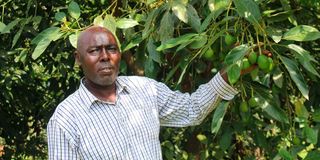
Richard Maritim, a Mugango village resident in Bomet County, is tending to his avocado trees on his two-acre farm. In a few days, the fruit will be ready to harvest.
A retired civil servant, Mr Maritim engages in mixed farming, growing crops such as tea, maize, potatoes and vegetables, which thrive in the area. Like most of his neighbours, he also keeps dairy animals.
“I was encouraged to start avocado farming after selling fruit from an indigenous tree that I had planted six years earlier for my family to enjoy for Sh9,000. This made me realise the huge potential of avocado production,” he said.
Richard Maritim, at his avocado farm in Mugango village, Bomet county in this photo taken on September 28, 2025, which in retirement keeps him busy and fetches good returns.
Photo credit: Vitalis Kimutai | Nation
Three years ago, he diversified into avocado farming, starting with 30 seedlings that he had bought from an uncertified nursery after realising the huge growth and earnings potential of the sector.
Most of the seedlings did not survive, and he realised that those that did grow were not the Hass variety, as claimed by the sellers. He was forced to cut his losses and change his supplier, taking precautions based on the lessons he had learnt.
“I sourced the next batch of seedlings from Isinya Roses in Kajiado County. I have increased the number over time to 200, and they have done very well. I am still expanding the avocado area on the farm,” said Mr Maritim.
He grows both Fuerte and Hass avocados, which help with cross-pollination on the farm, attracting bees seeking nectar and improving fruit health and yield.
Mr Maritim’s earnings from this investment have increased incrementally, starting with Sh9,000 from one tree whose fruit he sold to brokers, and rising to Sh 200,000 paid by an exporter in the last harvest season.
He was previously paid Sh47,000, then Sh93,000, and finally Sh200,000 from the sale of fresh avocados.
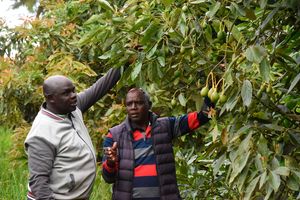
Richard Maritim, at his avocado farm in Mugango village, Bomet county in this photo taken on September 28, 2025, which in retirement keeps him busy and fetches good returns.
Photo credit: Vitalis Kimutai | Nation
He says that avocado farming keeps him busy and happy and provides his family with a steady and increasing income in retirement. He uses the proceeds to educate his children, who attend local universities.
“I plan to increase the area dedicated to avocado farming in order to raise production and subsequently earn more from this agribusiness. Avocado farming has a lot of potential for growth, with seedlings taking two and a half years to reach fruiting and harvesting stage,” said Mr Maritim.
He has adopted the measurements of seven by seven metres from crop to crop and six metres from one line to the next, which were advised by agronomists in the area.
“The beauty of avocado production is that you can intercrop with tea and other crops that do not require spraying with pesticides, nor compete for nutrients in the soil,” he stated.
In the event of an attack by pests or diseases, he seeks advice from local agronomists and also uses traps to prevent the pests from spreading further.
The advantage of avocado trees is that fruit production increases with every cycle before reaching full maturity in an average of four to five years.
“With good crop husbandry, it is possible to earn more than a million in one year from one acre. The sector has huge potential that has not yet been exploited,” said Mr Maritim.
Richard Maritim, at his avocado farm in Mugango village, Bomet county in this photo taken on September 28, 2025, which in retirement keeps him busy and fetches good returns.
Photo credit: Vitalis Kimutai | Nation
Brokers have exploited farmers in the region, which has led producers to organise themselves into cooperative societies, leveraging their high production to negotiate good prices.
“Last year, I was paid Sh200,000, and I am expecting a higher payment from my investment in the next harvest season,” said Mr Maritim in an interview at his farm. We found him tending to the crops on a sunny afternoon in an area known for its good rainfall all year round.
The national and county governments have been criticised for failing to protect farmers from exploitation by brokers, who buy a kilogram of produce for as little as Sh7, but sell it to exporters for over Sh100.
“Both levels of government should ensure that produce is sold through cooperatives by building packing houses with refrigerators to prevent brokers from exploiting farmers,” said Mr Maritim.
Through the Financing Locally Led Climate Action (FLLCA) programme, the Bomet County Government is seeking to increase avocado production, enable farmers to earn more from their produce, and address climate change issues.
Solomon Kimetto, the County Chief Officer for Water, Environment, Natural Resources and Climate Change, said that Bomet County, the third-highest producer of avocados in Kenya, had huge potential for avocado production.
"Under the FLLoCCA programme, we have distributed over 145,000 avocado seedlings to residents of the Bomet East, Bomet Central, Sotik and Konoin constituencies, whose areas have a favourable ecology for production," said Mr Kimetto.
He added that the county government had deployed enough agricultural extension officers to help farmers adopt modern farming techniques and increase their yields, with the aim of making Bomet the top producer of avocados.
Apart from addressing issues of health, nutrition and climate change, avocados are also a key source of increased income for farmers, as they fetch high prices.
The county previously distributed over 120,000 Hass avocado seedlings to residents, boosting production and encouraging more residents to engage in mixed farming to diversify their income.
“Farmers are encouraged to apply ripe manure to their avocado farms to increase production. High biosecurity measures should be implemented to prevent the transfer of pests and diseases,” said Mr David Korir, the Director of Agriculture at Bomet County Council.
He added that the county government was working with stakeholders to increase avocado production and organise farmers to sell their produce in bulk through cooperative societies, engaging directly with exporters.
Kembu, Merigi and Boito wards are the leading producers of avocados in Bomet County, with production increasing every harvest season. This is proving to be a valuable source of income for farmers.