From barren to bountiful: How community is restoring vital water tower

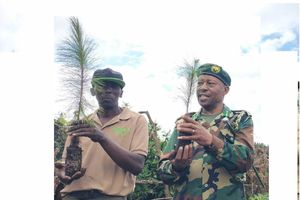
Samson Kiprono (left), a member of Community Forest Association in Kimore village, which is near Kaptagat Forest in Elgeyo Marakwet County, and Barnaba Cherop, a community leader, inspect an avocado crop at Kiprono’s farm on July 01, 2025.

What you need to know:
- The transformation began eight years ago with the Kaptagat Integrated Conservation Programme, a visionary initiative that refuses to treat conservation and development as competing goals.
The scars of environmental destruction once told a devastating story across the Kaptagat Forest landscape. Where lush canopies once sheltered diverse wildlife and fed vital water sources, bare earth stretched across more than 5,000 hectares of degraded land in the Elgeyo Hills and Cherangany Ecosystem.
But today, a quiet revolution is transforming this forgotten corner of Kenya's landscape. Through an innovative community-led conservation programme, Kaptagat Forest—one of the country's five crucial water towers—is breathing new life as communities discover that environmental restoration and economic prosperity can grow hand in hand.
The transformation began eight years ago with the Kaptagat Integrated Conservation Programme, a visionary initiative that refuses to treat conservation and development as competing goals. Instead of simply telling communities to stop using forest resources, the programme offers them something better: sustainable alternatives that improve both their livelihoods and the environment.
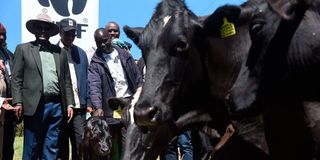
National Treasury PS Chris Kiptoo and World Wide Fund for Nature-Kenya Chief Executive Officer Mohamed Awer present calf and a heifer to Geoffrey Kigen, one of the 10 people who received heifers during Improved Livestock Distribution under the Kaptagat Restoration and Livelihood Improvement Programme.
"We are calling it one cow, one acre and one cash crop," explained Dr Chris Kiptoo, National Treasury PS and patron of the programme. "In each family, we are improving the breed of animals, introducing cash crops, and providing green energy. We want to see true empowerment of communities."
The formula is deceptively simple yet transformative. Each participating household receives support to acquire a high-yielding dairy cow, cultivate one acre of cash crops and improved pasture, and access clean energy through solar lighting and biogas systems. This "1-1-1" model addresses immediate economic needs while reducing pressure on forest resources.
The impact extends far beyond basic conservation. Supported by the World Wide Fund for Nature as a 10-year initiative, it has already restored 2,737 hectares of degraded forestland while directly improving thousands of lives.
Geoffrey Kigen's story illustrates the transformation. The crossbreed heifer he received through the project now produces more than 10 liters of milk daily, providing steady income to support his family. "I expect milk production to improve further due to improved pasture and proper animal husbandry," he said.
For Brian Tuitoke from Bombo village, the change has been even more dramatic. The two dairy cows he received through the Community Forest Association now produce an average of 18 liters of milk daily through zero-grazing techniques. "We can now receive reliable rainfall patterns following the regeneration of Kaptagat Forest," he observed. "This has empowered us to invest in mixed farming—keeping dairy cows and sheep while cultivating various vegetables."
Perhaps nowhere is the programme's innovation clearer than in its approach to energy. Zipporah Koima, who lives adjacent to Sabor Forest, represents thousands of community members who once depended on firewood and charcoal for cooking fuel—driving continued deforestation.
Six years ago, Zippoah regularly harvested trees from public forests or purchased expensive charcoal, whose costs have risen from Sh800 to Sh1,200 per bag as government restrictions on logging have tightened. Today, she powers her cooking with biogas generated from cow dung, eliminating her need for wood fuel entirely.
"The gas can burn for seven continuous hours depending on the amount produced at the digester by adding fresh cow dung," she explained. The system provides not only clean energy but also organic fertiliser for her crops; creating a closed-loop system that benefits both her farm and the forest.
The programme's agricultural components are equally transformative. Recent distribution of over 100,000 tea seedlings represents just one element of a comprehensive approach to cash crop development. Irrigation PS Ephantus Kimotho, who led the seedling distribution, emphasised the initiative's regional impact: "Neighbouring counties including Uasin Gishu stand to benefit from this integrated programme."
Samuel Kimeli's avocado orchard demonstrates the economic potential. His 50 avocado trees generate approximately Sh300, 000 annually; far exceeding what he could earn from traditional maize and wheat production. The programme has distributed over 100,000 avocado seedlings to community members, creating alternative income sources while supporting reforestation efforts.
The Kaptagat programme's success lies in its recognition that environmental conservation requires economic incentives, not just regulations. By simultaneously addressing water access through borehole drilling and dam construction, improving livestock breeds, introducing profitable cash crops, and providing clean energy alternatives, the initiative creates conditions where conservation becomes profitable.
"The integration of these components seeks to simultaneously support livelihoods, promote environmental stewardship, and drive local economic growth," Dr Kiptoo noted. The programme brings together multiple community-focused elements under a unified approach that makes environmental restoration economically attractive.
Research partnerships with institutions like the Tea Research Foundation help determine optimal crop varieties for different elevations and soil conditions, ensuring that agricultural interventions are both profitable and environmentally sustainable.
Jonah Cheruiyot from Kimore village embodies this transformation. Where he once grazed livestock in Kaptagat Forest, he now participates in annual tree-planting exercises while using biogas for cooking and organic fertiliser for crop production. "Most locals are now sensitive to climate action and participate in environmental conservation efforts," observed Samuel.