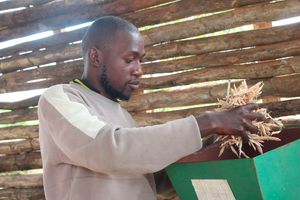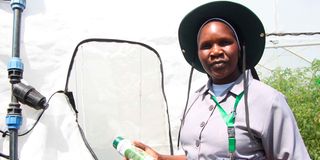
Rose Ochier, a scientist in Crop Protection at Egerton University and a researcher under the Integrated and Circular Technologies for Sustainable City-Region Food Systems in Africa (INCiTiS) project showing a bioponics innovation at the Nakuru ASK showground in this photo taken on July 1, 2026.

As climate change, rapid urbanisation and a growing population continue to put pressure on food systems, innovative farming technologies are emerging to ensure the sustainable production of food.
One such innovation is bioponics, a climate-smart, soilless farming system that produces safe, traceable and nutritious food.
According to Sister Rose Ochier, a Crop Protection scientist at Egerton University and a researcher on the Integrated and Circular Technologies for Sustainable City-Region Food Systems in Africa (INCiTiS) project, bioponics offers a practical solution for those with limited or no access to land.
When asked about the programme, she talks about when the INCiTiS programme sponsored her master's degree and research.
This also included advanced training in bioponic systems at Zurich University of Applied Sciences in Switzerland.
"The programme enabled me to study bioponics in depth and inspired me to develop a system that allows people without land to produce their own food," she says.
She believes that food production should not always depend on conventional farming.
“People do not have to till the soil to grow food. Our soils are becoming exhausted after years of intensive cultivation and the excessive use of chemical herbicides and pesticides. Bioponics allows us to conserve soil while producing healthy food from a known source."
Bioponics is a soilless cultivation system that uses inert growing media such as pumice, although locally available alternatives like ballast or cotton can also be used.
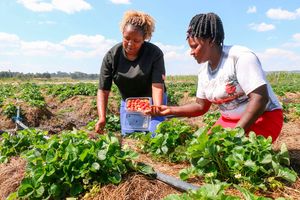
Crops including African nightshade (managu), spinach, amaranth and pigweed thrive in this system.
This technology is particularly well-suited to urban residents, peri-urban communities, and refugee camps where access to farmland is limited.
"Access to farmland is extremely limited in urban centres due to rapid development, rising property costs and unclear land tenure," Ochier explains.
"You can grow vegetables using pumice and organic fertiliser produced from black soldier fly waste to nourish the crops," Ochier explains.
By using this method of processing black soldier fly waste to produce organic fertiliser, households can grow vegetables while simultaneously producing fish and insect larvae that can be used to feed poultry and fish in aquaculture.
This closed-loop circular economy system recycles organic waste into valuable agricultural inputs.
The larvae of black soldier flies process organic waste, producing bio-fertiliser and bio-stimulants with natural insecticidal properties.
Ochier notes that excessive reliance on synthetic pesticides has contributed to pest resistance, reducing the effectiveness of conventional crop protection methods.
“Bio-stimulants help plants become more resistant to pests and climate stress, reducing dependence on synthetic pesticides. This supports climate-smart agriculture and protects biodiversity.'
The structure itself is simple and portable. It consists of an insect-proof net enclosure and pumice growing beds, as well as companion planting techniques, such as growing onions alongside vegetables to naturally deter pests.
As it is lightweight, the structure can be installed on rooftops, balconies, in courtyards, or in other small spaces, and can easily be dismantled and relocated when necessary.
“If I move house, I simply relocate the structure and continue farming,” she says.
A single unit can supply enough vegetables to feed seven to ten people, making it ideal for ensuring household food security.
Beyond food production, bioponics contributes to environmental conservation and several Sustainable Development Goals (SDGs), including poverty reduction, food security, climate action and sustainable cities.
According to Ochier, the technology also promotes inclusion by enabling people with disabilities to comfortably participate in farming activities.
The system is also well-suited to schools, where it can support practical learning under Kenya's Competency-Based Curriculum (CBC).
"Children can learn how food is produced, even in urban areas where many have never seen vegetables being grown. Farming becomes enjoyable, educational and accessible to everyone."
With its focus on traceable food production, organic inputs, resource recycling and efficient land use, bioponics is emerging as a promising innovation for creating resilient urban food systems that protect the environment.
Food traceability safeguards public health by enabling the rapid identification and isolation of contaminated items during foodborne outbreaks.
It enables us to trace all the steps that food takes from the farm, through the transformation process in the value chain, to the point at which it ends up on the table.
Follow our WhatsApp channel for breaking news updates and more stories like this.