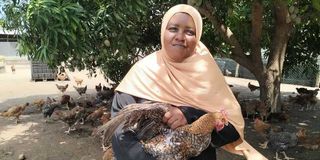
In the sun-drenched, remote village of Kauthara in the Hindi Division of Lamu West, Zahara Mohamed stands at a corner of a large open-air chicken coop.
The 45-year-old smiles as she holds a speckled brown chicken securely against her side with one arm, demonstrating her gentle, protective and experienced handling of the birds.
Around her feet, and spreading across the quarter-acre farm, hundreds of chickens — a mix of indigenous Kienyeji and improved breeds — peck at the ground, scratch in the soil, and flutter about in a lively manner.
The air is filled with the soft clucking of the healthy, bustling flock.
Ms Zahara is clearly committed to tending her farm, pausing to check the bird she is holding and thoroughly inspecting it to determine whether it has any parasites and to assess its weight.
“I don’t regret investing in these birds at all. Over the past few years of poultry farming, I’ve realised that there’s money to be made from rearing chickens. You can see that every bird and every egg here is worth something,” says Ms Zahara.
In 2021, Ms Zahara, who was then a housewife with no meaningful source of income, decided to start a poultry farm, investing all the Sh35,000 she had saved with her husband's help.
She bought 100 one-day-old broilers and improved Kienyeji chicks to start her poultry production business.
She also used some of the money to buy vaccines and medication, as well as starter, grower, and finisher feeds for her small flock.
Initial challenges included the high cost of chicken feed and the strict, delicate management required for the chicks until they reached maturity.
Due to her lack of business knowledge and naivety, Ms Zahara made small mistakes regarding feeding, hygiene and vaccination, which sometimes resulted in significant losses due to high mortality rates among her chicks.
Despite these initial challenges, Ms Zahara remained steadfast and focused.
Today, her flock has grown to over 1,000 birds.
This has enabled her to transition from being a housewife to becoming a high earner by building a poultry farming empire that earns her between Sh70,000 and Sh100,000 per month.
Zahara Mohamed at her poultry farm in Kauthara Village, Lamu West, on May 6,2026.
Photo credit: Kalume Kazungu | Nation Media Group
According to Ms Zahara, in a good month, she sells chicken meat worth Sh50,000, while during the same period, she earns almost the same amount from egg sales.
In an effort to encourage young entrepreneurs, President Ruto has often recounted his own history with the chicken and egg business.
When he was younger, Ruto sold chickens and eggs to motorists and truck drivers on the Eldoret–Malava road, particularly at Kambi Kuku.
He often refers to this experience to connect with ordinary Kenyans and emphasise his 'grass-to-grace' journey: he transformed from a roadside seller into a major poultry farmer and is now the President of the Republic of Kenya.
“President William Ruto is my inspiration. He has a positive and relatable background in the chicken and egg business. Every time I think about our President's history, I feel inspired to achieve more in my own poultry farming business,” says Ms Zahara.
Today, the mother of five is a sought-after supplier of eggs and chicken meat in Hindi Town and the surrounding area.
She sells her chickens for between Sh1,000 and Sh1,200 each, depending on their size and weight.
Ms Zahara sells crates of eggs for between Sh450 and Sh500, depending on the bargaining power and status of individual customers.
She sells between 40 and 50 broilers per month, earning her between Sh45,000 and Sh50,000.
"I also sell 50 to 80 crates of eggs, which earns me over Sh45,000 per month. In a bad month, I earn at least Sh70,000; in a good month, I can earn up to Sh100,000 from the sale of chickens and eggs alone,” says Ms Zahara.
When asked how she views poultry farming, Ms Zahara describes it as a fully-fledged business, or even a primary career, on a par with banking, teaching or medicine.
Chickens inside Zahara Mohamed's farm in Kauthara Village, Hindi Division, Lamu West on May 6,2026.
Photo credit: Kalume Kazungu | Nation Media Group
She admits that five or six years ago, she would have considered herself a housewife, but her views have changed.
“I consider myself a working-class woman, not a housewife. Raising chickens has absolutely transformed me into who I am today: financially independent and a self-employed entrepreneur,” she says.
She says that thanks to poultry farming, she has been able to educate all five of her children.
Two of her children have completed college, one is studying at a college in Nairobi, one is in Form Four and one is in Grade Ten.
“One of my children is employed by the Lamu County Government, and another is a qualified orthopaedic specialist who is still looking for employment. The rest are in college, secondary school and primary school. My poultry farming venture has contributed hugely to paying their school fees,” says Ms Zahara.
Her husband, Mohamed Abdi, 50, acknowledges that it is his wife’s zeal and determination that has made poultry farming a sustainable business.
He notes that whenever he looks at his wife, he sees a strong, empowered woman.
'Thanks to poultry farming, my wife has been able to generate income, build assets and contribute to our family finances. Now, we share household responsibilities. I am proud of her,” says Mr Abdi.
Anab Haji, the former Hindi Ward MCA, says that Zahara’s successful poultry venture has had a positive impact on the community, particularly on women.
Her farm is now a beacon of hope for many women, particularly in Hindi.
“Zahara’s efforts encourage us to pursue poultry farming as a viable means of achieving economic independence. I believe that, by following Zahara's example and embracing chicken rearing for meat and eggs, women can move beyond domestic tasks and earn a consistent income,” says Ms Haji.
Zahara’s journey has transformed her life and sparked social transformation in Hindi and the wider Lamu community.
Elizabeth Mutindi, a local resident, says that Zahara’s success story has spread throughout Kauthara Village and the wider Hindi Division, with several individuals, including herself, already seeking her advice on how to start their own small-scale poultry businesses.
For Zahara, her story is a testament to the power of resilience and determination.
Despite initial doubts about becoming an entrepreneur in poultry farming, Zahara now stands as a shining example of social transformation through determination and hard work.
She aspires to expand her poultry business and become a leading farmer and supplier of chicken meat and eggs, not only in her community, but also across the Coast region and the country.
Reflecting on her journey with a sense of pride and fulfilment, Zahara remains humble yet ambitious.
‘Investing in poultry farming is about more than just financial independence; it’s about changing mindsets and proving that we can find purpose in life. Many people view Lamu as a county where livelihoods depend entirely on fishing. We must let them know that, with the right care, agriculture, including poultry farming, can also be a flourishing livelihood,” she says.
She is appealing to the government to reduce the cost of chicken and animal feed, as prices continue to rise.
‘We have the Lamu Port here. They should allow us to supply chicken and eggs there. Poultry rearing does not allow for delays. Once the broilers have matured but the market isn't ready, the chickens eat into your profits with every extra day," says Ms Zahara.