When Kenneth Karuri hears the hum, clang and rhythmic clicks of machines inside his engineering plant, he translates every sound into money.
To him, each assembling click is a shilling earned, a reminder of a journey that began far from factory floors and automated production lines. Mr Karuri is the co-founder and CEO of Seven Twenty Holdings Ltd, a construction materials manufacturing company based in Mwihoko, Kiambu County. The firm specialises in manufacturing curtain rods, window, door and gate accessories, as well as architectural paint products, among other household fittings.
“The noisier the machines, the better for us. When the factory is busy, I feel very excited because I know production is happening,” he says.
Founded more than 11 years ago, the company is the product of engineering training, friendship and relentless determination.
Mr Karuri and his business partner met while studying Mechanical and Manufacturing Engineering at the University of Nairobi (UoN). Their bond, formed in lecture halls, would later become the foundation of a manufacturing enterprise. In 2011, after graduating from university, the duo joined thousands of young Kenyans searching for employment.
Armed with technical skills and academic credentials, they soon realised that the job market was less receptive than expected. Faced with uncertainty, they chose survival over pride. “We had to hustle to make a living. We started by hawking tea leaves and fruit juice,” Karuri recalls.
The two operated a small delivery shop in Kangemi, Kiambu County, selling basic foodstuffs door-to-door. The business, as simple as it was, became their lifeline. The profits from hawking tea leaves and fruit juice provided the seed capital that would later finance their first manufacturing venture.
Workers at Seven Twenty Holdings Ltd headquarters in Kiambu County on December 22, 2025.
Photo credit: Wilfred Nyangaresi | Nation Media Group
Driven by their engineering background and a desire to apply their skills, the partners decided to set up a welding workshop.
The space they used was part of Karuri’s two-bedroom house. The initial set-up, he says, cost them Sh30,000, money saved from their small trading business. It was a humble beginning, but it marked their transition from survival hustles to industrial entrepreneurship.
A turning point came when Mr Karuri and his business partner attended an exhibition at the Kenyatta International Convention Centre (KICC) in Nairobi. There, they encountered a metal-bending machine designed for steel flat bars used in making window frames. “That expo really broadened our vision. We saw what was possible.”
Inspired, they invested in the machine, which cost Sh120,000. Without sufficient capital, they borrowed the money from a friend, a risk that would shape their future. At the time, Karuri had secured a relatively well-paying job, which helped stabilise the business.
The metal-bending machine not only improved efficiency but also expanded their product range beyond window frames to include door frames, gates and metal furniture.
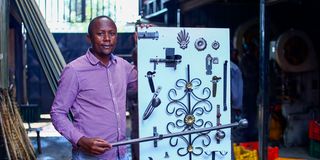
By 2019, the entrepreneurs were looking for ways to differentiate their venture in an increasingly competitive market. That year, they ventured into manufacturing curtain rod brackets, a niche product that would later define their brand. “We relocated our operations to Mwihoko, starting with a 10-by-10-foot workshop. At that time, we could make about 100 pieces per day. By 2020, production had risen to 1,000 pieces a day,” Karuri explains.
Seven Twenty Holdings Ltd co-founder and Chief Executive Officer Kenneth Karuri Kariuki at the company’s headquarters in Kiambu County on December 22, 2025.
Photo credit: Wilfred Nyangaresi | Nation Media Group
Today, the company operates on two parcels of land, each measuring 40 by 80 feet, housing expanded plants and automated production lines.
Mr Karuri serves as the CEO, while his business partner, whom he describes as “a magician”, oversees operations. “He is rich in ideas,” Mr Karuri says.
He firmly believes that co-founding a business is key to rapid and sustainable growth. Apart from pooling financial resources, partnerships enable brainstorming, shared decision-making and resilience during difficult times, he says. “I would not advise someone to start a business alone. Business partners help mobilise funds and share ideas.”
Since automating its operations in 2023, the company has recorded remarkable growth. It now manufactures more than 40 products, including curtain rods, window, door and gate accessories, and architectural paint products.
A technician at Seven Twenty Holdings Ltd headquarters in Kiambu County on December 22, 2025.
Photo credit: Wilfred Nyangaresi | Nation Media Group
The firm has benefited from the government’s affordable housing programme, suppling curtain rods to various projects, such as housing units in Mukuru Kwa Reuben, Nyeri and Nanyuki.
In line with the “Buy Kenya, Build Kenya” initiative, the company has shifted from importing raw materials from China to sourcing locally. The move, Karuri says, has reduced costs, supported local suppliers and strengthened the domestic manufacturing ecosystem. The business now employs 55 workers, including persons with disabilities.
But the journey has not been without challenges. Mr Karuri admits that managing people remains the biggest hurdle, both during the early stages and even today. “Managing employees is not easy. We work with a very diverse team,” he says.
To address this, the company has partnered with a human resource consultancy firm to improve professionalism and streamline workforce management.
Convincing people to believe in their venture was another uphill task. “When we borrowed money to expand, even family members doubted us. They did not believe in our determination,” he recalls. Over time, he says, turning to financial institutions helped bridge funding gaps and build credibility.
To keep growing, the company has invested heavily in research and development, and periodically introduces new products.
Their success has come with lessons. “When your business is small, you face small problems. When it grows, the problems become bigger. The key takeaway is that you should not walk alone in the journey,” he says.