There is a flurry of activity in the country occasioned by the shortage of animal feeds, the exorbitant cost of processed feeds and competition between humans and animals for the scarce maize, soy beans and sunflower seeds, among other feed.
The activity shows the industry is responding to a challenge that threatens to suppress livestock, which is a major component of Kenya’s economy.
There have been similar attempts in the past to introduce new feeds on the market but many have fallen flat because the fodder being presented was not well-researched or had been hyped without the claims of superior performance being scientifically verified.
Ordinary Napier grass was a successful fodder introduction into Kenya and was touted to be the panacea of dairy feeds challenge.
Every small to medium dairy venture in the country is incomplete without some clusters of Napier grass.
Despite its great popularity and usage, Napier grass lacks in proteins and energy required by livestock for optimum production.
The protein content, for instance is about five to eight percent against a requirement of 14-22 per cent, depending on the stage of production of cattle and other livestock.
Further, the dry matter content of Napier is low at about 22 percent.
Interestingly, when I ask farmers whether they understand how much Napier grass they would need to give their cattle to meet daily nutritional requirements, a majority are blank.
The answer is that most cattle in zero grazing are permanently in a situation of food and nutritional shortage.
It is also one of the reasons the animal breeds are growing smaller by the year because of calf stunting.
My response is that those animals are not small breeds of their types. They are stunted animals that never attained their mature weight and size due to prolonged nutritional stress.
Farmers should know that nutritional stress is one of the factors that can lead to breed size redefinition.
If the animals are bred continuously under nutritional stress, they may eventually change and become small breeds.
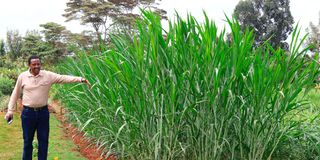
Last week, I talked about a fairly new fodder crop being called Super Napier. The plant is a cross of ordinary Napier and pearl millet and was developed in Thailand.
It is a big hype on the Kenyan market, with many people claiming to be multipliers and suppliers.
A farmer I visited in Murang’a County two weeks ago said she started planting Super Napier in May and the results have been encouraging.
According to Wanjiru, the farm manager, the 70 dairy cattle relish feeding on the Super Napier and have increased milk production highly.
She feeds every animal about six kilogrammes of the Napier daily as part of the total mixed ration of 30 kilos.
The cows are in top condition and show all the signs of feed satisfaction in quantity and nutrient content.
Additionally, a majority of the animals lie down calmly and chew the curd after a feeding session.
Wanjiru showed me the areas of the farm she has uprooted her ordinary Napier – Kakamega 1 and 2 varieties and lucern – and planted Super Napier.
It is almost as nutritious as lucern but is much easier to establish and maintain. The Super Napier produces large amounts of forage annually.
Published literature and some local analysis indicate Super Napier contains 16-18 per cent crude protein per kilogramme on dry matter basis compared to 18-22 per cent for lucern.
It also has nine Mega Joules of energy compared to negligible for lucern. This makes it a very suitable cattle feed.
Subsequent harvests are within 35 to 60 days. Wanjiru was able to confirm the claims on establishing and harvesting Super Napier.
In addition, the crop can produce 200 tonnes of herbage per acre every year, enough to feed 15 to 20 dairy cows.
Due to the hype given to Super Napier by its promoters and proponents, Kenyan con artists have picked up the flurry and livestock farmers are not safe.
The flurry of activity caused by introduction of the fodder crops calls for the Kenya Directorate of Livestock Production of the State Department of Livestock in the Ministry of Agriculture, Livestock and Fisheries to investigate the veracity of the claims and certify distributors of the fodder crops in order to save farmers from fraudulent suppliers.