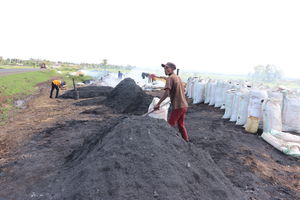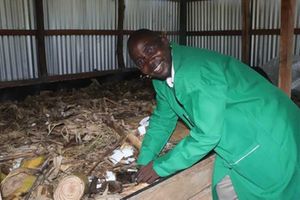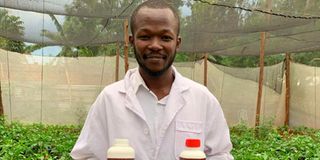
Brian Okeyo holding fertiliser made of waste at Nawiri farm, Bungoma, on January 24, 2025.

Bungoma is the fourth most populous county after Nairobi, Kiambu and Kakamega.
Because Bungoma is known for its fertile land, Brian Okeyo decided to switch careers from engineering to agriculture. He now makes liquid fertiliser.
The 31-year-old spends most his time at his Nawiri farm in Sinoko village. He uses wigglers – a type of earthworm – to break down vegetable waste, banana leaves and eggshells during fermentation.
“Farming is not for the elderly. After my studies, I realised I could offer solution to farmers,” he says.
Okeyo’s experimental farm is a testament to the effectiveness of organic inputs in fighting hunger.
The visitor is drawn to the many types of vegetables. The fertiliser used does not contain harmful chemicals.
“The soil at the farm has organic solutions produced here. The plants thrive because of the liquid fertiliser,” he says.
The fertiliser is produced through anaerobic fermentation – breaking down waste in the absence of oxygen. The end-product is environmentally friendly and enriches soil.
The system is kept airtight for 60 to 75 days at 30 to 40 degrees Celsius.
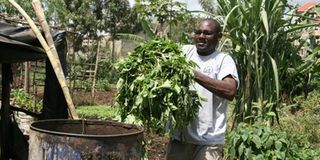
Robert Ngugi prepares liquid fertiliser from tithonia in his farm in Nairobi. FILE PHOTO |
He also applies vermicomposting, or using red wigglers to break down organic waste into a compost full of growth hormones and micro-organisms. It takes 45 days.
“At the end of this period, we mix the compost with water to get the fertiliser,” he says.
After compost is harvested, it can be used in solid form – a handful per plant – or dissolved in water at a ratio of 1kg:10 litres and used as a foliar spray or drench.
For the organic approach, some 10kgs of compost is mixed with 100 litres of water and left for a while before being sieved. The liquid is divided into two categories. The first and second grades are of higher quality and more expensive than the third and fourth.
“We encourage the use of the first grade fertiliser during planting,” he says.
Okeyo visits his customers to monitor their crops.
“If there is a problem, we investigate to determine the cause. Fortunately, we have never had serious problems,” he says.
Okeyo’s interest in agriculture started when he was at Kisumu Polytechnic in 2013 to 2016. He observed an overlap between engineering and farming.
Okeyo says he noted that engineering provides solutions for farmers by building irrigation systems, ponds and greenhouses.
“I developed interest in agriculture in my second year,” he says.
After graduating and working as an engineer for two years, he quit and bought materials and kits for his innovation.
“Before starting anything, ask yourself how it will be done. I had always dreamt of owning a company. Once you have capital, it is the best time to spread your wings,” he says.
Okeyo sought advice from an expert and others who gave him the necessary training.
He says farming is constantly evolving and criticises the idea of associating food with consumption instead of production.
He advises farmers to apply the fertiliser once, some 10 days after planting.
“We produce a lot during rainy seasons. It is also the time crops are susceptible to diseases, so farmers act accordingly,” he says.
Okeyo urges the government to make it easy for farmers to access organic waste. He relies on small-scale farmers for raw materials.
“The Kenya Bureau of Standards at on e time rejected our samples because of the waste we used. We switched to vegetable waste,” he says.
He uses banana leaves and eggshells because they are in plenty.
“We use half a tonne of waste to make the fertiliser every two weeks. Finding the waste in large quantities has become problematic. It makes us go as far as Kakamega and Kisumu,” he adds.
For the innovation, Okeyo was awarded Sh600,000 by Widu-Kenya under GIZ, an agency that has been in Kenya since 1975.
The money, Okeyo says, enabled him to create jobs for eight young people.
“The work is a lot during rainy seasons, so I hire 16 casuals,” he says.
Samuel Nderitu, the director of Global Bio-Intensive of Kenya, says more than 30,000 citizens have been given training in agro-ecological farming. It encourages them to avoid using chemicals that can harm beneficial insects and lead to health problems.
Farmers are encouraged to use natural or organic fertilisers that do not contain chemicals, which are beneficial to both humans and the environment.
“Organic solutions repel pests instead of killling them, making them safe for humans,” Nderitu says.
He adds that farmers can use three methods to make safe fertiliser.
“The first composting, which uses plant waste. Leaves are laid in a pit and covered with soil. Add small amounts of water once a week until the compost reaches a height of one metre. It is harvested after three months and place in a shade,” he says.
“The second method, called mukashi, involves fermenting materials that provide different nutrients. A farmer can use cowdung or quarry dust. The third method involves using charcoal residue, yeast and fermenting the mixture for 14 days.”
He advises young Kenyans to get involved in farming, “which offers employment opportunities and can generate more income than formal jobs”.