More than a decade ago, after years of working as Machakos and later Malindi town clerk, Steve Mbondo decided that it was time to retire from public service and venture into farming at his home in Machakos.
Like in many other parts of the Eastern region, farmers in Machakos have traditionally planted crops such as green gram and chickpeas that are resistant to the characteristic hot and dry weather in the county.
“I decided to grow the same at my farm in Masinga, but even though I followed every rule in the book, the returns I got kept falling short of what I invested,” said Mbondo in an interview with Seeds of Gold.
Eager to change this situation, Steve began to research other crops that would do well in areas which experienced the same weather and had the same soil that was found in many parts of Machakos County.
He discovered a number of crops that could do well in the black cotton soil of as Masinga, but coriander stood out as the crop that could fetch the best returns with the least resources invested.
“I calculated how much one could make from an acre of green gram, chickpeas and other crops, against what one could make from an acre of coriander. The difference was astonishing,” said Mbondo.
According to his calculations, on average, a farmer could get 315 kilograms of green grams from an acre of land in one planting season. With a kilogram going for about Sh80, this would translate to Sh25,200.
If the farmer were to plant coriander instead, they could harvest an average of 280 kilograms of coriander seeds in one season. With a kilogram going for about Sh180, this would translate to Sh50,400.
In addition to fetching a better price, Steve would spend much less on inputs such as pesticides and fungicides for coriander, which compared to other crops he planted before, is more resistant to infestations.
“Crops such as green gram are highly targeted by pests, but coriander has a strong aroma that repels pests and birds. If well taken care of, an acre can give you up to 400kg of coriander seeds,” stated Mbondo.
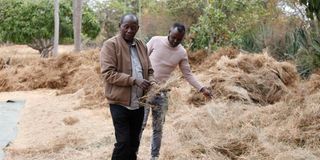
Within two and a half months of planting coriander, Steve harvested the crop, separated the seeds from the rest of the plant, dried the seeds and then packaged them into 40 kilogram bags ready to hit the market.
Since he did not have a ready market, the farmer approached brokers to whom he had sold the green grams and chickpeas before. It is at this point that he discovered why not many people grow coriander.
“I really struggled before getting a good market for coriander seeds. My only market when I started was brokers, who would buy at a very low price and take very small portions of what I harvested,” said Mbondo.
Steve Mbondo with his coriander harvest at his farm.
Photo credit: Pool
While searching for a better market, Steve got wind of a joint partnership between Unilever Kenya and Njoro Canning Factory that sought to empower farmers by purchasing goods directly from them.
He set out to meet officials at Njoro Canning Factory who, after hearing him out, gave him a contract to directly supply them with coriander seeds for spice production purposes.
“I started working with Unilever and Njoro Canning, and that is when things started to look up because they would take all my harvest and even then, I would still not satisfy their demand,” posed Mbondo.
Since he had a market that needed more seeds than he could produce, in 2021 Steve decided to introduce Shadrack Kakemu, a relative of his who was struggling financially at the time, to the farming profession.
“I had just lost someone who was very close to me, my career as an engineer was not going very well because contracts were not coming through, when they did, they did not pay enough,” said Kakemu.
Backed into a corner, Shadrack decided to plant coriander on an acre of land that his dad had given him. After following Steve’s instructions carefully, within two and a half months, he harvested the seeds.
“When I got a payment of more than Sh50,000 after selling the seeds to Unilever, I could not believe my eyes because I had never thought that an acre could get a farmer that much money,” explained Kakemu.
Able to take care of his family, pay up his debts and foot other crucial bills, Shadrack decided to drop his engineering career for full-time farming, expanding his operations to 34 acres.
Rumors about farmers who were planting coriander ‒ a crop whose market was known to be very small ‒ on large tracts of land in Masinga, began spreading across the village.
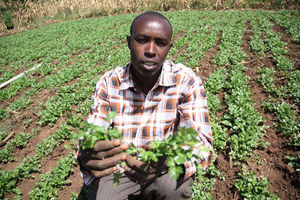
Out of curiosity, Dr Rose Wambua, a lecturer and farmer who had been planting green grams in the area, decided to look for these farmers to find out why they had stuck on coriander.
“I met Steve by chance on the road and he explained to me everything that a farmer needs to know about coriander farming,” posed Dr Wambua.
For starters, he told her that farmers need to get the correct planting seeds, as not all seeds produce the desired aroma. Purchasing a low-quality seed just because it is cheap could cost you in the long run.
Unlike other crops which ordinarily germinate within a week, coriander germinates in two weeks, therefore it is important for farmers to exercise patience and not be discouraged when they don’t see progress.
While coriander is resilient, farmers should check on the plants at least every two days, get rid of weeds and pay extra attention when they start flowering as this is the most crucial stage.
“Immediately it starts flowering, you should apply the requisite fungicides otherwise you could lose everything just when you are about to harvest,” stated Dr Wambua.
Farmers should not wait for their coriander to dry completely before they harvest it, as the crop could wither away due to its light nature. After harvesting, place it under a shed to dry for two days, separate the seeds and place them on a canvas to dry further then package them.
If the rains stop by the time one harvests, a farmer should start preparing the soil for the next planting season to retain moisture into the black cotton soil, which cracks when it is dry.
“If the rains continue after harvesting, one can decide to plant crops such as chickpeas, which would do well even if the rains subsided shortly after,” said Dr Wambua.
From three acres of land when she was starting out, Dr Rose now grows coriander on more than 20 acres of land. Although she still pursues her teaching career out of passion, she says that coriander farming is much more lucrative.
Steve, the pioneer of coriander farming in Masinga as they call him, has introduced five other farmers to the crop, bringing the total to eight. Collectively, these farmers have created thousands of jobs in the area.
“Along the value chain, we employ women to work on our farms during planting and weeding, their husbands do the harvesting which is more labour intensive, earning Sh150 to Sh200 per 40kg bag,” said Mbondo.
The farmer would like to see more locals getting into coriander farming, which with a ready market, he believes can uplift them. However, he says that poor mindset and low government support are stifling adoption.
“Many don’t embrace coriander because they believe it is a preserve of the rich. Then there are unscrupulous brokers who flood the market with coriander from Tanzania or Uganda, to create an oversupply that will force local farmers to sell at a throw-away price,” says Mbondo.