Hello

Your subscription is almost coming to an end. Don’t miss out on the great content on Nation.Africa

Ready to continue your informative journey with us?

Hello

Your premium access has ended, but the best of Nation.Africa is still within reach. Renew now to unlock exclusive stories and in-depth features.

Reclaim your full access. Click below to renew.

Nyangorora Banana Processors
Caption for the landscape image:

How banana farmers are getting full value from their crop

Scroll down to read the article

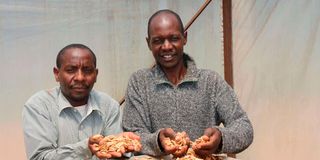
Simion Matunda (left) and Robert Okenye members of Nyangorora Banana Processors display dried banana at the Kenya Industrial Research and Development Institute in Kisii.

Photo credit: Richard Maosi | Nation Media Group

Bananas continue to fetch low market prices despite the high cost of production incurred by most farmers in Kisii and Nyamira. The smallholder farmers in the region have also been grappling with the uncertainties of market access.

However, all is not lost as a group in Kisii County is on a mission to make a difference. Nyangorora Banana Processors are into a game-changing initiative towards unlocking the potential of the highly perishable commodity by going beyond the fruit value chain to include waste management of banana stems.
Mr Jared Omiso, the director and founder of the group, says the business deals in banana value-added commodities to increase the market strength. He told Seeds of Gold that the terrain in Kisii poses a logistical challenge.

Jared Omiso

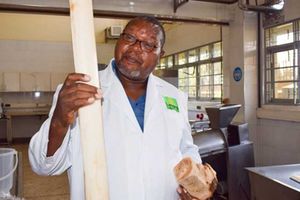
Mr Jared Omiso the director and founder Nyangorora Banana Processors at The Kenya Induastrial Research and Development Institute in Kisii with some of the products made out of banana wastes. 

Photo credit: Richard Maosi | Nation Media Group

"Transportation to the processing sites comes with serious setbacks and as a result farmers are left with their produce, which is associated with post-harvest losses as some of their produce ripen before reaching intended market," he says.

In order to deal with the challenge, the group has constructed cold storage facilities in rural areas in a bid to create community trading centres for increased shelf life.

The local farmers are also trained on proper handling techniques, beginning with how to transport their produce to the collection centres.

Nyangorora Banana Processors are also seasoned farmers and traders, says Mr Omiso. They not only cultivate traditional banana varieties but also improved ones for both cooking and ripening.

"Due to their sweet flavour and creamy texture the varieties of Ng’ombe, Nusu Ng’ombe and Uganda Green are best suited for cooking, whereas the Chinese dwarf, Williams and Giant Cavendish are preferred for ripening,” he says.

Mr Omiso explains that there are also banana stems, leaves and banana cuts that have been put into alternative use.

Once the produce is harvested the fruits are weighed, washed and converted into banana chips, crackles, bread, wine and flour.

Simon Matunda, a group member, highlights that for extraction of fibre, the banana stems received are first weighed, washed, trimmed and at times passed through a conditioner for strengthening when making products such as the bio degradable hair.

They also produce carrier bags, weaving fibre, and second generation products like sanitary pads and tissue paper.

To improve knowledge and skills, the group has trained with the Kenya Industrial Research and Development Institute (KIRDI). Mr Matunda says currently the group is using the site at KIRDI, benefitting from their technology and skills in order to reach as many farmers as possible.

Also they are collaborating with Food and Agriculture Organization FAO and United Nation Industrial Development Organization(UNIDO).

He further adds that Nyangorora Banana Processors source raw materials from the rural areas using motor bikes and a van, although they have not been able to collect a good number of the metric tonnes produced in the region.

"The important lessons learnt from the venture is that we can manage to contribute into conservation of the environment through sustainable use of agricultural resources," Mr Omiso says.

“We can also create job opportunities for the youths and women through the utilization of banana wastes,” he says.

An important milestone so far has been the training of 17 young people, who are below the age of 35 years and mostly graduates from universities and tertiary Institutions.

“We have trained them on the extraction of fibre, transportation of raw materials and development of end products,” he says.

The group has been able to acquire an International Organisation for Standardisation (ISO) certificate of compliance for their banana waste initiatives under what is referred to as circular economy. A major setback to the venture has been inadequate funds to expand the project.