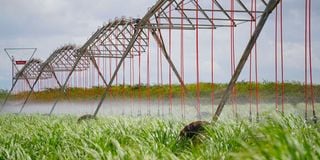
A mechanised irrigation system at Tana River Sugar farm in this photo taken on October 6, 2025.
At the heart of the vast Bura Irrigation Scheme, tractors rumble and workers bend over neat rows of green shoots.
On a 30-hectare plot, seedlings of eight carefully selected sugarcane varieties sway gently in the breeze from the nearby Tana River.
For Mr Jeremiah Namunyu, the manager of Tana River Sugar Limited, this is more than just another crop trial—it is the start of a bold venture to establish Bura as Kenya’s newest sugar-producing region.
“We started with a nursery for the eight varieties tested at Mtwapa Sugar Research. Once these mature, they’ll be transplanted to larger sections. The idea is to multiply the seeds in order to establish a solid foundation for large-scale sugarcane production,” he explains, gesturing towards the rows of seedlings.
Tana River Sugar is the first large-scale investor to set up in Bura.
The firm is experimenting with varieties that promise quicker maturity and a higher sucrose content. Among these is Guyana’s D-8484, a type of cane that matures within a year and has a sucrose content of 12.5 percent, compared to an average of 11 percent.
“Climatic conditions here are perfect. Sugarcane in Tana River matures at least four months earlier than in other parts of the country. That’s a competitive advantage we intend to build on,” says Mr Namunyu confidently.
A labourer at the Tana River Sugar farm weeds a sugarcane nursery at the Bura Irrigation Scheme ,Tana River County in this photo taken on October 6, 2025.
The company is not stopping at trials. A feasibility study is underway to identify the location of a new sugar milling factory, which is scheduled for construction in mid-2026 and expected to be operational by mid-2027.
Once complete, the factory will create thousands of jobs, integrate local out-growers, and contribute significantly towards closing Kenya’s persistent sugar deficit.
The arrival of Tana River Sugar has electrified the local community. In a county often associated with drought and poverty, the prospect of a sugar revolution offers hope.
Mr Namunyu outlines the company’s strategy: “Our plan is to bring in outgrower farmers, supplying them with seedlings, technical expertise and market guarantees. Our vision is to produce not just cane, but to build an entire economy around sugar,” he says.
The investor has already introduced machinery and casual labour, but as operations expand, demand for workers will exceed the local supply.
“The farm and factory will require both skilled and unskilled labour. We will start with locals, but when we reach full capacity, we will require more people,” he says.
For long suffering residents, this talk of factories and jobs represents a long-deferred vision.
For years, Bura has struggled to shed its ghost town image. Now, the expansion of the irrigation scheme and the arrival of investors are sparking dreams of revival.
A mechanised irrigation system at Tana River Sugar farm in this photo taken on October 6, 2025.
In a dusty corner of Bura town, John Macharia reflects on what he calls ‘the second coming’ of the settlement.
“Bura was once alive during the days of the white settlers. Then it all faded. But now, with these investors arriving, I can see Bura returning to its former glory,” he says, recalling a time when the town was full of staff homes, shops and social amenities.
Mr Macharia is convinced that sugar will do more than sweeten tea.
“Banks will open, roads will be upgraded, schools will expand and health centres will be built. Bura will be buzzing again. This place will become the economic hub of not just Tana River, but the whole region.”
His optimism is widely shared. For many residents, the prospect of large-scale farming means not only jobs, but also an opportunity to participate in Kenya’s broader economic development.
Local leaders are equally optimistic, though cautious.
Bura MP Yakub Adow describes the scheme as ‘a turning point’ for the constituency.
“This is our chance to become one of the country’s main contributors to food security. Investments here will inspire businesses, create jobs and reduce poverty. We must seize it,” he says.
However, Adow also issued a plea to the government, expressing concern for the welfare of the settlers and residents.
“As we welcome investors, let us not disrupt the lives of those who already live here. Herders must be allocated grazing corridors and watering points. This will ensure peaceful coexistence between pastoralists and farmers,” he says.
His call highlights the long-standing tension in Tana River of balancing large-scale agriculture with pastoralist traditions. However, the MP is convinced that, with careful planning, the two can coexist.
James Kirimi, manager of the Bura Irrigation Scheme, says that Tana River Sugar is just the beginning.
“In the next two months, we expect four more investors to begin test cropping. Two are setting up rice projects on 5,000 acres, one is investing in fattening livestock for export and another is venturing into pineapple production,” he reveals.
Each investor will establish a processing factory on site, which is expected to create direct and indirect jobs.
“This wave of investment has been inspired by the operationalisation of the gravity canal. It has improved the water supply, lowered production costs and boosted investor confidence. We are now appealing to locals to consider large-scale farming too,” explains Mr Kirimi.
For years, only around 5,000 acres of the 176,000-acre scheme have been cultivated. The goal is to expand this to 15,000 acres by mid-2026 and, eventually, utilise the entire area.
The Principal Secretary for Irrigation, Ephantus Kinuthia, expects investment in Bura to exceed Sh5 billion.
“The validation process is ongoing for several other investors. Once they have been cleared, they will conduct site visits and begin their projects. The scheme will be fully opened to anyone interested in farming, from rice to horticulture,” he says.
Mr Kinuthia emphasises that the government is committed to completing the remaining phases of the gravity canal to increase coverage.
“The soil in Bura is fertile and the climate is ideal for growing multiple crops. We are positioning this scheme as the flagship of Kenya’s irrigation master plan following Galana Kulalu,” he says.
He also aims to allay concerns about displacement.
“Smallholder farmers will not be disturbed. They will receive full government support and be linked with partners to access better markets. Investors are also expected to fulfil their corporate social responsibility by improving infrastructure and livelihoods in surrounding villages.”
Kenya’s sugar sector has been troubled for decades. Chronic underproduction, outdated mills and cheap imports have left the country vulnerable.
With an annual deficit of around 300,000 tonnes, the prospect of new sugar hubs is appealing.
Geoffrey Wafula, an agronomist working on the project, believes that Bura has the potential to help fill this gap.
He is particularly enthusiastic about the D-8484 sugar cane variety from Guyana: “It matures in 12 months and has a higher sucrose content than most local varieties. This is the kind of innovation that can turn Kenya’s sugar fortunes around,” he says.
The new system of irrigation on the River Tana, at the Bura Irrigation Scheme in Tana River County in this photo taken on October 6, 2025.
By capitalising on this, Bura could establish itself as a reliable sugar-producing region, competing with traditional strongholds such as Western Kenya.
The potential of sugarcane extends beyond factories and exports. It touches everyday life.
For traders in Bura town, more workers on farms means more customers in shops. For boda-boda riders, it means more passengers. For parents, it means the possibility of paying school fees on time.
“The moment these farms are up and running, we will all feel it. I’ll have more business. My children will eat better. Life will improve,” says Fatuma Hussein, who runs a grocery stall.
Her sentiments are echoed by youth groups who are already preparing to provide labour and services to the new farms.
Yet optimism is tempered with realism. Large-scale farming in arid and semi-arid regions has often encountered obstacles, ranging from mismanagement to environmental stress.
Water supply remains a key concern. Although the gravity canal has improved irrigation, questions remain about its long-term sustainability, particularly in the context of climate change.
There are also concerns that big investors could dominate smallholder farmers. “The government must ensure inclusivity. If only corporations benefit, locals will resist,” warns MP Adow.
Experts argue that balancing investor interests with community needs will be crucial. Without this balance, the scheme could reignite old tensions rather than resolve them.
Despite these concerns, the mood in Bura today is unmistakably upbeat. From farmers and traders to politicians and investors, there is a sense that a new dawn is breaking.
For Mr Namunyu, the sugar farm manager, the stakes are clear. “We are not just planting cane; we are planting an economy,” he says.
For residents like Macharia, the vision is personal. “Bura is rising again. This time, we won’t let it die,” he says with conviction.
While Kenya grapples with soaring food prices and mounting imports, the question remains: can Bura deliver on its promise? If it does, the once-forgotten town could become a symbol of resilience and a significant milestone in the country’s journey towards food security.