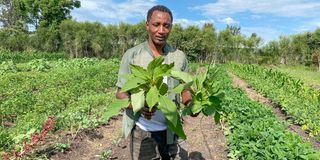
After spending 14 years as a journalist, focusing on science and the environment, Bernard Gitau found himself at a professional crossroads.
Having spent much of his career reporting on the state of the planet, the impacts of climate change and unsustainable agricultural practices, he decided to stop merely writing about solutions and start living them.
When he was made redundant, it became the final push he needed. He stepped away from his desk and swapped his press card for a pair of gumboots to pursue a mission.
He founded Sapphire Organic Farm, a mushroom and vegetable enterprise based in Joska, Machakos County, which is built around the principles of sustainability, climate action and food security.
Bernard Gitau, former journalist displays plant seedlings at his farm in Machakos County.
Photo credit: Boniface Mwangi| Nation Media Group
His deep concern for the environment led him to explore mushroom farming. With Kenya’s population now exceeding 50 million, demand for red and white meat in the country continues to surge.
In order to meet this demand, pastoralists and livestock farmers have been forced to rear more animals, often exceeding the carrying capacity of the land.
This leads not only to overgrazing and land degradation, but also to a significant increase in methane emissions — a potent greenhouse gas that contributes heavily to climate change.
“Mushrooms are a key part of the solution. As a source of protein and other nutrients, they can offer an alternative to meat while reducing pressure on land and livestock systems,” he says.
He adds that, as fungi, mushrooms play a crucial ecological role in breaking down dead organic matter, recycling nutrients and forming symbiotic relationships with plants that improve soil health.
Mr Bernard Gitau, the founder of Sapphire Organic Farm in Joska, Machakos County, displays a mushroom crop at his farm.
Photo credit: Boniface Mwangi| Nation Media Group
“Mushrooms are not just food; they are natural recyclers. Without them, our environment would be choked with organic waste,” he says.
Although he only recently entered the world of farming, he has approached it thoroughly. Prior to launching his enterprise, he devoted nearly eight months to intensive research and training under the guidance of mycology experts such as Susan Kabacia and Victor Otieno at the National Museums of Kenya.
He immersed himself in the taxonomy of fungi, the science of substrates, and cultivation techniques — an academic rigour that he now applies in practice in the day-to-day running of his farm.
Established officially a year ago, Sapphire Organic Farm specialises in oyster mushrooms, which are renowned for their rapid growth, rich flavour and adaptability. They are also beginner-friendly, requiring fewer inputs and being less susceptible to disease than other varieties.
Mushrooms crop at Bernard Gitau’s farm. The former journalist is the founder of Sapphire Organic Farm in Joska, Machakos County.
Photo credit: Boniface Mwangi| Nation Media Group
The growing process is structured but straightforward. First, a substrate is prepared, typically from straw, sawdust, coffee grounds, or cardboard. This substrate is pasteurised to eliminate harmful micro-organisms.
This substrate is then mixed with spawn — the mushroom equivalent of seeds — and packed into perforated bags to allow air to circulate.
These bags are then placed in a dark, warm room for incubation, where the mycelium (the vegetative part of the fungus) colonises the substrate over the course of a few weeks.
Once the substrate is fully colonised, the bags are moved to a light, humid fruiting chamber. With the correct moisture levels and air circulation, the mushrooms begin to sprout and are ready for harvest once their caps start to flatten.
Even after the first harvest, the same bags can produce two or more additional flushes before being composted. The spent substrate can then be reused as an organic soil improver, making the process economical and sustainable.
However, as with any farming venture, challenges are ever-present.
Founder of Sapphire Organic Farm in Joska, Machakos County, Bernard Gitau displays a healthy sunflower crop at his farm.
Photo credit: Boniface Mwangi| Nation Media Group
For Gitau, the biggest hurdle was securing the initial capital required to set up a suitable growing structure, acquiring grow bags and controlling the essential factors of temperature and humidity for consistent production.
"Grow bags cost between Sh250 and Sh500 depending on the source. Structures must also be designed to control pests, moisture and air quality. Pests are also a reality. Rats, slugs and insects can destroy a harvest,” he explains.
Gitau uses traps and pesticides to manage rats, salt to deter slugs, and flycatchers to control flying insects.
A particular challenge in mushroom farming is green mould, which competes with mushrooms for nutrients and significantly reduces the productive lifespan of the grow bags.
Despite these challenges, he has found satisfaction and profitability in the venture. His customer base currently includes government and private sector employees, select Nairobi hotels, and an expanding list of restaurants and retailers.
He emphasises that mushroom farming thrives on relationships and referrals. “Your market is your network. Once people try your mushrooms and love them, they spread the word. That is how the business grows,” he says.
Founder of Sapphire Organic Farm in Joska Machakos County, Bernard Gitau displays Jute Mallow (Murenda) crop at his farm.
Photo credit: Boniface Mwangi| Nation Media Group
Pricing is another area where careful planning pays off. Gitau says that fresh mushrooms sell for between Sh200 and Sh300 per 250g punnet, depending on location and packaging.
Dried mushrooms, which have a longer shelf life and are more convenient, can fetch up to Sh400 per 100 grams, making them a high-value product for both domestic and export markets.
Mushrooms are not only profitable, but also incredibly nutritious. Packed with protein, fibre, B vitamins and immune-boosting antioxidants, they are increasingly regarded as a 'superfood' by health-conscious consumers.
Unlike animal protein, mushrooms contain no cholesterol or saturated fats, making them an ideal option for people managing lifestyle diseases.
Sapphire Organic Farm does not just grow mushrooms. The farm also grows a wide range of exotic and indigenous vegetables, including kundé, mrenda, mitoo, spinach, capsicum, chillies, and cherry tomatoes.
Founder of Sapphire Organic Farm in Joska, Machakos County, Bernard Gitau displays a healthy sunflower crop at his farm.
Photo credit: Boniface Mwangi| Nation Media Group
One of the highlights of his farm is its organically grown sunflower, which has attracted attention across Kenya and beyond.
One plant has produced up to 40 blooms, all of which yielded seeds, sparking interest from local farmers and a potential buyer in Switzerland.
Like his mushrooms, the sunflower is grown organically. Although Gitau currently manages operations manually, he believes that technology is the next logical step for scaling up.
“Automated climate control, AI-based monitoring and efficient post-harvest systems will be crucial for growth,” he says. For now, though, doing things by hand helps him to stay connected to the process and keeps his costs low.
In Kenya, the mushroom industry has great potential. The country currently produces around 500 tonnes annually, compared to an estimated national demand of 1,200 tonnes.
This represents a market gap of over 700 tonnes, driven by a growing health-conscious population, urban diets and interest in plant-based alternatives.
Gitau believes that now is the right time for young people and professionals to consider mushroom farming, both for income and for impact. His advice? Focus on the three Ps: Passion, patience, and then profit.
However, he acknowledges the misconceptions that discourage many.
"People think mushrooms are plants, but they are not. They are fungi, which belong to a completely different kingdom. Others believe that mushrooms grow overnight.
While they can appear quickly, they require weeks of careful incubation," he says.
He adds that there is also the myth that mushrooms are poisonous. In fact, many varieties are safe to eat and full of nutrients.
As food systems become more strained and the effects of climate change become more severe, his model offers a compelling blueprint for the future of farming in Kenya.
As well as running Sapphire Organic Farm, Gitau has taken on a mentoring role.
Through informal training sessions, farm visits and community outreach, he is helping a new generation of young people to discover that mushroom farming can be a viable career path.
“Many people are stuck in the mindset that farming is a last resort. But once they understand the science, economics and sustainability of mushrooms, their mindset shifts,” he says.