A few years ago, Prof Joseph Ngugi Kamau, a lecturer at United States International University (USIU), bought his mother a high-yielding dairy cow that she had long desired.
The cow, according to Prof Ngugi, was meant to boost her income. However, he was not certain she could sustain it as she was still inclined to traditional methods of farming.
“It was an expensive cow and I decided to surprise her,” says the Entrepreneurship and Business Model Innovation lecturer.
The academic hails from Maragua in Murang’a County, one of the dairy and agriculturally-focused counties.
When he visited his mother two months after gifting her the cow, he was stunned to realise his mother had already disposed of it.
To his surprise, the dairy animal was sold at a throwaway price because, as he claims, she was unable to sustain it.
“She sold it at Sh2,000 (a throwaway price) because she fed it traditionally. It fell sick and could not produce milk anymore. She feared it could die and decided to dispose of it to a butcher,” Ngugi recalls.
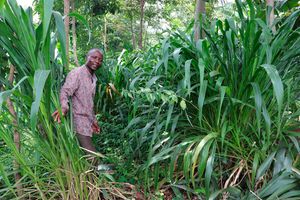
A Juncao grass plantation in Maragua, Murang'a County in this photo taken on September 19, 2025.
Photo credit: Francis Nderitu | Nation
The incident, compounded by the experiences he faced while growing up—searching for grass for their cows, one of the farming activities his parents depended on to raise and educate him and the siblings—became a turning point.
Prof Ngugi reminisces about travelling for over two kilometres in search of fodder, traditional farming methods that he insists are not sustainable any more in keeping the dairy sector afloat amid the ever-rising cost of animal feed in the country.
Additionally, prolonged droughts, one of the shocks of climate change, are making the livestock sector untenable as farmers lose animals, especially in Arid and Semi-Arid Land (ASAL) regions, while those in rainfall-receiving areas are forced to scale down operations.
It is for those reasons that the researcher has decided to change the face of Maragua and the entire Murang’a County dairy sector by introducing a ‘miracle grass’.
Introduced in Kenya in 2021, Juncao grass has already been embraced by farmers in counties including Nakuru, Turkana, Garissa, Kajiado and Makueni as a cushion against the surging cost of dairy feed.
Juncao was approved for cultivation in the country by state-owned research agencies, including the Kenya Plant Health Inspectorate Service (Kephis), after thorough tests and scrutiny.
“One of the biggest challenges in the dairy industry value chain, right from production to the market, is the high cost of feed. The miracle grass has proven its ability to cushion farmers,” Ngugi says. The lecturer is currently growing the fodder in Maragua and distributing cutting seeds to locals for reproduction.
He now has two acres under the climate-resilient fodder. “The grass is transforming many countries. It is a climate-smart resilient technological innovation. I am now expanding to propagate the seeds on eight acres,” he told Seeds of Gold during a visit to his farm.
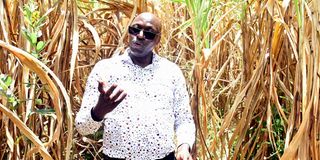
Prof Joseph Ngugi Kamau walks through his Juncao grass plantation in Maragua, Murang'a County on September 19, 2025.
Photo credit: Francis Nderitu | Nation
A tour of his farm reveals a green canopy of the magic grass, which grows up to eight metres high and easily attracts visitors. From a distance, the tall stalks resemble a sugarcane plantation.
Juncao (Jun means fungi and Cao means grass) was engineered in China in the 1980s by Prof Lin Zhanxi, a professor at the country’s Fujian Agriculture and Forestry University (FAFU).
Primarily, it was meant to replace timber with Juncao for mushroom growing (substrates), significantly lowering farming costs, reducing annual tree clearing, and hence providing an economical and environmentally friendly path for poverty alleviation.
Additionally, the forage can be used to prevent soil erosion while rehabilitating soil as it enhances carbon sequestration.
The fodder, according to experts, is rich in nutrients, estimated to have about 18 percent crude protein (CP) content, thus significantly outperforming traditional fodder options like Napier grass, which contains at most 10.8 percent.
It flourishes in low-fertility soils and can thrive under rain-fed conditions, providing a reliable source of fodder even during dry spells.
“Maragua, for instance, is quite hot and at times experiences dry seasons, but Juncao thrives,” Prof Ngugi said during the interview, revealing that it cost him Sh600,000 to start the propagation farm.
Apart from feeding dairy cows, the forage is given to goats, sheep, poultry, pigs, and is also used as mushroom substrate.
Sammy Kariuki, a Nakuru-based dairy farmer, has embraced the super grass.
“I started growing the grass in 2022—a year after it was introduced in Kenya, and I have experienced remarkable change in my livestock farming business,” he says.
A cow that was producing at most five litres of milk a day now produces double that amount, a statement also echoed by Prof Ngugi.
“I have researched and discovered that it increases milk production by between 40 to 50 percent. That is quite a huge rise,” says the lecturer.
A Juncao grass plantation in Maragua, Murang'a County in this photo taken on September 19, 2025.
Photo credit: Francis Nderitu | Nation
Selling a cutting at Sh10, Ngugi says he has a soft target for youths and women as he believes “it is a great innovation that young people can leverage to help revamp the agricultural and livestock sector and make it a lucrative business”.
In terms of production, the technological innovation expert demonstrates that an acre can produce about 10 tonnes per annum, explaining that a farmer can consistently keep over 20 cows or 200 goats, and they can be fed for a whole year.
That means if the grass is made readily accessible and available to farmers, particularly those who derive their livelihood from animal husbandry, it can be a great technology to make their lives better.
According to Prof Ngugi’s practical experience, it is grown like maize or other crops.
With a well-prepared land, the cuttings are spaced 50cm between plants and similar measurements between the lines.
“The cutting with two nodes should either be planted vertically or slanted a bit. One node is covered with soil, while the other is left to sprout. Planting is most ideal during the rainy season,” he explains, advising farmers to source the cuttings from original seedlings.
Fertiliser is not necessarily needed when planting, though a farmer can apply well-decomposed animal manure.
For top dressing, he recommends using fertiliser rich in nitrogen, phosphorus, and potassium (NPK) after a month of planting.
The fodder is ready to be fed to animals after three months, and for propagation after eight months.
Juncao takes up to 25 years before uprooting and planting new ones, therefore qualifying it as a sustainable method of farming.