The road from Kilifi town to Malindi offers a stunning beauty of exotic beaches, iconic landmarks and the vibrant culture of locals.
The East African Tall, a variety of traditional coconut, is the mainstay of many families. Some households supplement this with fruit growing and animal rearing.
When we land in Mkao wa Moto village, Ganda ward, Rashid Salim Kalu is busy tending to a his Sampoorna coconut tree – a new hybrid variety from India. It produces tender and fleshy coconuts.
“If anyone intends to grow a high-yielding and profitable coconut variety, Sampoorna should be the preferred choice,” he says.
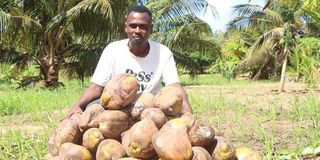
Rashid Salim Kalu from Mkaa wa Moto village with the hybrid coconuts at his farm.
Photo credit: Richard Maosi| NationMedia Group
Kalu is a proud coconut farmer, a venture he began in 2019 with the assistance of the Micro Enterprise Support Programme Trust, the Kenya Agricultural and Livestock Research Organization (Kalro)and the devolved government of Kilifi.
“My first harvest was in May 2022, meaning the Sampoorna hybrid variety takes two and half to three years to be mature,” Kalu says.
The farmer graduated from Strathmore University with a Bachelor of Commerce degree (Accounting) in 2013. He worked with several companies before plunging head-on into commercial coconut farming.
He says Sampoorna hybrid is more commercially viable than the indigenous East African Tall coconuts that are predominantly cultivated in the Coast.
“The indigenous varieties are tall and take six to seven years to mature,” Kalu says, adding that Sampoorna are much bigger, more fleshy, sweeter and fetch great prices.
They can withstand climatic shocks, are resistant to pests and diseases and produce coconuts throughout the year.
Kalu can get 200 to 250 coconuts from a single tree in a good year, unlike the African Tall which yields 100-150.
Organic farming, including application of farmyard manure, guarantees good results.
Rashid Salim Kalu from Mkaa wa Moto village, Malindi in Kilifi county, showing already harvested hybrid Sampoorna coconut variety in this photo taken on April 1, 2025.
Photo credit: Richard Maosi| NationMedia Group
Kalu has a coconut quarantine store at his farm where all the imported seeds are preserved for three to six months as per the requirements of the Kenya Plant Health Inspectorate Service (Kephis) and other state regulatory agencies.
“The recommended number of Sampoorna hybrid coconut plants per acre is 50 to 55,” Kalu says.
To overcomes post-harvest losses, Kalu imports and plants the seeds at different times of the year. He plans to increase acreage and be a model Sampoorna hybrid coconut farmer.
The farmer sells his coconuts in Kilifi, Mombasa, Taita Taveta, Lamu, Nairobi and Nakuru counties.
One coconut goes for Sh35 to Sh70, depending on size. Peak and off peak seasons also influence pricing.
Apart from the nuts, Kalu sells coconut palm leaves, locally known as Makuti, used to as roofing on houses.
“Coconut is a gem. We urge the national and county governments to invest in this value chain and train farmers on the practices they need to employ in order to realise good yields. The full potential of the coconut has not been realised,” he says.
There are challenges in the growing of the variety too. Kalu says the farmer needs to exercise a lot of caution when the plants are a year old as they are usually attacked by the rhinoceros beetle. Traps can easily overcome the problem. The Sampoorna coconut variety require a lot of water, unlike the East African Tall.
Mwalimu Menza, a scientist at Kalro, says Sampoorna is a dwarf, making it easy to work on.
Mwalimu Menza a senior Kalro researcher at a coconut quarantine facility in Kilifi.
Photo credit: Richard Maosi| NationMedia Group