The Eldoret- Ziwa Kachibora road is surrounded by misty hills brimming with beauty.
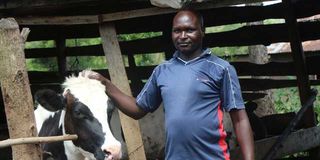
When we arrive at Mararai village, we find Eliud Kiprop tending to his 15 dairy cows. The herd is made up of eight milkers, five heifers and two newborn calves.
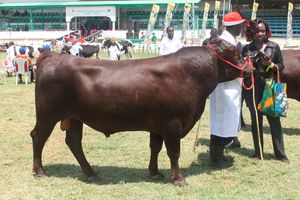
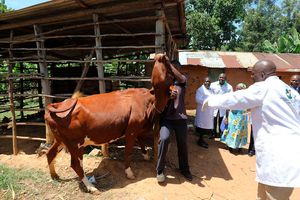
"My livestock breeds are mainly white Friesian and red Ayrshire, best suited for commercial production milk here," he notes.
Sitting on three acres of land the farm is also home to traditional chicken, collard greens (Sukuma- wiki), African nightshade (managu) and amaranth.
He also cultivates the super Napier grass pakchong, a high-yielding, nutrient-dense and climate-resilient livestock fodder.
Eliud says he was introduced to dairy farming by a friend in 2014, upon realizing that maize farming was no longer rewarding, with a bag of 90 kilos in most cases going for between Sh2000 to Sh2500.
This prompted him to shift to dairy farming, a venture he began by seeking knowledge on sustainable dairy farming at the University of Eldoret, by then Chepkoilel Campus.
After successful training, the university offered him a Friesian cow as it is believed to produce more milk compared to indigenous breeds.
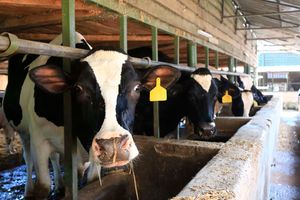
Dairy cows at a farm in Kapseret, Uasin Gishu County.
Photo credit: Jared Nyataya | Nation Media Group
Into the project, he pumped in some Sh20,000, with the money going to the construction of a temporary cow shed fitted with wooden resting cubicles, feeding areas and a milking point.
In 2016, he ploughed back the profit into the business and acquired extra two Friesian cows.
Another amount went to purchase a miller, mixer and chopping machines for efficient and affordable production of animal feeds.
On top of that, Eliud adopted record-keeping techniques to support key aspects such as breeding, milk production, nutrition and feed management.
To bolster his knowledge and skills, he started to attend farmer field days and seminars for mentorship opportunities to enhance dairy farming.
Eliud says his routine at the farm starts at 4am with his staff split into duties, first by ensuring the cow shed is cleaned thoroughly, followed by milking and feeding.
On a good day, Eliud milks between 60-70 litres of milk, each going for Sh40.
His dairy cows are mainly fed maize silage, hay, and supplemented with pakchong, depending on the stages of development.
"The herd is fed differently as the milkers are given more silage while the heifers rely majorly on hay," he adds, noting that the cows are fed in classes depending on how much milk each gives.
Eliud says he also alternates his feeds in order to foster productivity, with much emphasis put on Dairy meals to give energy, protein and mineral licks that are mostly rich in zinc, potassium, magnesium and calcium.
He also gives the livestock maize jam, wheat bran, canola, soya, cottonseed, sunflower and fermented maize flour, mixed in at a given farm ratio.
"The cattle are sprayed after every two weeks while deworming is administered on a monthly basis and vaccination after every six months,".
Other than milk, Eliud also sells dried cow dung to the locals who are also into the organic farming of vegetables.
Eliud Kiprop from Mararai village along Ziwa -Kachibora Road in Uasin Gishu County feeding a section of his dairy cow in this photo taken on November 13 2024.
Photo credit: Richard Maosi| Nation Media Group
The major challenge is that most farmers in the region are counting losses due to low milk prices as milk processors continue to cut prices due to an increase in production.
"The increase in production also comes with other constraints such as a lack of adequate markets and insufficient storage facilities," he notes.
Five years from now, Eliud sees himself venturing into the value addition of milk to make products like ghee, butter and yoghurt.
"Dairy milk products have a higher shelf life compared to fresh milk and also increase disposable income to individual farmers,"
Dennis Kiplel, an animal scientist at Egerton University and director at Kiplel's Farm says general improvement of livestock breeds increases efficiency and sustainability in production.
Running a profitable dairy farm entails the replacement of locally adapted breeds that are associated with pastoralism and not economically viable.
Additionally, for one to operate a successful dairy farm, they need to invest in milk storage facilities in order to reduce post-harvest losses.
On top of that, adopt a good feeding plan.
"Keeping farm records is also vital in management, planning and budgeting at the farm level, “he notes.