When Andrew Egala speaks about his agribusiness venture, his conviction is unmistakable. Every idea, he says, is anchored in one purpose: to build a food system that is both profitable and sustainable.
Mr Egala is the founder of Green Without Borders, a private-sector social enterprise trading under the brand Mugala Naturals.
The company processes agri-food products from climate-smart crops such as orange-fleshed sweet potatoes, cassava, sorghum, millet and chickpeas, and incorporates honey into many of its recipes.
“Even honey is part of the climate-smart value chain,” he says.
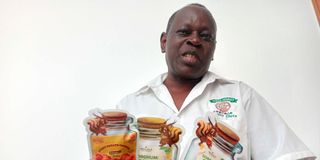
Mr Andrew Egala displays some of the Mugala Naturals products.
Photo credit: File
Green Without Borders works across the food ecosystem—from production and processing to distribution and waste reduction—linking farmers, transporters, processors and retailers.
“Our work starts with seed merchants, vine and stem suppliers, and input providers,” he explains. “We use organic fertilisers because our farmers are organically certified. Our products must remain organic.”
The network is deliberately inclusive, particularly of youth and women. Village advisors collaborate with county governments and organisations such as the Kenya Agricultural and Livestock Research Organisation (Kalro), which supplies weather index data to guide farmers amid increasingly erratic climate conditions.
Seasonality shapes sourcing. “Sweet potatoes have two growing seasons, so we buy from Migori and Busia depending on the time of year,” he says.
Transport is also integrated into the system, with boda-boda riders ferrying produce from farms to processing hubs often managed by women who handle drying, milling and other primary processing tasks.
Initial processing is carried out in Migori and Busia counties, with final finishing in Ruiru, Kiambu County. From this base, Mugala Naturals produces cookies, breakfast cereals, flours and snacks. Each value chain—cassava, sweet potato, sorghum, millet and chickpea—yields about one tonne of produce a month.
“We make cookies from cassava, sorghum and sweet potatoes, as well as flours and breakfast cereals,” Mr Egala says.
Prices reflect the cost of organic production: cookies retail at Sh100 for 50g, Sh200 for 100g and Sh400 for 200g; cassava flour goes for Sh250 a kilo, chickpea flour for Sh400 and sweet potato flour for Sh600 due to its low yield after drying.
Although the enterprise is not yet profitable, Mr Egala says it is scaling up.
“We have invested heavily in processing. Maybe next year, when we scale further, we will start to see returns.”
Mugala Naturals product portfolio includes breakfast cereals, honey, peanut butter, pre-cooked porridge, healthy snacks, and cookies.
Photo credit: File
Green Without Borders exhibited at the Bioeconomy Cluster Development Workshop hosted by the Stockholm Environment Institute (SEI) in Nairobi on November 6, joining stakeholders promoting Kenya’s growing bioeconomy.
“Our contribution is through value addition and supporting the bioeconomy,” he notes.
Financing, he says, remains the biggest hurdle. “Accessing capital is difficult. Even with a purchase order, banks still demand collateral. Government credit programmes have lengthy requirements.”
Beyond profit, his mission is to fight malnutrition. Mugala Naturals produces organic, gluten-free foods rich in iron and potassium to help combat anaemia and manage non-communicable diseases. Honey, with its low glycaemic index, aligns with the firm’s inclusive nutrition philosophy.
A sole proprietor, he runs the venture using equipment worth about Sh2 million and plans to automate next year. He funds operations largely through agribusiness consultancy work.
Despite high taxes, regulatory hurdles, rising transport costs and delayed payments from retailers, he remains optimistic. “Entrepreneurship is lonely, but the products push you forward.”
For him, the future is clear: “Food must be organic, local and sustainable—and collaboration will get us there.”