Farmers in Garissa are increasingly turning to beekeeping as a sustainable and profitable venture, tapping into the region’s rich natural resources and growing demand for honey and related products.
The Garissa Farmers Network (GFN) — an umbrella body with about 1,700 members — says apiculture is helping improve livelihoods while supporting biodiversity.
In 2022, Ms Ebla Dagane Hassan initiated a beekeeping project to enhance crop production on her farm along the Tana River. She grows watermelons, bananas, fodder, maize and tomatoes and needed reliable pollinators to boost yields.
“I started beekeeping because bees are excellent pollinators. Later, I realised I could also produce honey, wax and propolis,” she said.
She now harvests honey, beeswax and propolis, which farmers in the region use to make traditional remedies. She describes apiculture as labour-efficient, environmentally friendly and well suited to Garissa’s ecosystem.
Former Garissa County Executive Committee Member, Ms Saphia Sheikh Omar, is among 70 GFN members who have diversified from conventional farming. She says beekeeping is proving more profitable and less labour-intensive than pastoralism.
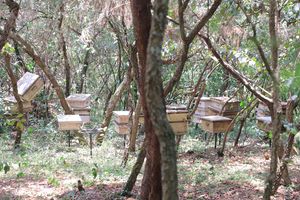
“Livestock require grazing land, water and medication. Beekeeping is simpler. From my 60 hives, I harvest at least 70 kilogrammes of honey each season,” she said.
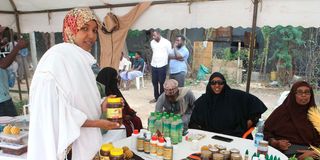
Her honey, branded Filayi, is sold through GFN outlets and is stocked in several shops in Garissa town.
Ebla Dagane Hassan displays packaged honey in Garissa on May 28, 2025.
Photo credit: Manase Otsialo | Nation Media Group
However, Ms Omar has had to address theft and wildlife intrusion at her apiary. She says honey thieves often collaborate with farmhands because farms are far from homesteads. “Since fencing my apiary and keeping the key myself, the thefts have stopped,” she said. Honey badgers are also a threat. Though they prefer brood comb containing larvae, they frequently destroy hives while foraging. Their thick skin and coarse hair make them resilient to stings.
Beekeepers cite climate change as their biggest challenge. Prolonged drought, erratic rainfall and the destruction of natural habitats due to settlement expansion and charcoal burning have contributed to declining bee populations.
“When it rains heavily, floods wash away hives and destroy vegetation. During drought, bees lack forage and water,” Ms Omar said.
Despite this, she still collects beeswax for making candles and traditional medicinal products.
GFN Chairman, Mr Abdullahi Abdi, says the network is drawing on indigenous knowledge and Garissa’s natural biodiversity to promote sustainable beekeeping. He notes that most farmers still rely on traditional methods to determine when to harvest.
“Many of us check hive weight manually or observe bee activity. But the Apiculture Platform of Kenya recommends using a simple kilogram scale placed between the hive and the tree hook. It is cheap and accurate,” he said.
According to the platform, an increase in hive weight indicates nectar flow, while stabilisation suggests that the honey is ready for harvesting. The method is especially useful when multiple hives are in the same area and feeding from similar nectar sources.
The Apiculture Platform of Kenya — a national multi-stakeholder organisation launched in 2026 — works with private and public stakeholders to strengthen the beekeeping value chain and promote industry standards.
Ms Hassan says observation remains her most reliable tool. “When activity around the hive is high, nectar is flowing. When it slows, I check the hive. Bees also become more aggressive when there is honey, so I prepare for harvesting.” A shortage of trained honey-harvesting professionals in Garissa continues to affect the sector. Farmers must hire experts from other regions. “We bring someone from Kisumu to harvest for us because we have no locally trained specialists,” Mr Abdi said.
Pure honey from local producers fetches up to Sh1,000 per kilogramme. Beekeepers also produce beeswax candles and honey-based creams. Garissa Deputy Director of Livestock Production, Marketing and Value Addition, Mr Siyat Onle, said more households along the Tana River — in Garissa Township, Fafi, Balambala and Ijara — are embracing beekeeping as a supplementary income source. He attributes this trend to the availability of permanent water sources and abundant flora.
Mr Onle said the county government has supported producers by mapping apiaries and organising farmers into producer groups. It has also developed a county beekeeping strategy, supplied modern bee-keeping equipment, and connected beekeepers with training institutions.
However, he noted ongoing challenges, including high costs of modern equipment, limited extension services and poor apiary management among farmers.
Another concern is competition from adulterated honey in local markets, which undermines genuine producers. “We are working to improve honey production by offering training, developing infrastructure, creating market linkages and establishing an apiculture policy framework,” he said.
To strengthen the sector, the county plans to conduct a honey value chain analysis to determine Garissa’s production capacity.
Currently, there are no accurate statistics on honey output, hindering long-term planning and investment.