Premium
The accidental livestock breeds
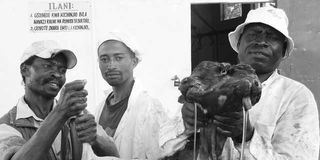
Workers at a slaughterhouse carry a dead calf with a two heads deformity. Mutations are accidental happenings in animal breeding.

The wonders of nature are many and varied, affecting some species and not others.
Most such happenings are rare and usually do not result in new breeds of animals. They only change a few characteristics of a breed mildly but maintain the overall appearance and performance.
Some natural changes like missing limbs, eyes or open backs are undesirable or incompatible with life.


Such abnormal traits are, therefore, prevented from establishing in the population.
The changed specimens are either destroyed or prevented from breeding to terminate propagation of the defective trait.
Rigorous testing
Abnormalities that animals are born with are called congenital or birth defects. They are caused by genetic changes that either occur naturally or due to interference of genes by chemical substances, nutrition or infective organisms. Viruses are a common cause of birth defects.
Physical agents such as radiation may cause congenital defects.
There was a genetic defect crisis in babies born by women who had been given a sedative called thalidomide in 46 countries in the late 1950s and early 1960s.
The drug was used to calm people with anxiety, sleeplessness and morning sickness.
The use of thalidomide resulted in what was called “The halidomide Scandal”.
The drug caused genetic deformities in babies, ranging from legs and hands being attached too closely to the body, under developed hands called seal limbs, limbs and hands missing and damaged eyes and brain, depending on the age of pregnancy at which a woman had been given the medicine.
In Germany alone, where the drug was manufactured and widely used, an estimated 10,000 babies with defects were born.
Many of them were too damaged and died soon after birth but some survived to adulthood.
The use of the drug was discontinued in 1961 when it was evident the chemical was causing genetic defects to babies.
Research shows that the defects seen in the thalidomide babies did not affect the reproduction genes.
Therefore, the survivors of the thalidomide defects went on to give birth to normal babies.
The thalidomide scandal goes a long way to prove that chemicals do cause deformities.
There is, therefore, need for rigorous testing of the effects of drugs before their safety is approved.
While thalidomide defects did not result in a different breed of human beings, some abnormalities affect the genes of the reproductive cells to create new breeds.
A good example is the myostatin gene that controls the growth of muscle fibres and their numbers.
For some reason, myostatin may be available in the body in low levels or be absent altogether. The total absence of myostatin activity leads to the development of a condition called “double muscling”.
It means the muscle mass of an animal may be doubled in number and size.
A specimen with the double muscle syndrome has its muscles replicated and they grow to very large size. The condition has been reported in humans, cattle, sheep, dogs and fish.
Double muscling is rare in humans but has been reported in at least two young men.
The condition is scientifically called myostatin-related muscle hypertrophy or overgrowth. It is a rare condition in humans, characterised by increased muscle mass and strength.
Where the activity of the myostatin gene is not fully lost, the muscle mass increases with a ratio equivalent to the activity of the myostatin gene.
The change in activity of the myostatin gene is caused by a change in the structure of the gene for reasons that are not known.
In cattle and sheep, the loss of the myostatin gene function has helped create new and useful breeds.
These are the Belgian Blue Double Muscle cattle and the Texel Double Muscle Sheep. The two are handy for meat.
Mature bulls
The Belgian Blue is a beast of a cow. Mature bulls weigh 1,100 to 1,250 kilogrammes, while a female weighs 700 to 900 kilos.
This is an impressive weight for any breed of cattle.
Myostatin-related muscle enlargement is thought to be inherited as a dominant trait.
This means a single copy of the mutated gene is sufficient to cause the condition. This is the reason that a Belgian Blue cow breeding with a normal muscle breed gives birth to a double muscle calf.
Mature Texel sheep with double muscle weigh 90 to 120 kilogrammes for rams and 70 to 110kg for females.
The Belgian Blue cattle and double muscle Texel sheep have large bulky muscles, increased muscle strength and reduced body fat, giving lean meat.
Double muscle breeds have a higher percentage of meat to bones than animals with normal muscling.
The animals’ skin is thinner than that of the normal muscled animals. The muscles are well contoured and bulge from the skin.
Double muscling is visually striking and the animals appear to be struggling with the burden of more than usual muscle.
However, the condition is not known to cause any special medical problems to the affected animals or humans.
Since the double muscling trait for the Texel sheep is a chance occurrence, the population of double muscle sheep is low and not well documented.
On the other hand, there are about two million Belgian Blue double muscle cattle the world over.
Mutations are accidental happenings in animal breeding. Most mutations are not beneficial but the occasional useful mutation may arise.
Such mutations should be propagated and, where appropriate, be used to create new superior breeds of livestock.