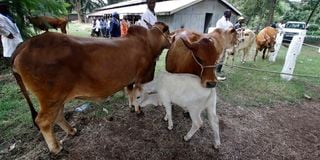
The State Department of Livestock estimates that Kenyan rangeland farmers, commonly called pastoralists, may lose up to 2.5 million cattle due to the drought ravaging the country.
Pastoral cattle provide most of the beef consumed in the country but still, even in the best of weather, leave a deficit of about 1.5 million slaughter animals in a year.
First, pastoral cattle farmers still keep animals for sentimental rather than commercial reasons.
They sell livestock because of a need for money, especially school fees, and not diversifying their investments.
They also sell animals due to the pressure of lack of pasture, especially during the advanced dry seasons or drought.
Due to selling animals under duress, pastoralists in most cases do not get value for their cattle or the cattle have deteriorated to the point they either die or are sold at throwaway salvage prices.
During the peak of the drought this year, a cow at Bisil market in Kajiado County would sell for as low as Sh500.
Pastoral cattle farmers in Kenya live in a vicious circle of gain and loss, with only a tiny fraction of real economic gains.
This means that when the weather is good and pasture is in plenty, the animals gain weight to their optimum and reproduce.
The farmers are happy but fail to realise that all the gains will be lost when the weather changes and pasture dries up.
The deficiency of economic awareness and the perennial cumulative losses of the livestock farmers may explain why the rangelands have lagged behind in socio-economic development despite the immense livestock wealth that lies untapped.
Having realised the potential of the rangelands and the real possibility of turning up the economic fortunes of pastoral farmers through livestock, the governments of Kenya, Ethiopia, Somalia and Djibouti and the World Bank have come up with the DRIVE Project.
It is aimed at deliberately commercialising pastoral farming in the Horn of Africa to cushion farmers from adverse weather, unlock the heavy financial potential of livestock and improve the economic wellbeing of the region.
DRIVE stands for De-Risking, Inclusion and Value Enhancement of pastoral economies in the Horn of Africa.
The project aims at financing pastoral livestock farmers and intermediaries in meat animal production, pasture production and linking farmers to the market.
In preparation to participate gainfully in the DRIVE project, it is important for farmers to understand the various breeds of meat cattle, including their advantages, disadvantages and availability.
In Kenya, most of the beef is from three cattle breeds – the small East African Zebu (SEZ), the Boran and Sahiwal.
A cross is an animal produced from two distinct breeds while a mixture is the product of more than two breeds.
The three most common cattle for beef in Kenya belong to the family scientifically called Bos indicus.
They are well known for their superior hardiness to nutritional, environmental and trekking stress.
No wonder the pastoralists, who keep moving in search of water and grass, find the animals very favourable to their environment and way of life.
Unfortunately, nature has its way of balancing things out where gains are balanced with negatives.
The Bos indicus have the disadvantage of being slow growers, late maturing and taking long to breed.
The SEZ is the smallest of the Bos indicus while the Boran and Sahiwal are roughly the same mature size of 500 to 800kg.
To build a vibrant beef industry, it is imperative that Kenyan pastoral farmers learn a few lessons from their South African counterparts of the veld.
The country has a legitimate claim to the coveted Boer goat, Dorper sheep and the Bonsmara beef cattle breed.
These breeds were developed by crossing indigenous animals with exotic ones to produce well-balanced, high performing breeds of the three species.
The most common Bos taurus beef cattle in Kenya are the Hereford, Charolais and Aberdeen Angus.
The Angus is called the Dorper of the beef cattle world due to its fast growth rate and hardiness to different environmental conditions and feed utilisation.
Charolais is the king of size in beef cattle farming for its superior height, body length, muscle mass and weight at different ages.
With its mature weight of 1,000 to 1,250kg, it dwarfs the Boran, Sahiwal and SEZ.
It would not be advisable for pastoralists to switch to Bos taurus cattle but valuable gains can be made by crossing the Bos taurus with the three Bos indicus breeds.
I have seen Hereford and Charolais crosses of Boran, Sahiwal and SEZ doing very well in some farms in Narok and Kajiado counties.
This would enable the pastoralists improve their beef cattle, produce more meat and make more profit.