Controller of Budget (CoB) Dr Margaret Nyakang’o has put National Treasury Cabinet Secretary John Mbadi on notice for perpetrating fiscal indiscipline in government after he approved expenditures of Sh281.5 billion without parliamentary approval.
The latest revelations by the CoB trap CS Mbadi by his own words during his time as a member of the National Assembly representing Suba South Constituency and chairperson of the Public Accounts Committee (PAC), the House watchdog committee.
Dr Nyakang’o, in her August 2026 National Government Budget Implementation Review Report for the 2025/26 financial year, warned CS Mbadi against the creeping habit of treating foreseeable government expenses as national emergencies.
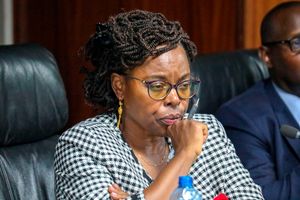
Controller of Budget Dr Margaret Nyakang’o.
Photo credit: Wilfred Nyangaresi | Nation Media Group
The additional expenditures for the year, which included Sh212.7 billion in recurrent expenditure and Sh68.8 billion in development expenditure, were procured under Article 223 of the Constitution.
This means that the National Assembly only came in to regularise them under Supplementary I and II budget estimates for 2025/26.
The expenditure was an increase compared to the Sh72.24 billion approved by CS Mbadi during the 2024/25 financial year.
In a stinging critique of the National Treasury’s financial management, Dr Nyakang’o warned that the upsurge in government expenditure that bypasses parliamentary oversight is illegal and unconstitutional.
“Article 223 of the Constitution should be strictly reserved for expenditure that is genuinely unforeseen at the time of budget formulation, urgent and unavoidable, in accordance with the constitutional requirements,” says Dr Nyakang’o.
The CoB noted that Article 223 of the Constitution should not be used by the National Treasury as a fallback plan for “bad” budgeting that seeks to sidestep Parliament’s check on public spending.
This came as she stressed that expected State costs must be planned for during the budget cycle “rather than being sneakily” funded through the emergency Consolidated Fund back door.
The Office of the Controller of Budget (OCoB) is established under Article 228 of the Constitution, as an independent watchdog, to ensure that public funds are spent prudently and strictly in accordance with the law.
The CoB does so by overseeing the implementation of the budgets of both the national and county governments by authorising withdrawals from public funds.
The CoB made the recommendation after observing that some of CS Mbadi’s approvals under Article 223 of the Constitution concerned routine, day-to-day office operations but had not been allocated funds in the budget formulation process.
This, she says, “resulted in the Controller of Budget seeking clarification as to whether approvals by the CS complied with the criteria set in Public Finance Management (National Government) Regulations 2015.”
Article 223 of the Constitution allows the national government to access additional funding during the budget implementation period by spending money that has not been appropriated by the National Assembly.
However, this only applies if the amount appropriated by the National Assembly for any purpose is insufficient, or a need for unbudgeted expenditure has arisen for which no amount has been appropriated, or money has been withdrawn from the Contingencies Fund.
The Constitution says that the approval of Parliament for any spending “under this Article” shall be sought within two months after the first withdrawal of the money.
Regulation 40 (3) of the Public Finance Management (National Government) Regulations 2015 stipulates that the purpose for which approval is sought for a supplementary budget shall be “unforeseen and unavoidable,” in circumstances where no budget provision was made.
The regulations also specify that the purpose for which approval under Article 223 is sought shall be unavoidable in circumstances where there is an existing budgetary provision “which is, however, inadequate.”
This includes expenditure that, although known when finalising the estimates for the original budget, “could not be accommodated within allocations, tariff adjustments and price increases.”
During his time as Suba South MP and PAC chairperson, Mbadi, an accountant, was the loudest critic of fiscal indiscipline in government, fiercely warning the National Treasury that its addiction to additional expenditures under Article 223 of the Constitution was destroying the country’s financial order.
“We have institutionalised supplementary budgets because of the serious fiscal indiscipline at the National Treasury. This is a clear sign of incompetence in the management of our economic affairs,” Mr Mbadi said in 2024 when he chaired PAC.
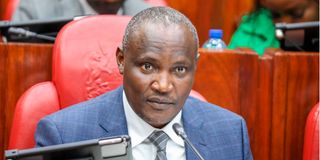
National Treasury and Economic Planning Cabinet Secretary John Mbadi.
Photo credit: File | Nation Media Group
At the time, Mbadi argued that introducing numerous supplementary budgets disrupts the implementation of development projects as he challenged the National Treasury “to dedicate its energies to serious planning.”
However, today, CS Mbadi finds himself at the receiving end of that exact same lecture, called out by Dr Nyakang’o for weaponising Article 223 to fund predictable government expenses through the back door and diluting the integrity of the budget.
Mbadi was appointed National Treasury CS on August 8, 2024, and by the time the 2024/25 financial year was ending, he had already processed three supplementary budgets for the year.
The 2025/26 financial year ended with two supplementary budgets worth Sh373.9 billion cumulatively having been processed under his watch.
Within three months of the start of the current financial year — 2026/27 — there is already one supplementary budget in the offing.
Despite the strict constitutional provisions and his own storied legacy as an MP championing fiscal discipline, CS Mbadi has turned a blind eye, facilitating government ministries, departments and agencies (MDAs) in violating the Constitution.
With the support of CS Mbadi, the biggest winners in the questionable additional funding under Article 223 of the Constitution during the 2025/26 period include the National Treasury that he heads.
Cabinet Secretary for the National Treasury and Economic Planning John Mbadi displays his briefcase before reading the 2026/27 budget at Parliament Buildings, Nairobi, on Thursday, June 11, 2026.
Photo credit: DENNIS ONSONGO | NATION
The National Treasury was allocated Sh86.29 billion to facilitate the issuance of an International Sovereign Bond (ISB) for liability management operations in the 2025/26 financial year, a foreseeable allocation that ought to have been considered during the normal budget-making process.
The National Treasury was also allocated Sh58.13 billion to facilitate the settlement of a buyback and accrued interest for an International Foreign Bond (IFB).
It also received Sh2.2 billion to cater for the implementation of the consolidated Financial Action Task Force plan by the implementation agencies and Sh2.05 billion to acquire disaster recovery sites at Konza Technopolis and upgrade Kenya Revenue Authority (KRA) ICT core systems.
The National Treasury also received Sh1.9 billion to cater for donor funds — International Development Association (IDA) — under the affordable housing finance project.
Others that received additional funding that was foreseen include the Teachers Service Commission (TSC), Sh7 billion, to facilitate payments to the Social Health Authority (SHA), and the National Intelligence Service (NIS), Sh4.5 billion, “to cater for enhanced security operations.”
There is also the State Department for Immigration and Citizen Services, which received Sh3.5 billion “to facilitate the ongoing joint national and civil mobile registration outreach programme towards efficient registration for national identity cards and birth certificates.”
The State Department for Higher Education and Research received Sh4.03 billion during the period under review for universities’ 2017-2021 Collective Bargaining Agreement (CBA) arrears.
The National Police Service (NPS) received Sh2.6 billion “for security-related and operational expenditures under the Presidential Escort Unit and GSU-Recce and G-Company,” as well as for a shortfall in police and Kenya Prisons Service (KPS) insurance.
The State Department for MSMEs received Sh3.6 billion in IDA funding for the National Youth Opportunities Towards Advancement (NYOTA) project.
The State Department for Early Learning and Basic Education received Sh4.76 billion “to facilitate ongoing national assessment and examination administration”, while the State Department for Social Protection and Senior Citizens Affairs received Sh3.71 billion to cater for full-year payment of the Social Health Insurance Fund.
The State Department for Culture, Heritage and Arts was allocated an additional Sh269 million to facilitate the planning and hosting of the Kenya Music and Piny Luo cultural festival, as well as the planning and hosting of the Kapkugo cultural festival.
To reduce over-reliance on Article 223 of the Constitution for foreseen expenses, Dr Nyakang’o wants the adoption of planning, budget practices and sound expenditure management by prioritising all essential services and aligning them with operational realities during the budget formulation and implementation cycle.
The Controller of Budget Margaret Nyakang'o.
Photo credit: Dennis Onsongo | Nation Media Group
The CoB is also recommending a review of the legislative framework governing the criteria for funding under Article 223 of the Constitution, “as well as the control mechanisms to ensure fiscal integrity and safeguard budget credibility.”
During the period under review, the government undertook liability management operations involving the buyback/partial redemption of existing International Sovereign Bonds (ISBs), financed in part by new longer-term International Sovereign Bonds funded under Article 223 of the Constitution.
The ISB buybacks, Dr Nyakang’o noted, “should be evaluated during the budget-planning stage to minimise reliance on Article 223 of the Constitution and enhance budget credibility.”
The CoB report also established that Article 223 of the Constitution was used to finance contractual obligations related to Kenya’s hosting of major continental sporting events, “despite those obligations being known and foreseeable during budget preparation.”
For instance, the State Department for Sports requested Sh3.9 billion to settle the contractual obligation for the Africa Cup of Nations (AFCON) 2027 hosting rights, which was due on March 30, 2026.
Although the expenditure had been included in the draft budget estimates submitted for the 2025/26 financial year, “it was omitted from the approved budget and subsequently financed through Article 223.”
A similar situation occurred in the 2024/25 financial year, when Sh1.68 billion was authorised under Article 223 to meet Kenya’s mandatory hosting fee for the African Nations Championship (CHAN), “despite the obligation being foreseeable.”
With foreseeable government expenditure on the rise, the CoB wants the National Treasury and accounting officers in government to strengthen budget forecasting, commitment planning and scrutiny of expenditure proposals.
This, she says, is to ensure that “all known contractual obligations are adequately provided for in the annual budget.”