The government has moved to unlock Kenya’s vast but largely invisible minerals economy by ratifying hundreds of artisanal mining groups, in a policy shift aimed at capturing lost revenues and tightening oversight in a sector long dominated by informal trade.
The Ministry of Mining, Blue Economy and Maritime Affairs said that at least 246 artisanal mining cooperative societies have now been registered countrywide in a bid to bring artisanal and small-scale miners into the formal economy.
The reforms follow a policy turn by the administration of President William Ruto , which decriminalised artisanal mining, opting to regulate and integrate it into the national development framework.
“We decided to formalise this subsector because they are the ones doing the actual mining,” said David Onyancha, Secretary for Administration in the ministry, in an interview. “It is largely traditional, mostly alluvial, and rarely goes beyond 30 metres.”
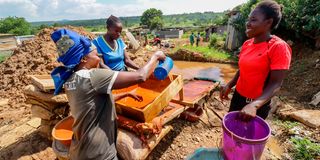
Gold mining in Migori, Kenya.
For decades, artisanal miners —many operating in gold-rich regions such as Migori, Kakamega, and other parts of Western Kenya—have existed outside the formal system, selling their output through informal channels with little traceability or benefit to the State.
Officials estimate that a significant portion of mineral output has been going unrecorded, effectively creating a parallel economy. In gold mining areas like Nyatike in Migori, for instance, miners often sell directly to itinerant buyers, locking the value chain outside formal markets.
“The mama in Nyatike will get gold, sell it to a buyer, get her food, and that ends there,” Mr Onyancha said, illustrating how earnings circulate at the subsistence level without feeding into broader economic systems.
The formation of cooperative societies is designed to change that dynamic. By organising miners into legally recognised entities, the government is linking them to licensing systems, structured markets and financial services, while also making it easier to enforce safety and environmental standards.
The initiative has been implemented through a “whole-of-government” approach involving the State Department for Cooperatives and county administrations, with Mining ministry officials undertaking nationwide sensitisation and capacity-building campaigns.
At the county level, Artisanal Mining Committees, chaired by governors and supported by national government officials, have been established to oversee licensing and coordination. So far, 40 committees have been approved in 40 counties so far.
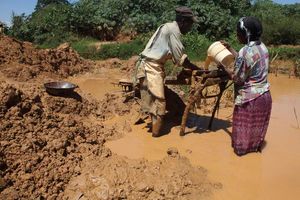
Artisanal miners prospect for gold in Rosterman in Kakamega County.
Photo credit: Tom Otieno | Nation Media Group
The impact of formalisation, the ministry officials say, is becoming visible in some mining zones.
In Migori, where gold processing is widespread, more than 200 leaching plants that previously operated outside regulatory frameworks have since registered.
“Many of them did not even know where the government comes in,” Mr Onyancha said. “Now they have willingly registered and are paying royalties, contributing to national development.”
The shift from informal trade is backed by enforcement mechanisms. The ministry, working with the Interior docket, has established a dedicated mining police unit, supported by intelligence officers seconded from the Directorate of Criminal Investigations.
Rather than relying solely on crackdowns, however, officials say the strategy prioritises awareness and gradual compliance. Illegal mining is being framed as an economic offence, with authorities encouraging operators to regularise their activities instead of facing punitive action.
“Most of the time we educate them,” Mr Onyancha said. “Once they understand the law and the benefits of formalisation, many are now coming forward on their own.”
He says the objective of formalisation is to stem revenue leakages, improve data on mineral output and position Kenya to better exploit its resource potential, not just in gold but also in gemstones, industrial minerals and rare earth deposits.