The first batch of contractors under the affordable housing programme (AHP) will pocket Sh85.6 billion in profits, a report commissioned by the government shows.
These profits relate to 215 AHP projects involving the construction of 198,947 houses across the country and valued at Sh285.5 billion.
This translates to a profit margin of 30 per cent, meaning that for every Sh100 Housing Levy deduction from Kenyan workers, Sh30 is ending up in the pockets of contractors implementing the initiative.
Globally, different institutions and governments recommend a profit margin of between two per cent and 15 per cent in taxpayer-funded projects. In the UK, for instance, the Global Institute of Building recommends between five per cent and 15 per cent profit margin for government contracts.
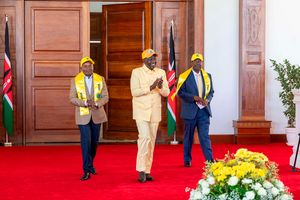
President William Ruto addresses graduate interns recruited under the Affordable Housing Programme during an engagement at State House, Nairobi, on January 23, 2026.
Photo credit: Wilfred Nyangaresi | Nation Media Group
The General Services Administration, an independent procurement agency funded by taxpayers in the US, places profit margins for government contractors at between two per cent and 12 per cent, depending on the nature of the contract.
The Architectural Association of Kenya (AAK), the body representing professionals across Kenya’s built environment, says profits for developers in Kenya’s housing industry are usually below 20 per cent.
“Developer margins vary widely depending on the project type, location, and target market. Key cost components include materials (approximately 60 per cent of construction cost), labour (around 20 per cent of construction cost), and additional costs such as consultancy fees, statutory approvals, and financing,” AAK president George Arabbu says.
This is because of highly speculative land prices that have made land acquisition a costly venture, high cost of construction materials and labour costs, says Mr Arabbu.
Developers under the AHP have the advantage of avoiding the land acquisition costs since they are implementing the projects on public lands, and previous disclosures have revealed cases where some developers have used public land titles to get bank loans.
The AHP developers have also gotten tax incentives such as a lowering of the corporate tax they pay by half to 15 per cent of profits for companies building at least 100 houses a year, a lowering of the Railway Development Levy from two per cent to 1.5 per cent, and a lowering of the Import Declaration Fee (IDF) from 3.5 to two per cent.
All these measures were expected to lower the cost of the projects under AHP and translate into lower prices for Kenyans buying the houses, most of whom are supposed to be from the low-income segment.
Still, developers in the AHP will make 30 per cent net profit from the programme.
The Grant Thornton report is based on an impact assessment of the AHP, undertaken by audit firm Grant Thornton, under a contract by the Affordable Housing Board and is dated March 19, 2026.
“The impact assessment exercise was carried out over two months across 215 AHP projects with 198,947 housing units in nine classified regions including: Eastern, Coast, Central, North Eastern, South Rift, North Rift, Western, Nyanza, Western Rift, and Metropolitan,” Grant Thornton said.
The audit firm provided a list of 84 projects covered during the impact assessment survey, cutting across more than 20 counties.
It also defined AHP as comprising affordable and social housing projects, institutional housing projects, rural housing, associated social and physical infrastructure, and affordable markets.
Detailing the financial impact of the AHP, the report listed Sh285.5 billion projects being implemented, whose main cost component is construction cost and materials, taking Sh157 billion of the project's cost.
An analysis of materials used in the construction of some 160,000 houses shows that at least 18.7 million (50kg) bags of cement, 1.19 million tonnes of sand, 2.99 million tonnes of ballast, 350.9 million kilos of steel, 171.37 million pieces of stone and 27.1 litres of paint have been used.
This is expected to hit 117 million bags of cement, 7.45 million tonnes of sand, 18.7 million tonnes of ballast, 2.19 billion kilos of steel, 1 billion pieces of stones and 169.4 million litres of paint by the time it gets to a million houses.
“Concrete was the key and primary construction material that was widely used on sites, comprising of cement, sand and ballast mixed in predetermined ratios and its consumption was proportionate in cubic metres,” the report stated.
At least 82 per cent of the materials are being sourced locally, a reality the report notes has caused “significant impact on the manufacturing industry.”
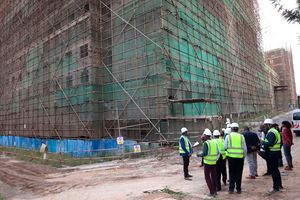
President William Ruto commissions the 60-unit Mabera Affordable Housing Project, Kuria West Constituency, Migori County on March 23, 2026.
Photo credit: PCS
Net margins (profits) for contractors engaged in the AHP projects follow construction/material costs consuming Sh85.66 billion, about 30 per cent of what taxpayers pay for under the programme.
Remaining costs under the analysed projects are Sh27 billion to cater for salaries (professionals and casual labourers), and some Sh15.7 billion costs listed just as “other costs (overheads)”.
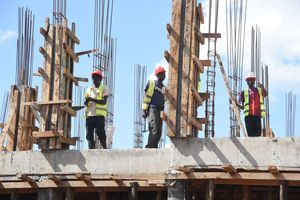
The report shows that construction/contractor companies employed 22,060 workers across the analysed regions.
Housing Principal Secretary Charles Hinga did not respond to queries on the number of contractors engaged in the AHP so far, the procurement model that the ministry used to award contracts, or the sustainability of the programme.
On Wednesday, communications officials from the ministry said they would reach out to the PS and revert, but had not done so by the time of going to press.
Grant Thornton, the audit firm that undertook the survey on behalf of the government, revealed the figures in an assessment of the impact AHP projects have had on government revenues.
It showed that Kenya Revenue Authority (KRA) will earn Sh46.9 billion in taxes from the analysed projects, which is just above half (54.8 per cent) of the profits contractors will make.
The taxes include Sh25.7 billion in corporate income tax (CIT), Sh14.4 billion in value added tax (VAT), Sh6 billion pay as you earn (PAYE) tax and Sh813.8 million Housing Levy.
Of the Sh46.9 billion projected taxes from the reviewed projects, KRA has already collected Sh24.89 billion (53 per cent).
“The surge in construction activities for the AHP has stimulated ancillary industries, increasing tax collection from VAT on construction materials, PAYE from construction workers, and income tax from suppliers,” the report says.
It adds that the programme has had a positive impact on tax revenue collection, serving as a new, high-performing revenue stream for the KRA.
Of Contractors and Sub-Contractors
Under the programme, the government awarded tenders to the main contractors who subsequently awarded sub-contractor jobs to “specialized business entities that offered various services and products on site.”
The sub-contractors are supplying 36 distinct construction-related services in the AHP sites, from materials supply, fabrication, installation, engineering solutions, mechanical services, and concrete production.
About a quarter of sub-contractors in the analysed data supplied fabrication and steel works, with an equal ratio (24 per cent) supplying concrete and cement products on site, the report states.
More than two-thirds of the sub-contractors started work in 2024, and 30 per cent of them last year, most of their contracts running for up to two years.
“A large number of subcontractors (65 per cent) were awarded tenders to complete their works within a period of 19-24 months while 28 per cent of the subcontractors signed to complete their projects within 13-18 months,” the report stated.
It notes that only two per cent of the sub-contractors are expected to take longer than two years on their work.
Only formal businesses can get into a contract with contractors working on AHP, the report notes. It, however, adds that informal businesses such as food vendors, small retailers and boda bodas benefit indirectly.
Auditor-General Nancy Gathungu has raised several queries concerning the implementation of the AHP, majorly faulting the slow implementation of the programme and questionable ownership of some of the land being used to construct units.
In an audit for the year ending June 2025, the public auditor raised concerns over a lack of land ownership documents in more than three-quarters of the 317 parcels where AHP projects are being implemented.
Ms Gathungu reviewed projects valued Sh53.87 billion that were being implemented by end of June last year, including the construction of affordable houses and other related infrastructural development across the country.
Auditor-General Nancy Gathungu.
Photo credit: Wachira Mwangi | Nation Media Group
“It is noted that the value of land has not been declared as the Fund has not procured any land but construct houses based on vested lands by either the national government entities and county governments,” Ms Gathungu said.
Of the 317 land parcels the public auditor reviewed, 269 lacked land documentation, 23 had a certificate of search, nine had letters of allotment, and only 14 had title deeds.
“A number of projects were implemented on community land or land held under customary arrangements, and this may precipitate challenge on how the sectional title deeds will be processed without the original land ownership documents,” she said.
In 2024, it was revealed that a private developer for one of the AHP projects in Nairobi had used a title deed for public land where houses were being constructed in Jeevanjee Estate to get a Sh1.9 billion loan from the National Bank of Kenya, raising concerns over the security of the public documents where the projects are being implemented and revealing that some of the developers are not using their money.
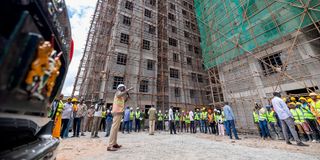
A view of the Eldoret Railway City Affordable Housing Project under construction in Eldoret City, Uasin Gishu County on April 20, 2026.
Photo credit: Jared Nyataya | Nation Media Group
The process of obtaining the loan was initiated in December 2022, just after the current AHP had started and the loan was processed in May 2023 after the Nairobi City County selected Jabavu Village Limited to undertake renewal and development of the Bachelors Jeevanjee Estate.
The Grant Thornton survey notes that government spending on housing increased from Sh86.5 billion in the 2024/25 fiscal year to Sh95 billion in the current year, contributing to a growing contribution by the housing sector to the construction industry.
The report has recommended that the government engage citizens and local communities through different stages of implementing AHP projects, delivering projects with amenities like schools, hospitals and waste management, and regularising the process to address issues such as titles and approvals.
“There is need to revise the designs of different housing units – for instance, rooms for market topologies are very small. There should mechanisms to consider rental houses for those not willing to rent-to-own the houses,” the report also recommends.
“Let the rooms be spacious enough. The current rooms are very tiny. #Designers should come to the ground before they design the AH,” it adds.