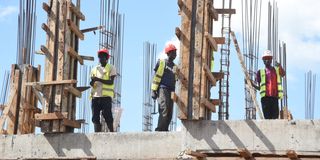
President William Ruto and his officers have overplayed the impact of the affordable housing programme (AHP) on the creation of jobs, fresh official data has revealed.
The data on employment in Kenya’s construction sector debunks jobs figures thrown around by the president and top State officials, raising questions over the AHP’s actual impact on employment.
Photo credit: Nation Media Group
The total number of Kenyans working in the construction sector – cutting across housing and roads – stood at 728,400 last year, according to the Economic Survey 2026. This included 490,100 persons working informally and 228,300 persons employed formally by construction companies and the government.
New jobs created across the sector last year alone were 35,800, marking a 5.2 per cent increase from the 692,600 workers in 2024, said the Kenya National Bureau of Statistics (KNBS).
“Growth in the sector was supported by sustained public and private investment in residential housing, commercial developments and infrastructure projects,” KNBS said, citing AHP as one of the key areas.
Since starting the programme in September 2022, President Ruto has pitched it as the key driver towards his promise of delivering a million jobs every year.
“The programme has created over 428,000 jobs, including architects, engineers, fundis, plumbers, electricians, carpenters, masons, steelworkers, transporters and thousands of MSMEs. At peak next year, it will employ up to one million Kenyans,” President Ruto told MPs during the State of the Nation address in November last year.
President William Ruto (centre) inspects the progress of affordable housing project at Kilimani Police Station in Dagoretti North, Nairobi, on July 9, 2025.
Photo credit: PCS
At the time, he said 230,000 affordable homes and 276 modern markets were being constructed under the programme, as he termed it a “national empowerment engine creating jobs”.
The Budget Policy Statement released by the National Treasury in February stated that 214,057 housing units had been under construction through the AHP between 2022 and 2025.
In July and August last year, the president indicated that 320,000 jobs had been created under the AHP, with some 161,000 housing units under construction by July 2025.
During the Madaraka Day celebrations earlier in June, he said, “We are firmly on course to delivering 150,000 housing units under the AHP, which have been under construction since September 2022, with 11,000 units already completed. Beyond providing dignified shelter, this transformative programme is driving job creation, having already generated over 250,000 jobs”.
The Makasembo Housing Project on May 29, 2025, marking a milestone in Kisumu’s affordable housing journey.
Photo credit: Alex Odhiambo | Nation
Affordable Housing Board Chairman Jeremiah Simu, in an annual report, said 330,000 jobs had been created through the programme directly and indirectly by end of June 2025.
A survey commissioned by the State Department for Housing to assess the AHP’s impact has gone a notch higher with the numbers.
“As per January 2026, the overall jobs created (direct and indirect) by the AHP stand at 640,442. The direct employment by the AHP was a total of 464,759,” the survey by audit firm Grant Thornton states.
More than three-quarters of the direct jobs under AHP, the survey says, have been created under affordable housing itself (379,194 jobs), with projects under institutional housing employing 52,740 and persons employed for construction of markets being 32,825.
Some 175,683 jobs, the survey says, have been created indirectly and are in Jua Kali and other small and medium-sized enterprises (SME) players (two-thirds), with professionals such as construction contractors and suppliers getting a third.
Data for the survey was collected across 215 projects under which 198,947 houses are being constructed, and 3,000 households were interviewed across nine regions in the country.
“The regional distribution of direct employees varied significantly in relation to the number of projects in each region, with the metropolitan region having the highest number. The Metropolitan Region, comprising Nairobi, Kiambu, Kajiado, Murang’a and Machakos, recorded the highest number of employees at 184,342,” states the survey report released by Housing Principal Secretary Charles Hinga.
Housing Principal Secretary Charles Hinga.
Photo credit: Dennis Onsongo | Nation Media Group
While figures from one side of the government say that jobs directly created under the AHP over the past three years are close to half a million, an analysis of the KNBS figures, which provides the official statistics for the country, shows a different picture.
Since the start of 2023, new jobs created under Kenya’s construction sector – which includes other areas such as roads – stand at 77,000, according to KNBS.
A review of previous Economic Survey reports shows that construction jobs in the formal and informal sectors have moved from 651,400 in 2022 to 728,400 by the end of last year.
Sharp spikes in new construction jobs were seen in 2023 (41,900 new jobs) and last year (35,800 new jobs), both of which fall nowhere close to the kind of impact painted by the president and his Housing PS.
In the Economic Survey 2026, KNBS was clear that a 6.8 per cent growth of the construction sector last year was largely supported by construction and maintenance of roads, as well as construction of residential buildings.
The survey also showed that 138,474 housing units with an estimated construction cost of Sh385.8 billion were under construction last year.
Housing PS Charles Hinga maintains that the AHP has created more than 600,000 jobs, despite the contradicting figures in the latest Economic Survey.
He adds that the State Department for Housing based its numbers on a conservative calculation of only one job being created by each unit under construction, hence the actual figure of jobs created could be higher.
"In terms of employment, the program has created over 640,000 direct and indirect jobs since 2022. These jobs cut across the full housing value chain—on-site labor, built environment professionals, manufacturing, logistics, and MSME supply networks," Mr Hinga said.
"It is worth noting that to consistently create 120,000 jobs annually, the construction sector needs to be able to produce 60,000 housing units every year. This is a modest number which can be easily fulfilled by the sector. Beyond the aggregate numbers, the AHP is deliberately structured to maximize inclusive employment. Nearly half of all workers are youth, between 21 percent and 30 percent are women, and a significant share of labor is drawn from the Jua Kali sector, supported through ringfenced contracts and Recognition of Prior Learning certification," the Housing PS added.