Kenya will spend Sh2.31 trillion on debt repayments in the financial year starting July 1, the National Assembly’s Public Debt and Privatisation Committee has said.
It said that of the amount, Sh1.25 trillion (54 per cent) will be spent on interest payments while Sh1.06 trillion will go towards repayment of the principal debt.
The National Treasury has tabled a Sh4.78 trillion budget for financial year 2026/27, meaning that debt repayments will consume nearly half of the proposed budget.
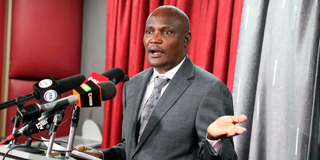
National Treasury and Economic Planning Cabinet Secretary John Mbadi.
Photo credit: File | Nation Media Group
In a report on the consideration of the expenditures of the Consolidated Fund Services (CFS) under the 2026/27 budget, the committee said public debt service accounts for 90 per cent of CFS.
The committee chaired by Balambala MP Abdi Shurie said pensions expenditure worth Sh241.94 billion constitutes 9 per cent of the CFS while salaries and other statutory expenditures amounting to Sh5.15 billion accounts for 1 per cent.
He added that overall CFS expenditure for financial year 2026/27 is projected at Sh2.56 trillion, reflecting a marginal decline of Sh21.6 billion from Sh2.58 trillion under Supplementary Budget I of 2025/26.
“The projected decline in 2026/27 is largely attributed to a Sh28.6 billion reduction in public debt service expenditure, partially offset by a Sh7 billion increase in pension related expenditures,” Mr Shurie said.
“Over the medium term, the CFS expenditure is expected to increase to Sh3 trillion by financial year 2029/30 and will have tripled from Sh1.1 trillion recorded in financial year 2020/21,” he added.
Mr Shurie said the upward trajectory is primarily driven by rising interest obligation and refinancing pressure associated with domestic debt, periodic maturities of sovereign bonds, and increasing pension expenditures.
Given that CFS constitute a direct charge to the Consolidated Fund, he said their sustained growth is likely to further constrain the fiscal space over the medium term.
“This underscores the need to strengthen cash management practices, proactive debt restructuring measures and broader liability management operations aimed at reducing the debt service obligations and creating lasting fiscal space to spur economic growth,” the MP said.
According to the committee, the projected debt service obligations comprise of domestic debt service amounting to Sh1.64 trillion or 71 per cent and external debt service of Sh680.38 billion or 29 per cent.
“Interest payments account for the larger share at 54 per cent, reflecting the continued cost of carrying public debt,” the committee report states.
“At about six percent of the Gross Domestic Product (GDP), interest payments exceed development expenditure, which is estimated at 3.6 per cent of GDP, indicating that debt service costs remain a major component of public spending and continue to shape the fiscal space available for development priorities,” it adds.
The committee said public debt stock, which amounted to Sh12.84 trillion as at February, is projected to reach Sh14.12 trillion by June 2027, equivalent to a Net Present Value of public debt to GDP ratio of 65 per cent.
“This remains above the statutory debt anchor of 55 per cent, with a 5 per cent margin, leaving only one year to meet the October 2028 target,” he said. “If the target is not met, it may weaken the credibility of the fiscal rules framework and the legislative measures intended to support prudent fiscal management.”
To contain the growth of debt expenditure, the committee has recommended that the National Treasury should implement a fiscal consolidation framework on a medium-term basis, ensuring it is aligned to Section 16 of the Public Finance Management Act and aiming at progressively reducing the fiscal deficit and stabilising public debt within the statutory debt anchor.
“In order to strengthen compliance with the statutory debt anchor, the National Treasury should within 30 days of adoption of this report, submit to the National Assembly a clear debt reduction path indicating annual targets, policy measures, and timelines for achieving 55 per cent debt-to-GDP threshold in Net Present Value terms,” the committee said.
“In order to ensure that additional borrowing generates measurable economic impact, the National Treasury should, as from July 1, 2026, strengthen resource mobilisation procedures by subjecting all loans to adequate project appraisal, economic valuation and assent of economic rates of return before contracting,” it added.
To safeguard value for money in liability management operations, the committee wants the Treasury to ensure that all such operations are supported by cost benefit analysis, disclosure of terms and conditions, and assessment of their impact on debt sustainability.
The committee has also recommended that the use of the loans should be clearly disclosed, including the portion used for debt repayment, the portion applied towards budget financing, and the projects financed.
The committee further wants the Treasury to rationalise non-recurrent expenditure and progressively increase allocations to growth-enhancing development expenditure from 3.6 per cent of GDP to 10 per cent over the medium term.