The government will reduce rice imports by 50 percent to protect local farmers amid pricing concerns, given that local production does not meet market demand.
Agriculture and Food Authority (AFA) Director-General Bruno Linyiru, issued the directive to cut down rice imports to protect the livelihoods of over 8,500 rice farmers from Kirinyaga and neighbouring counties.
“Going forward, AFA, in collaboration with the Ministry of Agriculture and other key stakeholders, is spearheading initiatives to reduce rice imports by 50 percent,” said Dr Linyiru.
Locally produced rice costs about Sh160 a kilogramme, with the imported ones, largely from Pakistan and India, costing Sh80 a kilogramme net of importation and haulage costs.
The move to cut down on the importation of the commodity that is slowly becoming a staple food in a majority of Kenya’s urban and rural homesteads followed a rice sector consultative meeting at the Mwea Rice Growers Multipurpose Cooperative Society offices, Kirinyaga, on May 29, 2025.
The meeting was attended by the director of Food Crops Directorate, Mr Calistus Kundu, Kenya National Trading Corporation (KNTC) Managing Director Lucy Anangwe, cooperative chairman, Mr Ndege Muriuki, and Dr Linyiru.
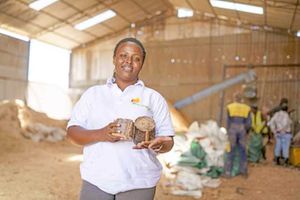
Lonah Anyango Okumu at her rice farm in Nyando Sub-county, on October 03, 2024. She has been a rice farmer for the last 40 years.
Photo credit: Alex Odhiambo | Nation Media Group
The AFA boss noted that the farmers’ calls to halt rice importation to allow for the sale of existing local stock forced the government to act.
“The Ministry of Agriculture recognises the importance of supporting local production first,” the AFA boss said even as he acknowledged the “strategic need for some imports due to the national rice deficit.”
Dr Linyiru revealed that despite a monthly requirement of about 100,000 metric tonnes during the 2024/25 season, Kenya produced 191,000 metric tonnes of milled rice, which is well below the national requirement.
“This can only last for two months because the monthly requirement is 100,000 metric tonnes,” said Dr Linyiru. “The shortfall necessitates importation to support local production.”
He noted that KNTC will mop up over 5,000 metric tonnes of the locally grown rice worth about Sh500 million.
The Mwea irrigation scheme, Kirinyaga County, is Kenya’s leading rice producer.
The scheme, located about 100 kilometres north of Nairobi, and which is home to about 7,000 farmers, produces an estimated 113,000 metric tonnes of rice annually, accounting for a significant portion of the country’s local produce.
Currently, traders import about one million 25-kilogramme bags of rice a month, but this still doesn’t meet the market needs as demand continues to soar, given the dwindling supply of maize flour that is slowly losing out as the country’s staple food commodity.
To enhance the local production of rice, Dr Linyiru revealed that the government is keen on the expansion of irrigation schemes, increasing the area under production, and introducing high-yield rice varieties.
He also noted that the cooperative will receive full payment within one month after delivery, a significant improvement on previous delays that hampered farmers' operations and cash flow.
This, he says, will empower more farmers to produce and enhance food security.