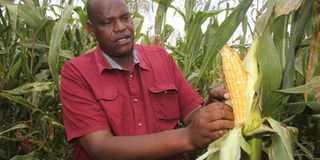
Erratic rainfall, prolonged droughts and rising temperatures brought about by climate change are tightening the squeeze on Kenya’s livestock sector, with animal feed manufacturers now pushing for the cultivation of yellow maize to reduce the country’s dependence on imported feed ingredients and lower production costs.
Industry players say climate shocks have reduced yields of key feed crops while increasing competition between humans and livestock for white maize, Kenya’s staple food.
The result has been persistent shortages of raw materials, rising feed prices and expensive animal products, including milk, eggs and meat.
The Animal Feed Manufacturers Association of Kenya (AKEFEMA) is now urging the government, researchers and farmers to promote the production of yellow maize exclusively for animal feeds while reserving white maize for human consumption.
“Raw materials account for between 70 and 80 per cent of the cost of manufacturing animal feeds. Kenya is still a net importer of many feed ingredients, yet we have the potential to produce most of them locally,” said AKEFEMA Chairperson Joseph Karuri in an interview with the media.
Last week, the association hosted the Africa Feed Exhibition & Conference (AFEC) 2026 in Nairobi, bringing together more than 200 companies and institutions from 27 countries across six continents.
The event, which aims to identify practical solutions for reducing the cost of livestock feed while revitalising the animal feed industry through innovation, investment and technology, has brought together industry leaders, investors, researchers, policymakers and technology providers to explore solutions that will shape the future of Africa’s feed and livestock sector.
Mr Karuri said maize remains the single largest energy source in livestock feeds, but because Kenya does not produce enough maize for human consumption, livestock producers compete directly with households for the same grain.
“We want to work with policymakers and researchers to promote yellow maize specifically for animal feed. That way, we reduce competition with white maize while creating a sustainable supply chain for livestock production,” he stated.
The association is also calling for expanded cultivation of sunflower, soybean, cotton and canola, whose oil cakes are vital protein sources in feed manufacturing. Currently, nearly 80 per cent of these protein ingredients are imported from neighbouring countries including Tanzania, Uganda, Malawi and Zambia.
According to AKEFEMA, Kenya currently consumes about seven million 90-kilogramme bags of maize annually for animal feed production, equivalent to about 630,000 tonnes. Although the country’s installed feed manufacturing capacity stands at about four million metric tonnes annually, actual production is only about 2.5 million metric tonnes because of inadequate raw materials, leaving a significant production gap.
Climate change is worsening the situation by reducing agricultural productivity and exposing farmers to unpredictable weather patterns that affect both crop and livestock production.
With shrinking harvests, feed manufacturers say the country must invest in climate-resilient crops and technologies that improve productivity.
Karuri said improving feed quality and livestock nutrition will be central to discussions during the Africa Feed and Feed Ingredients Conference (AFEC) 2026, where industry leaders are seeking practical solutions to strengthen Africa’s livestock sector.
He noted that despite Kenya producing about five billion litres of milk annually—the highest in Africa, the average dairy cow yields only seven to eight litres of milk daily, compared to nearly 10,000 litres annually per cow in countries such as the Netherlands.
“The difference is not necessarily the animals but how they are fed. Better nutrition will increase productivity, raise farmers’ incomes, improve food security and strengthen the economy.”
To improve feed quality, the association is championing adoption of Near Infrared (NIR) technology, which enables manufacturers to analyse raw materials and feed formulations in real time without using chemicals.
The technology allows millers to determine the nutritional composition of feed ingredients within five to 10 minutes, enabling nutritionists to formulate precise rations while lowering production costs and improving animal performance.
“For many years, we have lacked adequate analytical facilities. With technologies such as NIR, we can formulate feeds much more accurately, improve efficiency and reduce wastage,” AKEFEMA’s Vice Chairperson Dr David Murumba said.
The technology has since been introduced in Kenya. About 10 per cent of the association’s members have so far adopted the technology, but plans are underway to expand its use across government laboratories, private laboratories and commercial feed mills.
Dr Murumba said Africa, despite having the world’s largest livestock population, faces a growing challenge of producing enough quality feed because more than half of the continent consists of arid and semi-arid lands (ASAL).
At the same time, Africa’s population is expanding rapidly, creating rising demand for milk, eggs and meat. “We need to embrace new technologies in both feed production and livestock farming. Land sizes are becoming smaller, but the population continues to grow. Biotechnology and climate-resilient crop varieties will help us produce more raw-materials for animal feed while also increasing food production,” he explained.
Quality assurance remains another priority for the industry. Mr Karuri, the association’s chair, said all AKEFEMA members are required to comply with a strict code of practice, possess the Kenya Bureau of Standards (Kebs) standardisation mark and undergo regular training on feed safety and quality.
About 70 per cent of Kenya’s two million metric tonnes of commercially manufactured animal feed is produced by AKEFEMA members.
AKEFEMA Secretary General Dr Wilfred Kamau said unlocking the industry’s potential will require substantial investment in modern machinery, skilled personnel and affordable financing.
He noted that many feed millers, particularly small-scale manufacturers, struggle to access capital needed to purchase quality raw materials and modern equipment.
“Investment is not only about money for machinery. We also need to invest in people by building the technical skills required to run modern feed mills,” he said.
According to Dr Kamau, upgrading manufacturing equipment and adopting modern technologies will lower production costs and ultimately reduce the price of eggs, milk and pork for Kenyan consumers.