The morning sun has barely risen over the fertile plains of Taveta, but instead of the familiar sounds of tractors, irrigation pumps and farmers heading to their fields, the dominant noise is that of revving motorcycle engines.
Outside shopping centres in Kimorigo, Chala, Njukini and other villages in Taveta Sub-county, rows of boda boda riders wait patiently for passengers. Most of them are young men whose parents spent decades cultivating bananas, onions, tomatoes, maize and rice on the rich volcanic soils that once made Taita-Taveta one of Kenya's food baskets.
Banana Traders at the Taveta Border Market in Taita Taveta County in this photo taken on July 19, 2026. Taveta is one of the biggest Banana Producers in the Country.
Photo credit: Kevin Odit | Nation
Today, many of those farms lie idle as the aged retire from farming. Prolonged droughts, erratic rainfall, blocked irrigation canals, rising production costs, inadequate farming inputs and unreliable markets have steadily pushed young people away from agriculture in search of quicker and more dependable incomes.
"I grew up watching my parents harvest enough farm produce to feed the family and sell the surplus. Back then, farming paid school fees and built homes. Today we cannot rely on it. I bought a motorcycle because at least I know I can make some money every day," said 28-year-old Peter Mwakio from Chala.
Mwakio's story reflects the changing fortunes of several Coast counties that host mega irrigation schemes that have remained underutilised for many years.
Barely two decades ago, Taita Taveta supplied foodstuffs to Mombasa, Nairobi and neighbouring Tanzania. In the early 2000s, the county's irrigation schemes were reliable throughout the year, supporting thousands of households.
Today, that picture has changed dramatically. Across Taveta, abandoned farms, drying canals and shrinking rivers tell the story of a region battling the harsh realities of climate change and poorly maintained irrigation systems.
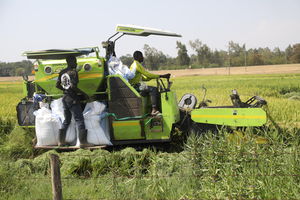
One of the irrigation machines stationed within the maize plantation covering thousands of acres at the Galana-Kulalu Food Security Project in Tana River and Kilifi counties on July 6, 2026.
Photo credit: Kevin Odit | Nation Media Group
Rivers that previously supplied irrigation water throughout the year now experience prolonged periods of low flow, while canals that distribute water to farms remain clogged with silt, weeds and debris.
The combined effect has been declining harvests, forcing many families to buy food they once produced in abundance.
Taita-Taveta County Executive Committee Member for Agriculture Dawson Mzenge admits the county has gradually lost its agricultural dominance, but all is not lost with plans to revive different irrigation schemes.
According to Mr Mzenge, the county lacks sufficient resources to undertake routine desiltation of irrigation canals.
"Without regular desiltation, water cannot reach farms efficiently. At the same time, many young people are abandoning agriculture because they see quicker returns in boda boda transport," he says.
To reverse the trend, the county has started introducing agriculture in schools to inspire children to view farming as a viable career rather than an occupation of last resort. Agricultural experts warn that if the exodus continues, the county risks losing an entire generation of farmers.
One crop that illustrates both the potential and the frustrations facing farmers is rice. Taveta remains one of Kenya's leading rice-growing regions, with more than 1,115 hectares under cultivation in Madarasani, Buruma, Majengo, Kimorigo, Patani Hill and Eldoro.
One of the irrigation machines stationed within the maize plantation covering thousands of acres at the Galana-Kulalu Food Security Project in Tana River and Kilifi counties, in this photo taken on July 6, 2026.
Photo credit: Kevin Odit | Nation
Farmers harvest two rice crops every year, producing an average of 35 bags weighing 90 kilogrammes per acre. Despite the encouraging yields, many farmers struggle to make meaningful profits.
Without modern milling facilities, they have for years been forced to sell paddy rice to brokers from Tanzania, Mwea and Kisumu for as little as Sh40 per kilogramme.
Ms Hanna Mwashighadi, a farmer, says middlemen have dominated the rice value chain for years, leaving producers with the smallest share of the profits.
"Tanzania traders process, grade and package our rice across the border before bringing it back to Kenya at premium prices. They control the market while local farmers remain trapped in a cycle of losses and exploitation," said Ms Mwashighadi.
Until recently, farmers depended on an ageing diesel-powered milling machine at Kimorigo donated by the Japanese Government through JICA in 2016 which can process only three tonnes of rice a day and lacks grading, polishing and packaging facilities required for premium markets.
Hope now rests on a new Sh45 million rice milling plant nearing completion in Taveta. The modern facility will process three tonnes every hour, enabling farmers to mill, grade, polish and package rice locally while reducing post-harvest losses and creating employment.
"Our objective is to ensure farmers earn more from their produce through value addition instead of selling raw paddy to brokers. This investment will create jobs and strengthen the local economy," said Mr Mzenge.
However, stakeholders insist that modern processing alone will not revive agriculture unless irrigation systems are restored.
The Njoro Kubwa Canal, which supplies water to more than ten irrigation schemes in Mboghoni Ward, has not been desilted for nearly two years despite the county purchasing an excavator specifically for that purpose.
Heavy silt deposits and overgrown vegetation have drastically reduced water flow, leaving hundreds of farmers struggling to irrigate their crops. The issue recently reached the County Assembly after Mboghoni MCA Khalifa Taraya demanded an explanation over the delay in rehabilitating the 13-kilometre canal.
He warned that continued neglect threatens food production, household incomes and employment in one of the county's most productive agricultural zones.
The Assembly has since directed its Committee on Water and Irrigation to inspect the canal and present a report, amid fears that further delays could disrupt the current planting season.
Farmers say inadequate access to quality seeds, fertiliser, irrigation equipment and affordable credit has compounded the challenges.
The closure of the Horticultural Produce Company buying centre years ago further weakened the sector by leaving growers without reliable buyers for their highly perishable produce. Today, many depend on brokers who dictate prices, leaving farmers with little incentive to invest in production.
Other mega projects in the Coast region that have carried the hopes of millions of Kenyans are the Bura Irrigation Scheme and the neighbouring Hola Irrigation Scheme in Tana River County, and the Mwache Multipurpose Dam in Kwale.
In the arid plains of Tana River County, the Bura and Hola Irrigation Schemes were envisioned as giant agricultural engines capable of transforming thousands of hectares into productive farmland and ending food shortages.
In Kwale County, the Mwache Multipurpose Dam was designed to supply clean water to Coast counties while at the same time opening thousands of acres to irrigation.
Together, the projects represent billions of shillings in public investment and form part of Kenya’s long-running ambition to reduce dependence on rain-fed agriculture.
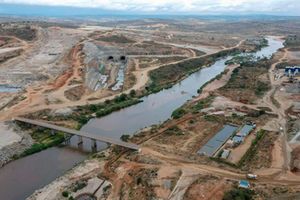
The dam is for the Galana-Kulalu farms in Tana River and Kilifi counties, in this photo taken on July 6, 2026.
Photo credit: Kevin Odit | Nation
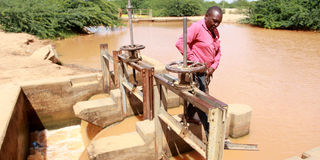
At the irrigation schemes in Tana River County, some of the equipment meant to supply water to farms is visibly rusty. Farmers in Bura and Hola raised similar complaints to those in Taveta.
“The biggest challenge we have is that water flow from the canals is unreliable. As you can see, some farms are bushy because the owners gave up,” Ms Jane Wanjiku, a vegetable farmer in Bura, says, pointing at neighbouring farms with overgrown weeds.
Bura Irrigation Scheme was established in 1978 as a World Bank-backed irrigation project. It was expected to become one of Africa’s largest food production zones.
Spread across a gazetted area of 176,000 hectares, the scheme was intended to support large-scale cultivation of maize, rice, sugarcane and other crops through mechanised farming.
Nearly five decades later, only about 12,000 acres have irrigation infrastructure, representing approximately 6.8 per cent of the gazetted area. Out of that, between 6,000 and 12,000 acres are actively under production depending on seasonal conditions.
Successive governments have repeatedly promised to revive the scheme, often presenting rehabilitation plans as key pillars of food security and regional economic transformation. The latest rehabilitation programme, which seeks to convert the scheme from costly diesel-powered pumping to a gravity-fed irrigation system, has consumed more than Sh7 billion over the past decade.
According to the Auditor-General, the total approved budget for the rehabilitation project stands at Sh7.57 billion over a ten-year implementation period. Funding has come from a combination of Government allocations and loans from the Arab Bank for Economic Development in Africa (BADEA), the Kuwait Fund and OPEC financing facilities.
However, the 2024/2025 audit reports questioned whether the pace of implementation matches the level of expenditure.
Solar Panels installed at the Galana- Kulalu Farm, which is managed by Nyumba AGRI, a private company operating in Tana River and Kilifi counties, in this photo taken on July 6, 2026.
Photo credit: Kevin Odit | Nation
However, the National Irrigation Authority says it has completed a 26-kilometre gravity canal worth Sh3.4 billion, that now delivers approximately 11 cubic metres of water per second, up from the previous 3.5 cubic metres under the pump-fed system.
Water is now abstracted from Kora Kora and conveyed about 76 kilometres to farms through gravity, reducing diesel consumption by an estimated Sh10 million every month. Principal Secretary for Irrigation Ephantus Kimotho says the gravity system marks a turning point.
"The Bura gravity project aims to shift from expensive pumped irrigation to gravity-fed systems to improve sustainability and unlock the full potential of the scheme," he said during a recent inspection.
A public-private partnership in sugarcane production has seen a private investor establish 700 acres of seed cane trials involving eight sugar varieties aimed at identifying the most suitable varieties for the region. The Government believes such partnerships could eventually transform Bura into a thriving agricultural and industrial hub.
In Kwale, hopes for the Sh20 billion Mwache project to contribute to the country’s food basket were dimmed after the World Bank scrapped the irrigation component of the Upper Check Dam (UCD) last year, citing unsustainable operational costs.
The UCD was originally designed with a reservoir capacity of 690,000 cubic metres dedicated to large-scale irrigation. However, after technical assessments and budget reviews, the World Bank determined that the high pumping and energy costs associated with delivering water to farms rendered the function economically unviable.
The cancellation shifted focus to small-scale, decentralised irrigation solutions targeting over 2,000 local farmers, out of whom 80 per cent are women. The farmers will be equipped with knowledge on sustainable practices, crop diversification, and market access.
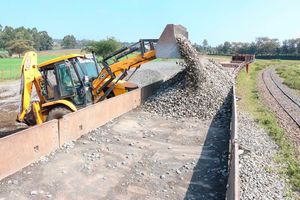
Construction workers at Mwache Multipurpose Dam Project in Samburu, Kwale County on May 30, 2025.
Photo credit: File | Nation Media Group
However, Auditor-General Nancy Gathungu flagged Mwache among delayed state projects that have exposed taxpayers to additional costs and interest penalties due to delayed payments.
The main construction contract has reportedly increased by about 60 per cent, rising from an initial Sh13.8 billion to approximately Sh22 billion because of inflation and price adjustments.
The challenge for policymakers is not only completing the projects but ensuring they deliver measurable returns for taxpayers.