With over 75 per cent of Africa’s soils degraded, a crisis driven largely by synthetic fertilisers, a quiet transformation is taking root in Nyahururu. Here, AgriFlora
Organic Solutions, a family-run enterprise, is pioneering a shift away from chemical-based farming by producing 100 per cent organic fertilisers to restore soil health.
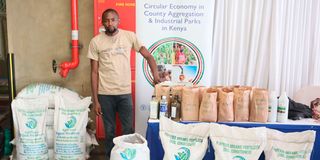
A sample of AgriFlora organic fertiliser.
Photo credit: Bonface Bogita I Nation Media Group
Leading this change is 34-year-old Paul Mburu, the company's lead agronomist. AgriFlora was inspired by the vision of his father, James Kuria, who first began crushing and selling animal manure from their backyard. “He used to crush manure and sell it to farmers, and I saw we could take it a step further,” Mburu recalls.
After earning a degree in Agricultural Economics and Resource Management at Moi University, Mburu joined forces with his engineer brother, Albert Kamau. Together, they formalised the operation, designing machinery, introducing lab-based quality control, and scaling it into a registered business. Today, AgriFlora produces up to five tonnes of organic fertiliser daily, employing five permanent staff and up to 20 casual workers, depending on production cycles.
The company’s commitment to sustainability is foundational. Their fertilisers are crafted from locally sourced waste: sheep manure from Samburu, cow dung, bones, eggshells, molasses, and even fruit syrup residues. “We take what others throw away and turn it into something that enriches the soil. We're not just recycling; we're regenerating,” Mburu explains.
This model also empowers local communities, particularly women in Samburu County, who are trained to compost using effective microorganisms. Instead of burning waste—a practice that contributes to air pollution—they now process it into valuable raw material, earning Sh30,000 for five tonnes. “This is far higher than what brokers used to offer,” Mburu notes.
AgriFlora produces two main products: granulated organic fertiliser for planting, and liquid foliar fertiliser for top dressing.
“The granulated version is rich in essential nutrients—nitrogen (10 per cent), phosphorus (36 per cent), and potassium (10 per cent)—along with micronutrients like zinc and manganese. The liquid foliar variant is sprayed on crops like maize or potatoes, tailored for the plant type and growth stage,” explains Mburu.
The company doesn’t just mix ingredients and send them to market. All products undergo lab testing using their NBQ3 quality control machine from China. “We test for nutrient levels, ensure we don’t exceed regulatory thresholds, and make sure all inputs are safe and beneficial,” Mburu says.
The company also offers soil testing, a service rare among regional organic producers. Dr Alex Njugi, an agroecologist, emphasises the importance of this practice. “Without proper testing, farmers tend to apply fertilisers uniformly, leading to overuse in some areas and underuse in others. This wastes inputs and leads to inconsistent yields and long-term degradation,” he says.
Dr Njugi explains the hidden costs of synthetic fertilisers, noting that while they have historically boosted crop yields, their excessive and imbalanced application is degrading soil quality and harming ecosystems.
“When ammonium-based fertilisers are applied in large amounts, they undergo microbial transformation that releases hydrogen ions, reducing soil pH. Acidic soils reduce the availability of essential nutrients like phosphorus and calcium, while increasing the toxicity of elements like aluminum and manganese. This stunts plant growth and damages root systems.”
Dr Njugi also warns of microbial imbalance. “Heavy use of synthetic fertilisers—especially without organic matter—encourages fast-growing microbes but suppresses beneficial ones such as mycorrhizal fungi and nitrogen-fixing bacteria. This reduces soil biodiversity, weakening its natural resilience.”
Dr Njugi adds that the benefits of organic alternatives go beyond soil. “They significantly reduce greenhouse gas emissions. Synthetic nitrogen fertilisers contribute to nitrous oxide—a gas 300 times more potent than carbon dioxide. Organic options, by contrast, support carbon sequestration and improve water retention.”
Recognising these challenges, Mburu notes that AgriFlora provides a practical solution. “Our model not only addresses soil degradation and emissions but also sources raw materials in ways that prevent methane from landfills and reduce deforestation by offering alternatives to charcoal.”
Despite its promise, the company faces an uphill battle, primarily centered on farmer mindset and policy. “Convincing farmers to move away from DAP and synthetic fertilisers is tough,” Mburu admits. “Many believe organic inputs are weaker or slower. But it’s about long-term sustainability, not short-term gains.”
He also points to a stark irony in government policy: “Government subsidies for synthetic fertilisers continue, distorting the market and discouraging organic alternatives.
Meanwhile, the same farmers who use these inputs find their produce rejected in European export markets due to chemical residue. They give us chemicals to grow food, but they won’t import what we grow. We eat what they won’t eat.”
Safety is another critical concern. Mburu laments that most agro-dealers are untrained, and farmers often use toxic inputs without protective gear or knowledge of safety intervals, leading to rising health issues. This unregulated exposure has been linked to rising cases of cancer, diabetes, and respiratory illnesses, even in children.
For real change to happen, Mburu believes the country’s opinion leaders must champion organic farming. “People listen to them. If they start using and promoting organic fertiliser, change will follow,” he asserts.
Looking ahead, Mburu is focused on scaling up, training more farmers, and advocating for policy reform. His mission is clear: “We’re not just making fertiliser. We’re restoring soil. We’re cleaning the environment. We’re saving lives.”