Growing gold under the canopy: Nyandarua farmers earn millions while greening forests
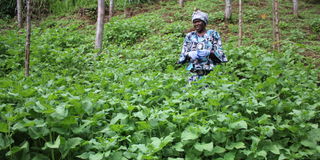
Julia Nyambura, a farmer from Nyandarua, harvests stinging nettle at Kirima Ngai Forest on September 25, 2025.

What you need to know:
- At Kirima-Ngai Forest area in Kasuku, Ol Joro Orok constituency, sections of restored woodland now flourish with stinging nettle, amaranth, African nightshade, and salageti (African spider plant), all thriving under the protective tree canopy.
In Nyandarua County, a quiet revolution is taking root beneath the forest canopy. Communities engaged in reforestation are pioneering an innovative approach that addresses two critical challenges simultaneously: environmental degradation and malnutrition.
The solution? Intercropping trees with traditional dark green leafy vegetables rich in protein, calcium, fibre, and iron, transforming forest conservation into a profitable, health-boosting enterprise.
At Kirima-Ngai Forest area in Kasuku, Ol Joro Orok constituency, sections of restored woodland now flourish with stinging nettle, amaranth, African nightshade, and salageti (African spider plant), all thriving under the protective tree canopy.
What began as a reforestation project has evolved into a thriving agribusiness. Motivated by substantial earnings and significant health benefits, farmers have enthusiastically adopted these wild vegetables, planting them on individual farms for sale, domestic consumption, and processing.
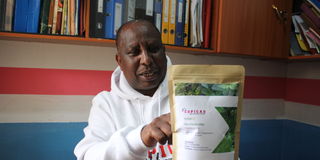
Thomas Macharia displays packets of processed dark green leafy vegetables from Kirima-Ngai Forest.
The initiative has grown so successful that a local processing factory now dries and packages the vegetables year-round, ensuring supply even during scarcity.
From forest forager to profitable farmer
Peninnah Nyakio's journey illustrates the transformation. After learning new farming techniques during reafforestation efforts, she planted a quarter-acre with salageti and another with amaranth.
"My salageti matured for harvest last month. I earned Sh20,000 from the sales. The amaranth was damaged by hailstorms, but I still got Sh8,000 from that crop," Peninnah recounts.
Learning from that setback, she has now dedicated two acres of family land to the venture, using an ingenious protective strategy.
"I discovered that hailstorms don't severely damage vegetables grown in forests. I'm now planting trees on my two-acre plot to intercrop with the vegetables. The trees protect the crops from hailstorms and serve as a long-term investment, so there's no wastage of land," she explains.
For Maina Hinga, value addition has transformed vegetables into premium products. He grows and processes the vegetables for sale, commanding Sh1,000 per kilogramme for dried produce.
"I learned the farming and processing skills from the Community Organisation for Positive Impact, Care and Development (COPICAD). I specialise in stinging nettles, selling a gramme for Sh1 after processing. Beyond what we grow as a group within the forests, I have planted half an acre of stinging nettle on my own farm," Maina says.
During our visit to his farm, Njoki Kabura, a buyer from Nairobi, was purchasing vegetables in bulk for repackaging and resale.
"I've bought 20 kilos today. Stinging nettle is in high demand in urban areas, but customers worry about sourcing and processing standards. I must get supplies from reliable sources—that's why I come directly to the farms to see how it's grown and processed," Njoki explains.
Healing through nutrition
The health benefits extend beyond market statistics. Mary Wanjira shares a personal testimony that highlights the nutritional power of vegetables.
"My husband suffered from severe joint pain and anaemia. Doctors advised me to feed him dark green leafy vegetables. I would collect them from the forests, where they were plentiful during the rainy season. His health improved dramatically within three months. He's now a healthy man. Growing them in forests and processing them has made these nutritious leaves readily available year-round.”
Thomas Macharia, COPICAD Chief Executive Officer, explains how the concept emerged from observing farmer behaviour during tree-planting initiatives aimed at restoring forests and the Aberdare water catchment areas.
"We noticed that after tree planting, farmers would forage in the forest for these vegetables. They were plentiful during rainy seasons, but during droughts, farmers complained about scarcity. We commissioned research on wild vegetable farming viability, nutritional value, and storage," Thomas recounts.
The research revealed a shocking reality: in Nyandarua, 18 per cent of children suffered from stunted growth due to malnutrition despite these nutrient-rich vegetables being readily available during rainy seasons.
"That's how we incorporated dark green leafy vegetables into the reafforestation programme," he adds.
The initiative has received significant support from GAIN-Kenya and CARE-International through the CASCADE programme, which provided training for both organisational staff and community members on the nutritional value of vegetables and proper storage techniques.
As a result, COPICAD employed additional agronomists and nutritionists, who received specialised training at Nyandarua National Polytechnic.
Now, in partnership with CASCADE's nutritional advocacy, COPICAD is contracting farmers to meet the factory's processing capacity.
"Incorporating dark green leafy vegetables in reforestation has motivated more farmers to plant trees on their farms, intercropping trees with vegetables that thrive in partially shaded environments. We've brought ECDE teachers, Sunday school teachers, clergy, and the Nyandarua County government on board to encourage this farming model and tree planting," Thomas says.
The organisation has also expanded to process carrots, addressing market volatility during peak seasons and subsequent scarcity.
"Through reafforestation, the community has gained alternative income sources while we simultaneously address malnutrition," Thomas notes.
Esther Karimi, a nutritionist working with the programme, emphasises the organic nature of these forest-grown vegetables.
"Traditionally, forest land is very fertile and doesn't require fertilisers or manure. These vegetables have grown in forests for decades, just as wild fruits do, without any special care. That's the beauty of nature, it gives you clean, healthy food, chemical-free," she explains.
COPICAD has trained farmers in optimal harvesting and drying processes to preserve the nutritional value of their crops. The process involves cleaning the vegetables, soaking them in hot water for about three minutes, then transferring them to cold water with salt—a step that deactivates enzymes that cause food to rot.
"The vegetables should be dried in a solar dryer. For small-scale farmers without solar dryers, they should dry them in shaded areas to prevent nutrient loss," the nutritionist advises.