17.24 million trees: Village elders mobilised for Mazingira Day restoration drive
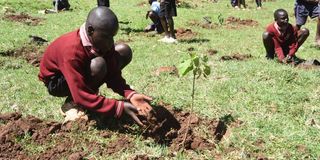
Pupils of Kapsumbeiywet Primary School in Uasin Gishu County plant tree seedlings on October 10, 2025 during the Mazingira Day celebrations.

What you need to know:
- The village-level target will see village elders mobilise communities to plant 100 trees in each of the 77,252 villages spread across 30 counties.
Kenya is targeting to plant 17.24 million trees, with 7.7 million to be planted across 77,252 villages.
The planting will be part of activities to mark this year's Mazingira Day on October 10, when communities across the country will take part in tree growing and environmental restoration.
Government Spokesperson Charles Owino said the arrangement is intended to take tree growing beyond the national event and into communities, where elders can also monitor what happens to the seedlings after planting.


"The village elders are very effective because they are at the village level," Owino said. "They can tell us how many trees have grown, how many have died and where we need gapping or replacement."
The village-level target will see village elders mobilise communities to plant 100 trees in each of the 77,252 villages spread across 30 counties.
Cabinet Secretary for Environment, Climate Change and Forestry Deborah Barasa explained that the emphasis on tree survival comes at a time when the country is grappling with drought, floods, soil erosion, land degradation and pollution.
"Our input is planting trees, but let us remember that our outcome is really survival," the CS said. "So now we are not just focusing on tree planting but looking at their growth and their survival."
According to CS Barasa, Kenya has so far grown about 2.2 billion trees under the current restoration campaign.
"Another 300 million trees regenerated naturally last year. Measures such as fencing helped protect areas where natural regeneration is taking place."
The government is also said to be using aerial seeding to reach areas that are difficult to access.
However, the planting campaign comes as Kenya prepares for another period of heightened climate risks, including the possibility of heavy rainfall associated with El Niño conditions.
Owino said the Kenya Meteorological Service Authority is monitoring sea surface temperatures in the Pacific and Indian Oceans because of their influence on the intensity of El Nino.
"We are also working with the counties because we have already mapped areas that are prone to heavy rainfall, floods and landslides."
The preparedness efforts are said to involve many sectors, including environment, agriculture, health, roads, power, urban systems and disaster management agencies.
This year's Mazingira Day will be preceded by a week-long programme involving tree-growing and clean-up activities in basic, private and higher education institutions.
In addition, there will be restoration of mine sites in Kakamega, Siaya, Migori, Busia and Kisii counties, highway greening and drainage clean-ups, as well as a nationwide clean-up exercise across all 47 counties.
"The Friday clean-up will also focus on drainage and rivers, areas that frequently become flashpoints during heavy rainfall," Owino said.
The week is expected to produce 17.24 million seedlings through seven different planting streams.
The largest single component will come through the Presidential Green Challenge, which targets 5.1 million trees at 79 sites across 31 counties.
"51,115 community members have been mobilised for the exercise," Owino said.
Kenya Seed Company is expected to provide 80 hectares, while another 140 hectares identified as Kimothon will also be used for planting.
"The Kenya Forest Service and community forest associations will oversee pitting and planting across 4,951 hectares in 31 counties," he explained.
Across 77,252 villages in 30 counties, elders will lead the planting of 100 trees each, giving a combined target of about 7.7 million trees.
"The village programme will also be linked to community environmental dialogue barazas," Owino said.
According to the Ministry of Environment, village elders will be trained on environmental restoration, pollution prevention and preparedness for climate-related risks.
"We have 108,000 village elders and we have prepared booklets to capacitate them," she explained, "so that they can know what restoration is all about, how to do clean-ups, how to avoid pollution and how to prepare for El Nino.
Owino said that the elders can also help identify communities living in areas exposed to floods and landslides.
"They know their villages. They know who is living along the rivers, they know the areas that are prone to landslides, and they can advise communities and even help in moving people to safer areas."
The government is also assigning specific planting targets to public institutions.
The Kenya Prisons Service will plant one million trees across 68 correctional facilities, while the National Youth Service is expected to plant 1.5 million trees after pass-outs.
TVET institutions have a target of one million trees, basic education institutions 640,000 and higher education institutions 400,000.
The military will also mobilise units to plant trees around their areas of operation.
However, the restoration programme is being expanded because the environmental damage facing the country is not confined to forests.
Kenya's forests, wetlands, lakes and rivers are under pressure from climate variability, drought, floods, soil erosion and land degradation.
"We cannot afford to have a fragmented approach if we want to have food security, health security, water security, disaster response and even national security," she said.
She said restoration must therefore extend across different landscapes.
"If we restore only the water towers and we forget the river and areas, then again there will be damage to that area," she emphasised. "If we restore the coastal region and we forget the dry lands, there will be damage to that area."
Farmers are also expected to play a role through agroforestry, which the ministry says can help reduce soil erosion while providing food and income.
The government estimates that the 17.24 million trees could be worth about Sh172.24 billion over 10 years, based on an estimated value of Sh10,000 per tree.
The ministry further says it is planning a national scorecard to track progress and show how many trees have been planted, how many are surviving, which ecosystems have been restored, what economic benefit is being gained and how the quality of life of Kenyans is changing.
"We are not only looking at how many trees have been planted," she explained. "We want to know how many trees are surviving, which ecosystems have been restored and what economic benefit we are getting from those trees."
The monitoring will involve focal points in counties and ministries, while satellite imagery will also be used to track changes on the ground.


