250 million children face triple climate threat as schools, vaccines, and water supplies collapse
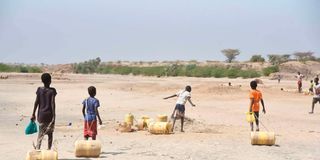
School-going children fetch water from a well dug in a seasonal riverbed, where the water table has receded deeper, at Kerio in Turkana Central Sub-County, Turkana County, on February 12, 2026.

What you need to know:
- A new Unicef report reveals that over 250 million children worldwide are now battling at least three overlapping climate hazards, from devastating droughts to lethal heatwaves.
Like most people, you have probably found yourself thinking or talking aloud about the extreme weather events that have defined our recent past. In fact, climate change has become part of everyday life. For some, its effects are felt through the cost and availability of food. Rising prices, poor harvests, and prolonged droughts are forcing households to adjust what they eat, cut back on portions, or do without certain foods altogether.
For others, it is parents waking their children in the middle of the night as floodwaters creep closer to their homes, or families searching for relief from intense heat.
Also read: When extreme weather forecast is right but the response falls short: Africa's climate warning gap


In some parts of the country, children have missed school because of floods and hunger, while others have had to endure learning under extremely high temperatures.
A new United Nations Children's Fund (Unicef) report, The Children’s Climate Risk Report 2026, observes that, globally, at least three overlapping climate hazards are now threatening the health, education, and survival of more than 250 million children worldwide.
"This compounding of threats overwhelms the capacity of unprepared social services and undermines the resilience of families and communities. For instance, intense droughts can devastate crops and worsen food insecurity. Dry vegetation left behind by a drought can fuel wildfires, which in turn exacerbate air pollution and leave the land vulnerable to flash floods later in the year. These effects can create a vicious cycle: destroyed homes can lead to displacement, which can result in a lack of shelter, depriving children of protection from additional impacts and making them even more susceptible to future hazards. Disrupted education can have lifelong consequences, making it harder for children to build a stable future and break free from the cycle of hardship," reads the report.
Children’s vulnerability
Data released by the World Health Organization in 2024 reveals that more than 130,000 children in Kenya missed the recommended routine vaccines.
While issues such as misinformation affect uptake, the report also points to climate shocks that are worsening existing vulnerabilities by disrupting vaccine cold chains, destroying clinics, and increasing the spread of diseases.
Droughts and floods are expected to disrupt food supply chains and drive malnutrition, which could lead to 40 million children being stunted globally by 2050.
“In 2024, 634 million children still lacked safely managed drinking water, 1 billion lacked safely managed sanitation, and 489 million lacked basic hygiene. Floods contaminate water sources and droughts dry them up, leaving children vulnerable to deadly diseases and increasing the burden of fetching water,” it said.
Despite being responsible for less than 0.1 per cent of global greenhouse gas emissions, Kenya faces an escalating climate crisis marked by severe, alternating cycles of drought and flooding. This volatile climate has placed roughly 12 million children at risk nationwide. The danger is most acute in the arid and semi-arid areas, where recurrent disasters continuously threaten the survival and well-being of the youngest generation.
The report found that the climate crisis is systematically robbing children of their futures by attacking the very foundations of their safety, from education to physical protection, and economic stability. In 2024 alone, extreme weather such as severe storms and heatwaves disrupted the schooling of at least 242 million students across 85 countries. Beyond the classroom, climate-driven disasters are fueling severe child protection risks such as child labor, early marriage, and family separation, and have already caused 62.1 million internal child displacements between 2016 and 2023. As these cascading shocks wipe out livelihoods, families without access to robust social safety nets are forced into desperate coping mechanisms, accelerating a downward spiral that threatens to push over 130 million people into extreme poverty by 2030.
Unicef’s Executive Director, Catherine Russell, said: “This analysis can help governments and decision-makers plan better and invest more effectively in resilient services.
When we strengthen health and education systems and improve infrastructure with children in mind, we protect them from today’s climate threats and help secure their future.”