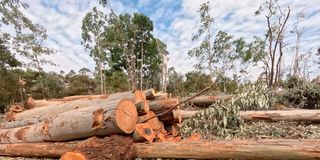
A proposed amendment to Kenya’s forest law has sparked fierce opposition from environmental activists and civil society groups, who warn that the changes could open the door for roads, utilities and commercial developments inside protected public forests.
The proposed amendment to Section 56 (2) of the Forest Conservation and Management Act, 2016, seeks to grant the Kenya Forest Service powers to approve easements for public roads, infrastructure projects and utility wayleaves within public forests. It further introduces provisions allowing “easement for public roads and other public installations” as well as “wayleaves for public utilities.”
The Green Belt Movement has condemned the proposal as “a dangerous legal pathway” that could normalise infrastructure expansion and commercial encroachment into forests through administrative approvals disguised as public development.
“Kenyans must not be deceived by the language of public utility and public installations,” the organisation said. “This amendment is not innocent. It is a dangerous legal pathway being created to open up our public forests to roads, infrastructure, utilities, commercial interests and eventual destruction.”
The organisation warned that forests are already under pressure from what it describes as a systematic pattern of encroachment.
“This is not a coincidence; it is a pattern where first comes a road, then utilities, then temporary access, then commercial developments,” GBM said. “Slowly, public forests disappear piece by piece until nothing remains.”
The debate has revived memories of recent legal battles over some of Kenya’s most sensitive ecosystems.
An excavator inside Karura Forest.
Photo credit: Courtesy| Friends of Karura Forest
In 2024, environmental groups and residents successfully challenged attempts to excise more than 51 hectares of Karura Forest for the expansion of Kiambu Road.
“In Karura Forest, there was an attempt to excise 51.64 hectares for the expansion of Kiambu Road,” GBM said.
The project triggered public outrage, court action and findings of procedural irregularities and lack of public participation.
“It took public outrage, legal action and the intervention of the courts to stop the destruction,” the organisation added.
GBM further noted that Karura remains under pressure from proposals for security installations and barracks inside the forest.
“Today, Karura remains under pressure from attempts to introduce security installations and barracks inside the forest,” it said.
In the Aberdare Forest, conservationists are opposing a proposed 25-kilometre road cutting through a key water catchment ecosystem. At Ngong Road Forest, environmental groups have also opposed the construction of a luxury hotel inside the forest and plans to excise about 10 hectares for a road linking Bomas of Kenya and the planned Talanta Stadium.
“Our forests are not for sale. Our forests are not corridors for destruction. Our forests must live,” GBM emphasised.
In an interview with Nation, Job Mwangi linked the proposed amendment to growing financial pressure on the Kenya Forest Service following a directive by President William Ruto in October 2024 requiring the agency to become financially self-sustaining.
“During the President’s address to KFS, he told them they cannot continue relying on the exchequer for survival,” Mr Mwangi said. “Since then, they have been trying to come up with different ways to generate income.”
He said this has influenced how public forests are managed, including changes in Karura Forest, where recreational revenue streams were redirected through the e-Citizen platform.
“They are trying all ways possible to survive and generate their own income,” he said.
Mr Mwangi explained that Section 56 already allows KFS to issue temporary authorisations such as permits, timber licences and special user licences.
“All these authorisations are temporary and we are okay with them,” he said. “But what we are opposing is the attempt to give authority to issue easements for roads and public installations inside forests.”
Mwangi further revealed that GBM appeared before the Senate committee on lands, environment and natural resources last Thursday, May 7, 2026, to present its submissions.
He said Environment Cabinet Secretary Deborah Barasa referred questions from Senator Faki Mohamed to the legal consultant who drafted the amendment.
According to Mwangi, the consultant defended the proposal as necessary.
“The legal consultant told the committee that the amendment was necessary,” he said.
However, GBM said the explanation was not convincing.
“From our perspective, the explanations that were given were not satisfactory,” Mwangi said.
Defending the amendment, George Tarus from the State Department of Forestry told Nation that the proposal is meant to introduce stronger safeguards on forest use and ensure prioritisation of public interest.
“The reason for the proposal is to provide more guardrails on forest access and usage,” Tarus said. “Currently, people are able to access public forests for uses that are even private in nature.”
He said the amendment would restrict forest use to public-oriented needs such as water infrastructure, electricity lines and transport corridors.
“It will limit the options so that utilisation in public forests is strictly for public needs,” he said.
Tarus explained that individuals can currently apply to access forests through the Kenya Forest Service, even for non-forestry uses.
“You can apply and go through a process where even private persons can utilise the forest for uses outside its core purpose,” he said.
“That clause is meant to address previous mismanagement that allowed non-public uses in forests,” he said.
The footpath near the Mau Mau caves leads up the Karura River to the waterfalls. Karura Forest, Nairobi.
Photo credit: File | Nation Media Group
Tarus insisted that environmental safeguards remain in place, including mandatory Environmental Impact Assessments.
“Before any public investment in a forest, an Environmental Impact Assessment must be undertaken,” he said.
He added that the amendment must be read alongside broader regulations on sustainable forest management.
“We are also developing regulations such as Participation in Sustainable Forest Management, which will act as a guide on access and thresholds,” he said.
“That fear is not founded on facts,” he said. “We are also on a journey to increase forest cover, not reduce it.”
“We also have to look at environmental trends and the wider context of development,” he said, citing transport demand and infrastructure expansion.
Tarus said stakeholders had been widely consulted, including conservation groups, private sector actors and community organisations.
“We have involved the entire republic,” he said. “This is a public process, not a private one.”’
Tarus said the amendment process included public participation across 10 regions, alongside engagement with stakeholders from the government, private sector and conservation groups.
“Even before coming up with the amendment, we involved public participation last year around March in the 10 regions,” he said.
He added that the process also involved a wide range of actors, including conservation organisations, private sector bodies, community forest associations, and industry groups.
“We invited comments, stakeholders came and they provided input,” he said. “Even Parliament and the Senate are going through the same process.”
However, Mwangi argued that the amendment risks undermining constitutional protections.
He cited Article 62 (1)(g), which classifies government forests as public land, and Article 62 (2), which places management of public land under the National Land Commission.
“Through this amendment, the government is trying to take away the constitutional mandate of the National Land Commission,” he said. “That is an illegality.”
Akshay Vishwanath, the Executive Director of JustAct warned that the proposal reflects broader efforts to weaken environmental safeguards protecting public resources.
“For the last two decades, we have created laws and institutions meant to protect public resources such as forests and national parks,” he said. “But these protections are now becoming barriers for political and commercial interests.”
The Gate A entrance to Karura Forest along Limuru Road.
Photo credit: Wilfred Nyangaresi | Nation Media Group
He said environmental litigation has repeatedly blocked controversial projects in forests such as Karura, Ngong and the Aberdares.
“They are making these amendments to undermine those protections,” he said.
The debate comes as Kenya faces worsening climate shocks, including droughts, floods, rising temperatures and water insecurity.
Environmental groups warn that weakening forest protections could accelerate ecological degradation, as forests remain central to water security, biodiversity and climate regulation.
“When projects are proposed in forests, environmental advocates go to court to stop them,” he added. “Now there is an attempt to change the law so that cannot happen.”
“This is not just about trees,” GBM said. “If we remain silent today, tomorrow there may be no Karura, no Aberdares, no Ngong Road Forest and no public forests left to defend.