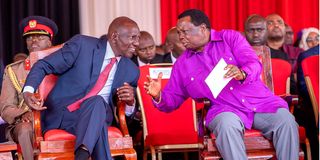
President William Ruto with Cotu Secretary General Francis Atwoli during Labour Day celebrations at Chavakali Boys High School in Vihiga County on May 01, 2026.
Yesterday, like so many before it, I took the day off, but this year something made me pause. In all the years I’ve celebrated Labour Day, I’ve rarely stopped to reflect on what it means today. And in a world transforming fast and furiously, that reflection feels urgent. The education systems that shape our workforce, the very nature of work itself, and the rights of workers are all being tested by a climate in crisis, global energy and nature transitions, and the rise of artificial intelligence. Labour Day is no longer just a moment to rest, but also to think about the future we’re building and the conditions in which we work.
What began as a movement for workers in the United States demanding an eight-hour workday in the late 1800s has become a globally recognised day. In Kenya, the struggle for workers’ rights was instrumental in sustaining momentum towards independence through the Kenya Federation of Labour and Tom Mboya in the absence of notable African political representation during the State of Emergency.
Nowadays it is easy to take for granted the movements and sacrifices needed to get us to this point and instead look forward to a day off. But when we look closer, we find that this commemoration has changed working life for the better.
Fight for workers’ rights
For generations, the fight for workers’ rights centred on a clear demand: fair wages, reasonable hours, and safe conditions. These battles are not over, but the frontlines have shifted. In just six years, a global pandemic rewrote how employers think about where work happens. Now the stakes are even higher. In Nairobi, floods in recent months have uprooted businesses and disrupted livelihoods. AI is redrawing the boundaries of skill and productivity almost overnight. The urgent transition to renewable energy is transforming entire industries. The world of work is changing before our eyes.
Consider agriculture, a key pillar of most African economies. Nearly one billion people, roughly 28 per cent of the global workforce, depend on the land for their livelihoods. But the land depends on stable weather and reliable water supply. As floods, droughts and hurricanes intensify, the losses are environmental and economic. The question is no longer just about better conditions; it is whether their work will exist at all. We need to think ahead and ensure a just transition where jobs may disappear. Climate change has become a labour issue. Food security and human dignity demand that we treat it as one.
This reality extends deep into our cities. Across Africa, industrial zones are often treeless, sun-baked and starved of green space. For workers in these areas, extreme heat is a daily threat to their health, productivity and lives. Access to cooler environments, cleaner air, and green spaces like Uhuru Park and Karura Forest are not a luxury but must now be seen as workers’ rights. Protecting workers’ rights should not only be about what happens inside the workplace, but also about the world we return to and the environmental systems sustaining dignified livelihoods.
Artificial intelligence is another force already reshaping work in real time. Entire job categories are disappearing while others are being transformed. Consider software engineering, which just a decade ago seemed to offer a sure pathway to prosperity. Today, junior developers are struggling to find footing in an industry being rapidly automated. And if even the tech sector is not immune, no sector is. In a world where corporations can choose efficiency over employment, we must ask what happens to the social contract that says if you work hard, study hard, and build your skills, opportunity will meet you. That contract cannot be allowed to collapse. We need bold protections, forward-thinking legislation, and a commitment to ensure technological progress lifts people up rather than leaving them behind. Every worker must be able to adapt, and no generation written off because machines moved faster than policy.
Highest labour standards
The transition to renewable energy carries one of the great moral tests of our time, and nowhere is that test more acute than in Africa. The continent is home to the critical minerals powering the clean energy revolution, including cobalt and coltan. Yet the workers extracting these minerals too often do so in dangerous, exploitative conditions. Mines collapse. Lives are lost. The irony is impossible to ignore: the human cost of “clean” energy is being paid disproportionately by African workers.
True clean energy must be clean for all in the chain. African countries must be empowered and expected to uphold the highest labour standards. But more than that, they must be ambitious. The time has come to move beyond exporting raw materials and begin exporting finished products, capturing value, building industries, and ensuring the green economy creates dignified work.
Work has changed since the first Labour Day was marked. Yet one thing remains unchanged: we must protect the dignity of the worker, recognise their humanity, and celebrate the dedication, resilience and hard work of all.
Ms Mathai is MD for Africa & Global Partnerships at the World Resources Institute and Chair of the Wangari Maathai Foundation.