This Wednesday is International Mother Earth Day, and what wouldn’t we do for our mothers. The theme “Our Power, Our Planet” resonates deeply with the electric energy those of us who witnessed the genius of Too Early For Birds Wangari Maathai Edition are still carrying.
We owe our environment, our landscapes, and all our natural systems our very best because they sustain us, shield us against the worst, and hold us the way only a mother can.
This year’s theme calls us to rise through collective action, civic engagement, and the boldness to shape environmental policy, accelerate climate action, and forge meaningful change in our own backyards, and across the globe.
When we think of the solutions to the worst impacts of climate change, we often think of the big policy changes that must be effected across the world to reverse its effect. We think of the waiting that must happen, the lobbying, the convincing and the amounts of money that must flow to countries which are most vulnerable.
While this is critical, we must recognise the everyday efforts of people and communities on the ground who are already taking action. Locally. Daily. These restoration champions who are leading this reversal of degraded landscapes to productive lands are doing so without waiting for someone to come to their rescue.
Next week on the April 21, Restore Local will announce a new cohort of investments. 53 local champions will employ more than 13,000 people to grow more than 6 million trees across 16,200 hectares of degraded land.
The restoration economy is growing! Restore Local is an initiative convened by the World Resources Institute to accelerate locally led land restoration across Africa.
The initiative focuses on three key landscapes: Kenya’s Greater Rift Valley, the Ghana Cocoa Belt, and the Lake Kivu and Rusizi River Basin spanning Burundi, Rwanda and the Democratic Republic of Congo.
Restore Local’s TerraFund partnership provides funding to these local communities and also equips them with the right tools, training and visibility they need to succeed.
In Africa, nearly 65 per cent of our farmland has been degraded by climate change, unsustainable farming practices, and deforestation, and this has threatened the livelihoods of the 60 per cent of Africans whose lives are rooted in the land.
Yet this is not a story of despair, because the opportunity before us is as vast as our continent’s spirit. Africa holds 750 million HA of restoration opportunities and reclaiming it means green jobs, renewed landscapes, and reclaimed futures. The story of restoration champions is the story of ordinary people doing extraordinary things to turn the tide.
Take the example of Jane Maigua and Charity Ndegwa, who co-founded Exotic EPZ, a company which purchases macadamia nuts from farmer families, processes them and sells them around the world. Now in partnership with thousands of farmers, it inspires an agroforestry tree growing movement that generates economic benefit while restoring landscapes. In the Kikuyu Escarpments, the Kijabe Environment Volunteers (KENVO), a community based organisation, engages in developing sustainable nature conservation programs through forest restoration, youth empowerment, promoting ecotourism, and research. Through their efforts Kereita Forest has protectors who ensure the forest remains intact. In Ghana, Tropenbos Ghana nurtures a movement that not only plants trees, but transforms communities and rebuilds the environment along the degraded Cocoa Belt. These examples reveal that restoration is not an abstract concept, but a lived reality.
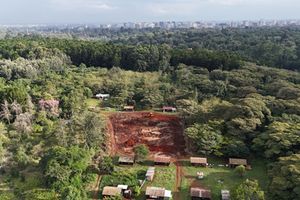
Kenya’s bold pledge to plant 15 billion trees is a vision worth celebrating, but its success lives or dies with local communities executing within a coherent plan. Which is why a proposal to clear 3 acres of Karura Forest for a tree nursery struck such a wrong note. The real power of the 15 billion tree campaign lies in local communities, forest authorities, and restoration champions working in concert, and doing so locally.
And as we restore, we must fiercely protect what we still have. Article 69 of our Constitution commits us to maintaining 10 per cent tree cover, which is a promise that must be defended, not quietly dismantled. When new forest bills offer easements for roads and utilities in public forests, they crack open the door to irreversible encroachment. One law must not be allowed to quietly undo another.
This is the central tension of climate action, balancing development with conservation. But it is a false choice. Restoration is an economic strategy with every dollar invested in degraded land returns up to USD 30 in economic value. Our restoration champions prove that flexible funding, paired with new technologies and deep local knowledge, can be converted into transformative, measurable impact.
As this new cohort marks the TerraFund partnership’s 250th investment since 2022, we are reminded that the future of restoration will not be determined solely by global commitments or national targets, but by the strength of local action. The announcement will come at an uplifting time, a day before the International Mother Earth day which reminds us to recover our ecosystems and shift to a more sustainable economy that works for both people and the planet. The task is clear: back restoration champions on the ground, protect what remains and build restoration movements that are as rooted as the soils we seek to heal.
Ms Mathai is MD for Africa & Global Partnerships at the World Resources Institute and Chair of the Wangari Maathai Foundation.