African leaders call for a climate-health project facility to turn plans into funded programmes
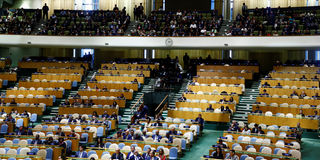
Delegates at the General Assembly hall during the 81st United Nations General Assembly (UNGA) at UN headquarters in New York City, US, September 24, 2026.

In New York
African health leaders used the sidelines of the 81st United Nations General Assembly this week to deliver a blunt message to the world's financiers: stop funding assessments and plans, start funding the programmes that keep clinics running when the climate turns violent.
The call came during "Building Africa's Climate Buffer: Financing Climate-Resilient Primary Health Care," an investment roundtable convened by Amref Health Africa and Seed Global Health on 23 September, bringing together African governments, Africa CDC, development finance institutions, climate funds and philanthropies.


“Climate change is a health crisis, not a side issue for environment ministries alone. Extreme heat, drought, flooding and shifting disease patterns are already straining health systems, yet health still receives only a sliver of global climate-adaptation finance; this was the message.
Dr Vanessa Kerry of Seed Global Health opened the discussion by naming the widening gap between the scale of the threat and the resources reaching health systems, stressing that the burden falls hardest on countries that did the least to cause the crisis.
"Capital must serve climate justice", she said.
Dr Githinji Gitahi of Amref Health Africa grounded Africa's position in climate justice. Most African countries carry very low per-capita emissions and should not shoulder the same mitigation burden as the world's biggest polluters, he argued.
His three priorities were direct: faster emissions cuts from high-emitting nations, room for African economies to grow through renewable energy, and immediate investment in adaptation for communities facing impacts they did not create.
He pointed to ongoing efforts to mobilise Green Climate Fund resources for Tanzania and Zambia, led jointly with those governments, and to a new Climate Research and Policy Lab at Amref International University meant to turn climate-health plans into evidence-backed, investable programmes.
Sierra Leone's Minister Demby described 380 health facilities fully solarised, with a national target of 2,000 by 2030. Eighteen major hospitals, including Connaught Hospital, now run on 1.2 megawatts of solar power. The country has deployed 140 ambulances and plans to double that fleet, with water and tricycle ambulances added next.
Zambia's Dr Simpungwe laid out a three-stage pipeline linking a Climate and Health Roadmap to a Vulnerability and Adaptation Assessment, and ultimately a National Health Adaptation Plan. Immediate priorities: climate-informed disease surveillance, resilient water and sanitation, and a workforce trained to anticipate climate-driven threats.
Kenya's Principal Secretary for the State Department for Public Health and Professional Standards Mary Muriuki named solar-powered primary facilities, integrated early-warning data systems, and investment in frontline health workers as priorities. But she flagged the real obstacle: short-term, fragmented project funding. "We need predictable and flexible financing that can reach all 47 county governments and support locally determined priorities," she said.
Delegates at the General Assembly hall during the 81st United Nations General Assembly (UNGA) at UN headquarters in New York City, US, September 24, 2026.
Ethiopia's Dr Masebo linked climate change directly to emerging disease risk, citing the country's first reported Marburg outbreak alongside intensifying El Niño exposure. With COP32 set for Addis Ababa in 2027, she said the summit "should be used to set an African climate-health agenda, not simply to host another global conference."
The missing link is bankability, not ambition.
Africa CDC's Dr Tajuddin presented a costed continental framework worth roughly $480 million, built with African Union member states, to support community-centred, climate-resilient, epidemic-ready primary health care increasingly backed by domestic resources. He pressed for tighter coordination so partners reinforce national priorities instead of duplicating them.
Dr Antwi-Boasiako Amoah, chair of the African Group of Negotiators on Climate Change, made the sharpest point of the day. Identifying risk is no longer the problem, he said. Most countries have completed vulnerability assessments and drafted National Adaptation Plans for health. "The missing link is the capacity to convert those priorities into costed, bankable and implementable programmes," he said.
He proposed a grant-based project-preparation facility to help health ministries build credible investment pipelines, alongside more concessional financing from multilateral climate funds and development banks.
Participants pointed to a structural barrier behind that gap: health ministries often lack the fluency to present their priorities in the language finance ministries and investors expect, leaving strong health cases stuck outside the room where financing decisions get made.
The Rockefeller Foundation pushed for instruments like first-loss capital, guarantees and blended finance structures that connect early-warning systems to pre-arranged funds, so countries can act before a threat becomes a full emergency.
The World Bank pointed to growing climate integration across its health portfolio, including co-financing and debt-for-health swaps. The Gates Foundation called for longer philanthropic time horizons and greater investment in health workers, surveillance and AI, particularly in fragile settings.
The Valerian Fund warned that gender-neutral planning hides the different risks women and girls face while urging philanthropies to align funding behind shared, country-led outcomes rather than parallel agendas.
Participants proposed a climate and health project-preparation and financing platform to help countries convert their National Health Adaptation Plans into investment-ready programmes within 12 months.
Follow our WhatsApp channel for breaking news updates and more stories like this.


