President William Ruto’s decision to travel to New York for the United Nations General Assembly with seven Cabinet Secretaries (CSs) has opened a fresh battle line in the Senate, with legislators questioning whether the size of the delegation is justified at a time when Parliament is seeking answers from the Executive on pressing issues affecting Kenyans.
The disagreement played out on Wednesday during the Senate’s Mashinani sitting in Kilifi, where opposition senators linked the absence of several CSs to delays in addressing issues raised by residents and House committees, while their Kenya Kwanza counterparts defended the delegation as necessary for conducting government business on the sidelines of the global meeting.
At the centre of the dispute was growing concern over the impact of having several Cabinet secretaries out of the country at the same time, particularly as senators sought answers on issues affecting residents and government projects.
Kakamega Senator Boni Khalwale questioned why seven CSs needed to accompany the President to the UN General Assembly, arguing that the size of the delegation raised both governance and financial questions.
“Kenya is not a failed state where seven Cabinet Secretaries can accompany the Head of State to the UN General Assembly and the responsibility that they are going to discharge is to sit in the background when the President is reading a statement,” Senator Khalwale said.
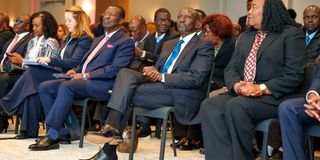
President William Ruto, Mama Ida Odinga and Prime Cabinet Secretary Musalia Mudavadi during a meeting with Kenyans living in the United States in New York on September 21, 2026 ahead of the 81st United Nations General Assembly.
Photo credit: PCS
He said the absence of the ministers had an impact on the functioning of government and the cost borne by taxpayers.
“Parliament of Kenya should be disturbed because this not only has a bearing on the efficiency of how our government is run, it also has a financial implication,” he said, pointing to the cost of air tickets, security and other expenses associated with the delegation.
The criticism became more pointed because the Senate was meeting outside Nairobi, where senators were receiving complaints from residents and following up on projects that fall directly under the absent CSs.
CS for Education Julius Migos, Mining and Blue Economy's Hassan Joho and their ICT counterpart William Kabogo were among those whose absence drew attention during the proceedings.
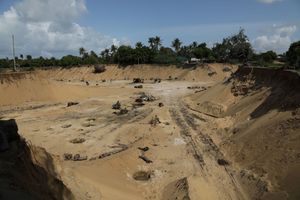
Nairobi Senator Edwin Sifuna said the absence of CS Joho was particularly frustrating because senators had just visited the Kilifi Central fish landing site and were preparing to raise concerns emerging from the visit with the ministry responsible for the sector.
Mr Sifuna said the Agriculture Committee, together with the Energy and Lands committees, had visited the facility and heard concerns from fishermen, young people and residents over the project's future and the opportunities it would create for the surrounding community.
“They are very worried, especially the young people there, who have not been given any assurance that they will be the ones given priority to work there,” he said.
The senator said residents had also been told that the facility could eventually be operated through a public-private partnership, creating further uncertainty over who would benefit from the investment.
“People are worried. Senator Mungatana was there. You heard the concerns of the beach management units. You heard the concerns of the area residents and it would have been a very useful conversation to have,” he said.
He questioned the disconnect between senior government officials travelling abroad and the conditions facing Kenyans at home.
He said he had seen CS Joho posting on social media while walking through the streets of New York, contrasting the scenes with the experience of ordinary Kenyans navigating Nairobi.
“The most interesting thing Kenyans have noted is that this government delegation has never taken a walk in our own capital the way that they’re walking around in other capitals,” he said.
He argued that Nairobi should be investing more in infrastructure that supports non-motorised transport and makes the city safer for pedestrians instead of having government officials only encounter such infrastructure when they travel abroad.
The immediate consequence, he said, was that senators who had gathered concerns from residents were left without the Cabinet Secretary they expected to engage.
“I’m just to register the disappointment on behalf of the young people and the fishermen that spoke to us yesterday at the fish landing site and to hope that we will have the CSs appear soonest possible. I don’t know how long UNGA lasts,” he said.
The criticism, however, was challenged from within the Kenya Kwanza ranks. Tana River Senator Danson Mungatana defended the decision to have Cabinet secretaries accompany the President, arguing that international engagements often allow ministers to pursue separate government business while the President attends the main diplomatic programme.
Mr Mungatana said the trips should not be viewed simply through the lens of the President's public engagements because CSs could use the same trip to hold bilateral meetings, negotiate agreements and engage their counterparts.
“Whenever we accompany the Head of State, if it is a ministry and there are agreements to be signed, you have separate meetings, side meetings and you are able to execute,” he said.
“In the same trip, you multitask, you do many things at the same time instead of coming back and going and going and going,” he added.
He also rejected the suggestion that ministers accompanying the President spend their time merely sitting behind him during official functions.
“It is not true, Mr Speaker, that the only duty that the ministers execute is to sit behind the President and just pass notes,” he added.
The competing arguments expose the tension inherent in presidential travel: while international meetings such as the UN General Assembly create opportunities for ministers to engage foreign governments and institutions, their absence can also leave gaps in the handling of domestic business, particularly when Parliament is sitting and committees are actively seeking answers.
The Senate’s Mashinani programme is designed to take parliamentary business closer to the people and provide a platform for residents to place their concerns before their elected representatives.
In Kilifi, senators were not merely holding formal proceedings. They were visiting projects, meeting residents and collecting complaints on issues ranging from fisheries and health to infrastructure and service delivery.
The absence of Cabinet secretaries therefore became part of a larger question about the distance between Parliament, the Executive and citizens.
The Constitution gives Parliament powers to summon CSs and other persons to provide information or evidence when required. Article 125 gives either House and its committees the power to summon persons to appear before them and produce evidence.