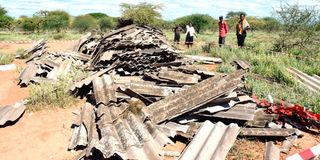
Authorities in Makueni County are responding to an illegal dumping of asbestos roofing materials at Smart Village in Kaasuvi Sub-location, Makindu Sub-County, after unknown individuals offloaded the hazardous waste under the cover of darkness.
The National Environment Management Authority (Nema) confirmed the incident on its official X page on Tuesday, saying it had moved quickly alongside Makueni County's Public Health Department to contain the situation. According to Nema, the affected area has been secured and cordoned off to prevent residents from coming into contact with the materials.
"Residents are strongly cautioned against touching, collecting, transporting, or reusing the dumped asbestos materials," Nema said in its statement, adding that relevant authorities are working to ensure safe handling, transportation, and disposal of the hazardous waste in accordance with environmental and public health regulations.
The authority is asking members of the public with information that could help identify whoever is responsible to come forward.
Asbestos was banned in Kenya in 2006 due to its carcinogenic effects. Its fibres, when disturbed and inhaled, can cause respiratory diseases, lung damage, and cancer, including mesothelioma, a cancer of the lining of the lungs and abdomen that is almost exclusively caused by asbestos exposure. According to the World Health Organization, there is no safe level of exposure.
But despite the ban, asbestos is not hard to find in Kenya. Documents submitted to Cabinet last year by the Ministry of Environment, Climate Change and Forestry, signed by then-Cabinet Secretary Aden Duale, paint a detailed picture of just how much of the material is still in use across the country. According to the ministry's records, government-owned facilities and institutions alone hold at least 21,604 tonnes of asbestos, while a further 8,467 tonnes sit in private facilities, bringing the total to more than 30,000 tonnes.
"The National Treasury and its agencies top the government list with a staggering 8,048 tonnes, most of it at the Moyale Kenya Revenue Authority border post, which alone accounts for 8,000 tonnes. The Ministry of Housing comes in next at 4,941 tonnes, followed by the Ministry of Interior at 4,669 tonnes, and the Ministry of Education at 3,180 tonnes spread across schools, colleges and universities around the country," the documents show.
The Ministry of Health, the agency most associated with public health protection, reports 2,143 tonnes at its own facilities, including hospitals and health centres. Among them: Kisii Teaching and Referral Hospital with 100 tonnes, Rift Valley Provincial General Hospital with 178 tonnes, and Balambala Sub-County Hospital in Garissa with 190 tonnes.
Schools are among the most concerning entries. Egerton University in Nakuru County reports 400 tonnes. Jamhuri Primary School in Nakuru has 200 tonnes. Freehold Primary, also in Nakuru, has 120 tonnes. Nanyuki High School has 115 tonnes. Some of the tonnages recorded at primary and secondary schools around the country suggest children are attending classes beneath roofs that are classified as a hazardous substance.
In the private sector, the list includes well-known names. Nation Media Group, Bamburi Cement, CMC Motors, Coca-Cola, Serena Hotels, and Standard Chartered Bank are among the companies recorded as holding asbestos on their premises, according to the ministry documents.
The Cabinet brief, prepared by the State Department for Environment and Climate Change, notes that asbestos was widely deployed in Kenya in the 1960s and 1970s.
"Most of the older infrastructure in the country still have asbestos including roofs of many of the public and private facilities including government buildings; hospitals; and schools," the brief states.
According to the WHO, approximately 125 million people globally are exposed to asbestos, and the material is responsible for roughly 255,000 deaths per year. More than 50 WHO member states have banned it through law.
The Cabinet brief called for approval to remove asbestos from all facilities across the country, both public and private, and directed ministries, counties, and agencies to take action within their own jurisdictions.
Who is responsible for asbestos disposal in Kenya?
Under Kenya's Environmental Management and Coordination Act, Nema is the lead authority on asbestos management. Nema licenses:
Experts who carry out environmental and social impact assessments before removal Firms certified to remove and transport asbestos safely Sites approved for final disposal of asbestos waste
The ministry's Cabinet brief, submitted in 2025, also invoked the "polluter pays" principle, meaning the owners of facilities where asbestos is found are expected to bear the cost of removal and disposal themselves, whether they are government agencies, private companies, or individuals.
County governments are encouraged to establish their own designated asbestos disposal sites in line with Nema requirements.