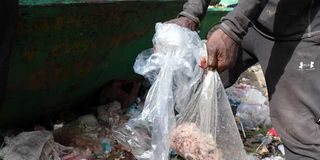
Nearly a decade after Kenya enacted what was hailed as one of the world's toughest bans on plastic carrier bags, the evidence of failure is easy to find.
Walk through any of the country's open-air markets and you will see it: fruit vendors wrapping pineapples in transparent plastic bags, butchers packing meat in the same outlawed material, hawkers handing over tomatoes and sukuma wiki in bags that were banned in 2017. Those same bags end up discarded along roadsides, clogging drainage systems and floating in rivers.
A fruit vendor sells sliced pineapples packed in plastic bags in Kangemi, Nairobi, on April 18, 2026.
Photo credit: Bonface Bogita I Nation Media Group
The ban, enforced by the National Environment Management Authority (Nema), once carried penalties of up to Sh4 million or four years in prison. At its peak, it worked. In the early years, some reports pointed to an 80 per cent reduction in plastic bag litter in urban areas. Today, that gain is unravelling.
"The use of plastic bags was banned in 2017," says Dr Ayub Macharia, Nema's director of Enforcement. He is quick to add that the ban has not been lifted. It has, however, been complicated.
Between 2017 and 2024, regulators struggled to balance environmental protection with practical needs in food packaging, particularly for perishable goods and sanitation‑sensitive products. That tension eventually produced the Plastic Packaging Materials Regulations of 2024, which introduced controlled exemptions.
Under these regulations, businesses may apply to Nema for permission to use specific plastic packaging materials, including flat bags and films of up to 250 microns in thickness. Approvals are temporary; valid for one year, and come with strict conditions. Crucially, any entity granted an exemption must demonstrate how it will manage post-consumer waste within Kenya's borders.
"Some food essentials such as the packaging of sausages, with Nema's consent, were allowed to use these plastic bags for sanitation and health purposes," Dr Macharia says.
The Extended Producer Responsibility (EPR) Regulations, gazetted as Legal Notice No. 176 in November 2024, fundamentally change how waste is managed. Under the law, firms must register with NEMA, develop take‑back systems, pay fees tied to product volumes, and submit annual reports. The intent is to shift waste management costs from the government to the producers who introduced plastic into the market in the first place.
In practice, the system is struggling. Both Nema and industry agree on the reason. At the heart of the problem is money, specifically who is paying whom along the waste chain. That chain runs from waste pickers, who collect discarded plastic from the environment, through aggregators who sort it, transporters, and finally recyclers who process it. Each link depends on the one before it being compensated properly.
"If you see waste in the environment, somebody somewhere is not paid well," Dr Macharia says bluntly.
He accuses producers of underpaying waste pickers, or failing to pay them at the agreed rates, thereby undermining the entire system.
James Odongo, CEO of the Kenya Extended Producer Responsibility Organisation (KEPRO), the country's largest producer responsibility organisation for non-hazardous packaging, paints a more layered picture. He says that since KEPRO began operations in 2021, it has facilitated the collection of over 88,000 metric tonnes of waste and pumped more than Sh300 million into recycling initiatives. But he is candid about the gaps.
The biggest structural problem, he says, is that most of Kenya's waste ecosystem operates informally. Waste pickers, who form the first and most critical link in the collection chain, typically cannot generate tax-compliant invoices, known as eTIMS receipts. This makes it legally difficult for organisations like KEPRO to pay them directly.
"We cannot ask the waste picker to generate an eTIMS invoice to give them an incentive from the EPR, since the majority of our waste ecosystem is operating informally," Odongo explains.
As a result, support for waste pickers has largely been limited to capacity building, awareness campaigns, and protective equipment—rather than the direct financial incentives that would make picking economically viable. The consequence is a system where the people expected to clean up plastic waste remain undervalued, and the chain weakens from the bottom up.
Enforcement is struggling too
Even where the policy is clear, enforcement is not keeping pace.
Dr Macharia acknowledges that courts often require Nema to identify and produce the original suppliers of illegal plastic bags, individuals who are, in his words, sometimes "well connected" and difficult to trace. Kenya's porous borders compound the problem. A 2024 Nema report found that 35 per cent of plastic bags in circulation are illegally smuggled, mainly from Uganda and Tanzania.
Technology has also moved against the regulators. Advances in manufacturing have made it possible to produce plastic bags using small, portable machines, sometimes from private homes, making raids difficult to plan and execute. Even licensed producers have been caught exploiting grey areas.
"Some of the producers we have licensed to use plastic bags sometimes tend to stop labelling them at night," Dr Macharia says, removing identifying information to avoid accountability. In April 2026, Nema issued a fresh directive requiring producers to fully comply with Section 18 of the EPR regulations, demanding detailed breakdowns of how
County governments are missing
Both Nema and KEPRO identify a critical and underreported gap: county governments are largely absent from enforcement and infrastructure.
Under the County Government Act 2012, counties are responsible for waste management infrastructure, including collection systems and material recovery facilities. In practice, investment has not followed. According to KEPRO, only a handful of counties, including Mombasa, Murang'a, and Nairobi, have operational material recovery facilities out of 47. "Waste has not yet been prioritised enough from a budgeting point of view," Odongo says. "And so, more often than not, there will be a lot of littering happening." Without these facilities, even well-sorted waste has nowhere to go.
Legal challenges have also slowed progress. Court cases and conservatory orders delayed full implementation of EPR, creating what KEPRO describes as a semi-voluntary ecosystem where compliance is inconsistent.
"We are still in this sort of semi-voluntary ecosystem where it is more on a willing-buyer-willing-seller basis," Odongo says.
The result is a system where large, compliant brands shoulder the burden while smaller producers free-ride because enforcement is too weak to compel them. "The big brands
Odongo compares EPR implementation to "a baby that is still crawling." That may be generous. A 2024 Nema survey showed an increase in single-use plastics found in urban drainage systems of nearly 40 per cent compared to 2020.
For Dr Macharia, the stakes are generational. "For producers to fail in this responsibility is to put future generations at risk," he says.
For Odongo, the answer is not blame but coordination. "It is not all gloomy. But it requires a whole-of-society approach."