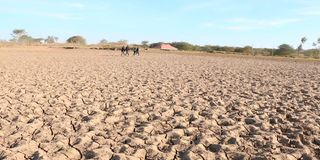
Early this year, a meme made rounds on social media. It showed the map of Kenya somehow slipping loose from the Earth and drifting towards the sun. It was absurd, funny and, in a strange way, familiar. For weeks, Kenyans had been asking the same question in different ways: Why is it so hot?
The joke captured something that weather charts and temperature records sometimes struggle to convey: the visceral experience of living through a warming world. When extreme heat hit Turkana residents two years ago, they said they had resorted to animal-like survival tactics like pouring water on themselves and sheltering under trees. The heat was unbearable, they lamented.
For someone looking out of the window this week, talk of a warming world may seem distant, even improbable. Across much of Kenya, the weather has taken a different mood. The Kenya Meteorological Service Authority’s latest forecast points to morning showers along parts of the Coast, with afternoon thunderstorms expected in sections of the western, Rift Valley and central regions. Other areas will remain partly cloudy, with scattered showers continuing into the night in parts of Kilifi, Mombasa, Kakamega and Bungoma counties. The sky, in other words, is doing what it has always done: changing.
But beneath those clouds, something much bigger is unfolding. The planet is warming. Global temperatures are on course to cross the 1.5°C target potentially within the next few years, increasing the risks of dangerous heat, extreme rainfall, droughts and other climate impacts, a new United Nations Environment Programme report warns. The world, it says, is moving deeper into dangerous territory.
Over a decade ago, governments agreed to keep the rise in global average temperatures above pre-industrial levels “well below” 2°C and “pursue efforts” to hold warming to 1.5°C. Pre-industrial refers to the period before widespread fossil fuel combustion and large-scale manufacturing. But to understand the context, you need to go back to the 1970s.
For decades, environmental scientists and political leaders struggled to define a clear boundary between planetary catastrophe and manageable warming. Through the 1970s–90s, policymakers settled on the 2°C limit above pre-industrial levels, which was adopted by the UN Intergovernmental Panel on Climate Change and formally codified at international summits such as the 2009 Copenhagen Accord.
During the lead-up to the 2015 Paris Climate Agreement, developing states, led by the Alliance of Small Island States and African nations,launched a unified diplomatic push under the slogan “1.5°C to Stay Alive.” They argued that a 2.0°C rise posed an existential threat: rising sea levels, catastrophic agricultural failure across arid regions, and severe economic collapse for vulnerable societies least responsible for historical emissions. Their insistence forced a compromise in the final text, binding 195 nations to limit warming to “well below 2.0°C” while actively pursuing efforts to cap it at 1.5°C.
Last year, the International Court of Justice, the world’s top court, issued an advisory opinion stating that governments must act as ambitiously as possible to limit warming to 1.5°C. Failure to do so, it said, could leave them open to lawsuits in international courts.
2024: Hottest year on record
While the 1.5°C limit defined in the Paris Agreement refers to a 20- to 30-year climate average, 2024 was the warmest year on record and briefly exceeded the 1.5°C threshold, spike influenced by El Niño conditions. This year, the warming conditions of the ocean are expected to influence the October–November–December season, with meteorologists predicting “very strong” El Niño conditions that could result in heavy and catastrophic rainfall across the country.
The UNEP report Limiting Overshoot warns that within the next few years, global temperature rise is set to cross 1.5°C, “pushing climate risks and impacts to increasingly dangerous heights. Every year of delay and every fraction of a degree above 1.5°C increases risks and makes recovery harder, with irreversible losses possible even if temperatures later decline.”
“This summer’s scorching heat, raging wildfires and deadly floods are a warning of what lies ahead,” said UN Secretary-General António Guterres. “We must make the overshoot above 1.5°C as small and short as possible. That demands an overshoot of ambition.”
Inger Andersen, executive director of UNEP, called for a doubling of climate action. “There are no good outcomes if we remain above 1.5°C. Across the globe, extreme heatwaves are already proving that climate impacts will strike faster, hit harder and last longer, costing more lives and causing deeper disruption. We must get on the right path by cutting greenhouse gas emissions, strengthening resilience and adaptation, and ensuring exceedance of 1.5°C is as small and short as possible.”
What does a world above 1.5°C mean?
In a previous interview with Nation, Chris Hewitt, director of Climate Services at the World Meteorological Organization, explained that global warming is calculated as an average over 20–30 years and does not mean all countries will warm at the same rate. “Parts of the world, particularly the high latitudes, so the North Pole and South Pole, have been warming more than that average. Other parts have been warming less because it’s an average over the whole planet. So individual countries will have different numbers.”
“As the planet warms, we would expect to see more heatwaves, and also for those heatwaves to be more extreme because the temperatures in them will get warmer. A particular hot period for a few days or weeks won’t necessarily be groundbreaking. But warming the planet does lead to a greater chance of these more extreme heatwaves.”
The UNEP report states that humanity’s best hope to limit damage is to adopt an “overshoot, peak and decline” pathway, ensuring immediate and sustained cuts in greenhouse gas emissions, combined with steps to remove carbon dioxide from the atmosphere.