How one woman turned degraded grazing field into a thriving food forest
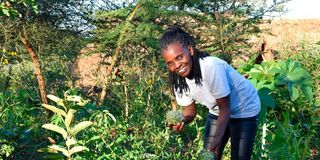
Benadetta Kyengo shows a section of her rehabilitated farmland in Muiu, Makueni County on June 5, 2026. She has transformed the land through agroforestry, restoring its productivity and fertility.

What you need to know:
- The reported promise of agroecology in reversing the decline in agricultural productivity linked to climate change has sparked frenzied interest in the approach.
- Makueni is the latest county to launch an agroecology policy, joining Murang’a, Nakuru, and Vihiga counties in mainstreaming sustainable food production.
As the world fought to wriggle itself free from the grip of the Covid-19 pandemic, Benedetta Kyengo set out to keep herself busy by rehabilitating her parcel of land. What began as a personal project has since outgrown the five-acre plot at Kwa Miui Village in Makueni County, and transformed how smallholder farmers in the region view agroforestry.
To turn around a degraded piece of land that neighbours had reduced to a grazing field, she embarked on fencing, terracing, soil bunds, and water pans to conserve soil and water. This was followed by the preparation of hundreds of zai pits for planting trees.
Just as she was about to introduce the seedlings, something unexpected happened: the neighbours who had helped her dig the zai pits began talking behind her back. They thought she was crazy.
“They did not expect to see trees growing inside the farmland,” she recalled. “To them, trees are only supposed to line the edges of farmland.”
A fresh master’s graduate in Sustainable Business and Innovations from Utrecht University in the Netherlands, Benedetta shrugged off the gossip. She went ahead and filled the farmland with hundreds of assorted tree seedlings. When she was done, there was a tree everywhere.
Today, Benedetta has not only created a sanctuary from what was once a degraded landscape but has also significantly boosted many of her neighbours’ resilience to drought.
The farm is now a tapestry of abundance: tubers such as arrowroot, cassava, garlic, and sweet potato; cover crops like thorn melon and pumpkin; fruit trees including avocado and banana; and dozens of indigenous trees that thrive in drylands. She has even done the unthinkable; grown coffee and cacao in the region.
Visitors tiptoe around the farmland, located a stone’s throw from Maiani Township along the Nunguni-Salama Road. Stepping on the mounds of heavy mulch that separate rows of crops and trees is strictly prohibited.
“We make our own soil,” Benedetta told Healthy Nation during a guided tour. Scooping a handful of moist soil from under a tuft of mulch grass, she explained: “Our soil is alive. It contains delicate living organisms which keep it versatile. They require regulated exposure to sunshine.”
Swarms of bees dancing around dense Acacia tortilis and Lantana camara thickets announce the presence of an apiary and mark the boundaries beyond which no visitor should go.
“Ours is a food forest. It is not a farm. It is designed to ensure that a farmer has something to harvest throughout the year while keeping the ecosystem balanced.”
She practices syntrophic agroforestry, a farming system that mimics a natural forest by strategically integrating different types of crops alongside various tree species. The system ensures that a farmer gives back to the soil as much as they harvest from it.
“A key principle of syntrophic agroforestry is intensive planting, which guarantees farmers maximum output from minimal farmland. It is recommended to integrate plants that require a lot of sunlight with those that require little sunlight for maximum production,” she said.
Benedetta has opened the doors of her farm to the community, a move that has significantly shifted local attitudes towards agroforestry. Through Feedback to the Future, an organisation she founded to champion this new way of farming, she brings the community together for regular training sessions. There, she sheds light on the connections between global warming, changing climate patterns, erratic rainfall, and declining crop yields, while underscoring how agroforestry builds resilience and mitigates the effects of drought and climate change.
As Kenya joined the world in celebrating World Environment Day with renewed calls for environmental conservation, Benedetta showcased her farming project to agroecology champions, government officials, and community members. A major highlight of the field day was her collection of rare indigenous seeds of assorted crops.
She operates a makeshift seed bank that seeks to make traditional crops cool again.
“Indigenous seeds are the shortest route to food security. They are affordable and tend to do well in drylands. Indigenous avocado, for instance, is well adapted to this region. Its cost of production is lower compared to the grafted ones,” she said.
Benedetta’s crops and trees thrive exclusively on organic manure. She keeps dozens of indigenous chickens, supplementing their feed with Azolla, which she grows herself, and black soldier fly larvae, which she also rears. She keeps rabbits, whose urine is used in a unique fertiliser-making process centred on earthworms. Both the earthworms and the black soldier flies feed on food waste, promoting a clean environment. She also keeps pigs.
The field day provided an opportunity to acknowledge the significance of agroforestry and mixed farming in addressing nutritional needs while guaranteeing a balanced ecosystem. According to Prof Alex Awiti, the principal scientist in charge of agroecology at Landscape Alliance Global (formerly CIFOR-ICRAF), agroforestry and mixed farming optimise the ecological services of different trees while minimising the risks associated with climate shocks such as drought.
“As we move towards more regenerative soils that rely on less and use fertiliser more efficiently, there is a mitigation benefit in that we are using fewer farm inputs that have a fossil fuel footprint. Once we enhance the capacity of soils to absorb and store water, we are creating resilience to dry spells caused by climate change,” he told Healthy Nation in a recent interview.
The reported promise of agroecology in reversing the decline in agricultural productivity linked to climate change has sparked frenzied interest in the approach. Makueni is the latest county to launch an agroecology policy, joining Murang’a, Nakuru, and Vihiga counties in mainstreaming sustainable food production.
A spot check in the region bordering Benedetta’s farmland shows that many smallholder farmers have switched from mono-cropping to agroforestry and mixed farming.
“A planting bed measuring 15 metres by 7 metres holds up to 30 different trees at different stages of growth. It also contains two rows of grass and a row of assorted food crops such as cassava. We apply heavy mulching to regulate moisture loss,” said Christopher Makau, chairman of the Kilome Syntrophic Agroforestry group, a community-based organisation that brings together 300 households. The group works closely with Benedetta in championing agroforestry and mixed farming.
“We are food secure because our neighbourhood receives a lot of rainfall compared to the neighbouring region. Those who have managed to build water pans have gone commercial. They produce assorted vegetables throughout the year for the market,” Makau added.
Impressed by the agroecology model, Makueni Governor Mutula Kilonzo Junior’s administration has enlisted Benedetta’s farmland as a centre of excellence for diffusing sustainable agriculture practices. Armed with an agroecology policy, the county government has intensified its efforts to promote climate-smart agriculture. Agronomists are betting on traditional crops such as cowpea, mung beans, sorghum, and finger millet to address food security, as they guarantee yields even when rainfall is unreliable.
“We shall work closely with Benedetta to accelerate the agroecology campaign by bringing batches of farmers from across Makueni County to her farmland to learn the farming model,” said Mary Muteti, the director of agriculture in Makueni County.
With this collaboration, Benedetta is assured of accelerating the spread of her model across the county.