Climate change is erasing male turtles but limited research funds cloud the real picture

Lamu Marine Conservation Trust (LaMCoT) Field Operations Manager, Famau Shukry displays turtle eggs at Manda-Takwa Beach in Lamu on June 11, 2026.

Komoro Odo kneels beside a turtle nest at first light, before the heat of the day makes the sand unbearable. He has been doing this for 32 years. His hands know the texture of the nests the way a surgeon knows an anatomy. He can feel things in the sand that most people would miss.
He is 72 now. His back hurts. His knees creak. But he comes to Manda-Takwa beach anyway because the turtles need someone to watch them and he decided a long time ago that person would be him.
The hatchlings are emerging. Tiny, wet, frantically scrambling toward the ocean. But something troubles him this morning. The sand feels different than it did three decades ago. Hotter. The incubation took fewer days than his notebooks from the 1990s recorded. When you have spent your entire adult life measuring time in turtle seasons, you notice when the rhythm changes.


"It's too hot down here," he says, watching the hatchlings move. His voice carries worry beneath the words. "The sand temperatures have spiked. With heat like this, the vast majority of these babies will be female."
This is not a guess. This is the observation of a man who has spent more time in turtle nests than most people have spent in their own homes. But when you ask him how he knows this, when you ask for data to back up the worry, Odo can only offer what his body has learned over decades. He cannot offer what a scientist would need to prove it.
And here lies the central tension of what is happening to sea turtles in Lamu right now: between what an experienced conservationist feels in the sand and what climate science has already proven is happening elsewhere in the world.
Odo's worry is grounded in biology most people have never heard of. Sea turtles have no sex chromosomes. They do not inherit their sex from their parents the way humans do. Instead, the temperature of the sand surrounding their eggs during a specific window in their development determine whether they will become male or female.
This system evolved over millions of years. In a stable climate, it works like a thermostat, keeping populations balanced.
Below 27.7 degrees Celsius, embryos develop into males. Above 31 degrees Celsius, they become females. In the narrow band between these thresholds, some combination of both sexes emerges. But cross above that upper limit and something happens that should terrify anyone who cares about sea turtles: nearly every hatchling becomes female.
This is not theory. It is happening right now at one of the world's largest sea turtle nesting sites, thousands of kilometers from Lamu. The story of what is unfolding there is a story Lamu may soon have to tell about itself.
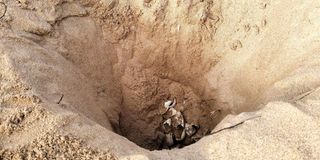
A turtle nest at Manda-Takwa Beach in Lamu on June 11 ,2026.
Raine Island sits on the outer edge of Australia's Great Barrier Reef. For over one thousand years, green sea turtles have returned to this island to lay their eggs in the warm sand. It is the longest continuously used sea turtle rookery anywhere on Earth. The island pulses with life. Researchers report seeing over 250 turtles in a single hour of observation. In peak years, up to 100,000 nesting females have been counted on the beach.
But something has changed. With the temperature of the sand on Raine Island at record highs, 99 per cent of the hatchlings are now female. This has been the case for at least the last 20 years.
Think about what that number means. Twenty years of virtually no males being born. A generation of young turtles entering the ocean with no breeding partners of their own sex. A population structured almost entirely around reproduction that is becoming mathematically impossible.
The cause is climate change, expressed directly through the thermometer of beach sand.
Increasing global temperatures have caused the temperature of green turtle nests at Raine Island to be too high for male hatchlings to develop since the 1990s. The Australian government's Department of Climate Change, Energy, Environment and Water is blunt: Rising air and sand temperatures are leading to a predominance of female hatchlings, which is expected to lead to a scarcity of adult males in the future and potential reproductive collapse.
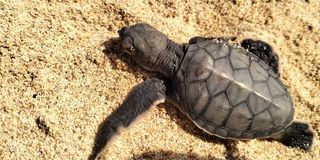
Freshly hatched turtle moves towards the Indian Ocean in Manda-Takwa Beach in Lamu on June 11, 2026.
There is more. Hatching success for Green Turtles has also been low at Raine Island since the late 1990s. Only 30 to 60 percent of embryos develop successfully inside eggs. Scientists think this is caused by increasing flooding of low-lying nests during very high tides, storm surges and heavy rain, all of which occur more often under changing climate conditions. The few males that are born are vastly outnumbered by females who cannot find mates. And the females themselves are failing to produce viable offspring at replacement rates because the nests are flooding and the embryos are overheating.
Climate scientists have modeled what happens if warming continues on current trajectories. Some tropical rookeries could shift toward nearly all-female populations within fifty to one hundred years. At Raine Island specifically, even under moderate climate change scenarios, the island is predicted to suffer 100 per cent nest flooding.
This is what climate change looks like when written in sand and hatchling sex ratios.
When Teresa Jahangir first heard about Raine Island, she understood immediately what it meant for Lamu. She works for Lamu Marine Conservation Trust and has spent fifteen years studying sea turtles in Kenyan waters. She has studied marine biology, published research, and thought about this question more carefully than anyone else in the region.
She sits in a small office in Lamu town. Maps of nesting beaches cover the walls. Notebooks with years of observations fill shelves. She has tried to prepare for what might be coming.
"When I learned what was happening at Raine Island, I thought about Lamu," she says. "I thought, could this happen here? And the honest answer is yes. It could."
The organisation she works for has been protecting turtles in Lamu since 1992. They have protected nearly 900 nests across that time, documented the emergence of more than 185,000 hatchlings, and become a reference point for sea turtle conservation across East Africa. Yet the basic instruments that would answer their most pressing question have never been systematically installed on their beaches.
To know whether Lamu's turtles are actually becoming feminized like Raine Island's, you would need years of sand temperature data collected consistently across all major nesting beaches. You would need baseline incubation records from decades past to compare against current data. You would need instruments that measure not just temperature but also the dozens of variables that affect when an egg hatches: nest depth, sand moisture, beach location, egg size, rainfall patterns.
The pivotal question for Lamu is not theoretical. It is practical. Do we have the data? The answer is no.

Lamu Marine Conservation Trust (LaMCoT) Scientist and Project Manager Teresa Jahangir sits near turtle eggs at Manda-Takwa Beach in Lamu on June 11,2026
"We have not deployed the temperature sensors that would give us actual data," Jahangir says. "We know that Komoro Odo observes faster hatching. We know that staff report warmer sand. But observation is not the same as measurement."
Temperature sensors cost significant money. They must be placed when a turtle mother is excavating her nest, a window that might last an hour. The devices are easily lost in sand. They require careful retrieval and maintenance. They are fragile in tropical heat and humidity.
This is where the story sits. Between Odo's thirty-two years of embodied knowledge and the data that would confirm what he suspects, there is a gap. Missing instruments. Undeployed sensors. Questions that require five or ten more years of careful measurement to answer.
Three-quarters of Lamu's population depend on fishing. Fish depend on seagrass beds for nursery habitat. Green sea turtles graze on those seagrass meadows, maintaining them and preventing overgrowth. Without turtles, the seagrass degrades. Without seagrass, juvenile fish have no place to shelter from predators. Without juvenile fish, there is no adult fish for fishermen to catch.
"This is why we protect," says Atwaa Salim, who coordinates conservation work for LaMCoT. "Not because turtles are beautiful. Because Lamu depends on them."
Beyond fishing, turtles drive tourism income. Visitors come to see them. Fishermen supplement earnings by taking tourists on traditional dhows for sunset cruises and snorkeling. A healthy turtle population means additional income.
Follow our WhatsApp channel for breaking news updates and more stories like this.


