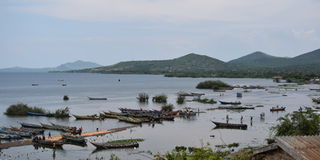
At dawn on Koginga Beach, a group of fish traders scans the horizon, waiting for fishing boats to return from their nightly expeditions. But as the vessels dock, the faces of the fishermen tell a familiar, grim story: another night of meager catches.
Wadianga Beach in Sindo Town, Homa Bay County. Climate change is identified as one of the factors leading to the decline in fish production in Lake Victoria.
Photo credit: George Odiwuor I Nation Media Group
He explains that the lake's fish stock has reduced over the years, and the remaining species face numerous threats that are further diminishing their numbers.
Bramwel Otieno, another fisherman, explains that his team now spends Sh2,000 on fuel for a night's work, only to often break even or suffer a loss. "In the past, we would get up to 30 troughs of fish, which we would sell at Sh1,500 per trough. Now, we are lucky to get 10. Instead of fish, our nets often catch low-value crustaceans," he laments.
Fisheries experts point to climate change as a primary driver of this crisis. According to Michael Omondi, coordinator of the Aquaculture Business Development Programme (ABDP), rising global temperatures are directly impacting the lake's ecosystem.
"Water temperature is rising, and this affects fish life. Some species migrate to areas with more favourable conditions, making them harder to catch," Omondi explains.
He adds that unpredictable rainfall patterns, crucial for triggering breeding in many species, have disrupted fish reproduction cycles. "Some fish species are on the decline while others are multiplying rapidly due to climate change."
Also read: Kenya’s fish output jumps to Sh40bn despite Lake Victoria woes
"Changes in the lake make it difficult for wild catch and for us as fish farmers," says company co-founder Joseph Rehmann.
He blames irregular land use as a major factor accelerating climate change and calls for greater resilience and adaptation to adverse weather conditions.
Victory Farms Chief Development Officer Caesar Asiyo emphasises that fish experience discomfort and stress from sudden changes in water temperature, just as humans react to extreme weather.
In response, fishermen and companies are turning to innovation. Victory Farms now uses drones to monitor water quality and deliver fingerlings to lake cages, reducing carbon emissions from boats. The company plans to introduce 26 million fingerlings into the lake by 2026 through drone technology. This will enable it to supply at least 2,000 tonnes of fish every month.
Asiyo notes that the company has also launched a reforestation programme and aims to recycle all its plastic waste.
“We have committed to planting 100,000 trees by 2028 and to recycling all plastics used in our fish production.
Clifford advocates for adaptation strategies such as climate-resilient fishing, improved aquaculture, and better water quality management to boost the lake's fish production. He bases this on data showing a significant decline in fish stocks due to climate change. "Policymakers and communities must adopt these resilient methods," he says, "to enhance fish populations and secure the livelihoods of those who depend on them."
On a smaller scale, fishermen are adopting solar-powered lights for night fishing instead of paraffin lanterns and are trialling electric boat engines to replace fossil fuels. [email protected]