More than three decades ago, fishermen operating in Lake Victoria were assured of a bumper catch that could sustain them for days after selling their fish at the market.
However, that joy has faded as ecological changes in the lake have drastically reduced fish populations.
Today, fishermen are desperately crying out for help as their nets often bring in only small quantities of fish—insufficient to earn them a living.
Some species are now on the verge of extinction with the decline attributed to pollution, overfishing and climate change.
Ecological changes have drastically reduced fish populations in Lake Victoria.
Photo credit: File | Nation Media Group
To address these challenges, various initiatives have been introduced including investments in cage fishing where fish are confined from hatching to harvest.
Multiple companies, individuals and groups have established hundreds of cages in the lake, raising fish for at least eight months before harvesting.
According to the fisheries department, Homa Bay now hosts up to 980 fish cages, the highest concentration on the Kenyan side of Lake Victoria.
Experts warn that water quality around these cages is deteriorating due to fish feed and waste, potentially compromising water quality over larger areas. They have called for regulations on cage fishing, particularly concerning the materials used in constructing cages.
The Homa Bay County Government has now developed a policy to ensure only appropriate tools and technologies are used to protect the lake from further harm.
The Fisheries and Aquaculture Development Policy 2025 will regulate fishing activities in the lake, including cage fish farming.
County Fisheries Executive Sarah Malit noted that the county faces several challenges affecting fishing communities. She said the county government is working to address these issues to increase fish production.
“We have launched the policy to help us respond to mounting ecological and economic pressures on the lake,” she said.
Before establishing cages, investors must submit a concept paper to the fisheries department detailing their intended activities, number of cages and fish species.
“The lake has been mapped and specific areas identified as suitable for cage fish farming. Investors are directed to place their cages in these zones,” Ms Malit said.
Fisheries officials then review the concept for approval or rejection. If approved, it moves to the cabinet for further consideration.
Ms Malit explained that the governor must also approve the concept before it advances to public engagement.
“I am the final authority for approval at the county level. However, this depends on recommendations from fisheries officers who are familiar with the technical concerns,” she said.
Sustainable fishing practices
Investors are then required to engage fishermen in areas where cages will be placed. Beach officials must sign a memorandum of understanding (MoU) with the investor.
Other requirements include an environmental impact assessment by the National Environment Management Authority (Nema.
National Beach Management Chairperson Tom Guda said more regulations are needed for introducing cages into the lake.
He noted that since fishermen sign MoUs with investors under the Fisheries Management and Development Act, additional regulations are necessary to protect the lake from potential harm.
“We seek a structured agreement and call for further regulations in cage fish farming,” Mr Guda said.
Ms Malit said the Fisheries and Aquaculture Development Policy will strengthen existing guidelines to control cage fish farming.
Despite advancements in technology, fishermen continue to face other challenges.
Ms Malit said the region suffers from climate-related disruptions, widespread illegal fishing and growing territorial conflicts over water.
She warned that the situation has reached a critical point, threatening thousands of livelihoods and the region’s blue economy.
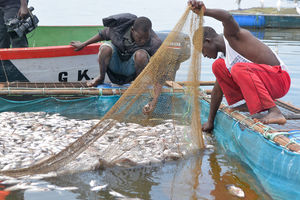
Fish farmers retrieve dead tilapia from cages at Dunga Beach, Kisumu County on September 29, 2025.
Photo credit: Alex Odhiambo | Nation Media Group
“We therefore need an urgent shift toward stricter regulation, scientific management and sustainable production systems. The policy is a response to those challenges—and a bold step toward a more resilient, inclusive and prosperous future,” she said.
The policy identifies several endangered fish species and aims to overhaul the fisheries sector and raise annual fish production from 37,000 metric tonnes to 300,000 metric tonnes by 2050.
Key strategies include increasing fish stocks, reducing post-harvest losses, mobilising resources, improving environmental sustainability and supporting climate change adaptation.
Other areas of focus include modernising landing sites, improving fish processing infrastructure, enforcing sustainable fishing practices and expanding aquaculture through cage and pond farming.
“With the implementation of this policy document, there will be clarity in institutional roles and frameworks. This will create a conducive environment for investment, promote food security and harness the endless potential of the blue economy sector,” Ms Malit added.
WorldFish Senior Scientist and Global Impact Lead Rahma Adah explained the importance of research-driven planning, noting that the document draws from extensive studies on climate change, declining fish stocks and long-term food security.
“The policy will help the county improve fish production. It aims to unite various actors to enhance fish production sustainably,” she said.
She added that the policy also addresses gender issues and challenges faced by marginalised groups in the fishing sector.
The policy also targets ongoing conflicts on Lake Victoria, including confrontations between Kenyan and Ugandan fishermen, as well as internal disputes in Suba and other parts of the county.
Aquaculture Business Development Programme Coordinator Michael Omondi stressed the need for sustainable fisheries development.
He called for the protection of the lake, saying the livelihoods of fisherfolk should not be jeopardised by activities conducted by companies or individuals operating in the lake.
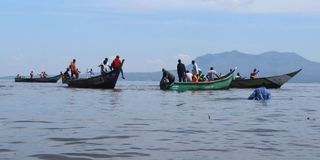
Fishermen on a fishing expedition near Rusinga Island in Homa Bay County.
Photo credit: George Odiwuor | Nation Media Group
Mr Omondi said the coordination of fisheries activities is currently inadequate, and that the policy will provide a roadmap for addressing challenges facing fishing communities.
“We have plans for marketing and value addition,” he added.
Stakeholders from various sectors, including beach management units, contributed to the drafting of the policy to ensure local needs were fully addressed.
David Otieno, the Community Relations Officer at Victory Farms, said the aquaculture company is promoting the restoration of fish breeding sites.
“Victory Farms is collaborating with BMUs to save certain fish species from extinction. We commit to continue supporting local communities in combating climate change and the use of illegal fishing gear,” he said.